25 May 2026 - {{hitsCtrl.values.hits}}
By Nishel Fernando
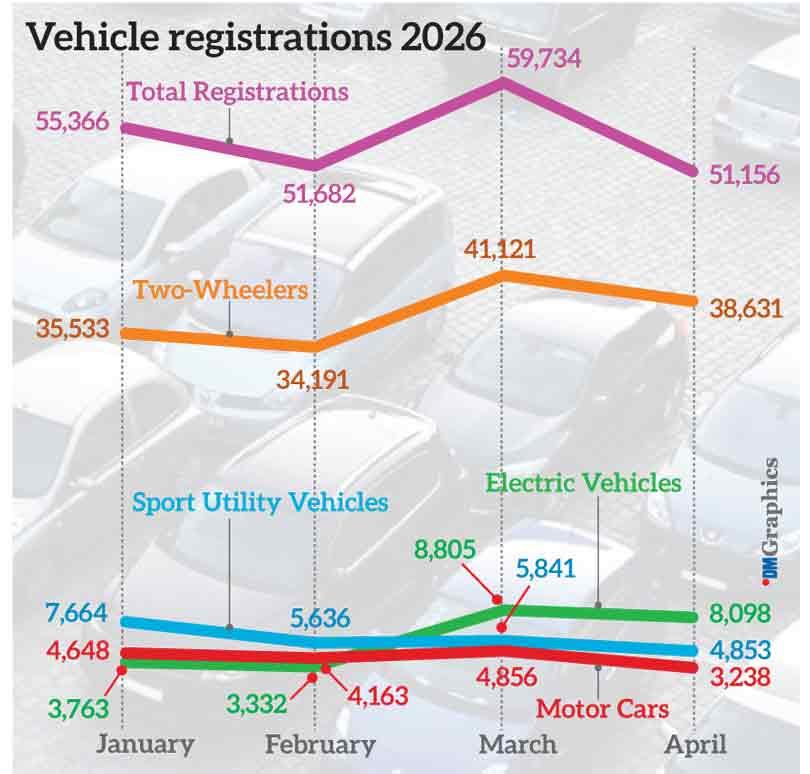
Automotive market volumes in Sri Lanka declined sharply in April, falling to 51,156 units from 59,734 units in March, signaling a potential cooling of the sector following a period of high volatility.
According to the latest analysis by JB Securities, published in the Daily Mirror, almost all vehicle segments recorded contractions. The downturn coincides with the implementation of a new digital firewall between Sri Lanka Customs and the Department of Motor Traffic to curb documentation fraud, alongside swirling controversies over a recently announced vehicle duty surcharge.
A deeper dive into the JB Securities data reveals significant shifts within the motor car segment, which fell to 3,238 units in April from 4,856 units in March. Brand-new car enrollments dropped steeply to 467 units from 1,432 units, with nearly all brands experiencing sizeable contractions. A notable exception was BAW, which saw its volumes rise to 238 units driven by its entry-level E7 electric vehicle. Conversely, BYD, which had previously dominated with 807 units in the segment in March, posted a mere 29 units in April. In the pre-owned category, which declined to 2,771 units, Suzuki maintained its market lead with 914 units, largely powered by the Wagon R, followed closely by Toyota with 821 units, driven by the Yaris and Roomy.
The premium passenger vehicle segment also softened, easing to 125 units from 147 units in the previous month. Mercedes-Benz retained its position as the market leader with 32 units recorded in April, followed by BMW with 30 units and Audi with 29. Despite the overall contraction, the month witnessed several high-end luxury additions, including one Rolls-Royce Cullinan SUV, one Ferrari 296 GTB supercar, four Porsche Macans, and four Lexus LX SUVs.
Sport utility vehicles and crossovers followed the broader downward trend, with volumes falling to 4,853 units from 5,841 units in March. Toyota led the SUV segment decisively with 1,725 units, fueled by the popular Raize model which alone accounted for 1,204 units. Honda ranked second with 906 units, almost entirely from the Vezel, while Suzuki secured the third spot with 688 units.
Meanwhile, electric vehicle additions, which had surged in March, contracted to 8,098 units, with EV motor cars taking a particularly sharp hit. However, electric two-wheelers remained robust, recording 7,452 units to surpass March volumes and sustain their upward trajectory.
The commercial and two-wheeler segments were not immune to the market correction. Three-wheeler numbers plummeted to 1,355 units from 4,031 units in March, heavily impacted by a massive contraction in Bajaj passenger volumes. The broader two-wheeler market declined to 38,631 units from 41,121 units, though Bajaj held its ground as the overall market leader with 9,924 units, followed by TVS and Honda. Across the board, financing shares remained notable, hovering around 40 percent for small cars and 54.1 percent for two-wheelers.
Amidst these shifting market dynamics, industry experts are calling for greater transparency and structural economic reforms. JB Securities Chief Executive Murtaza Jafferjee pointed to recent parliamentary revelations suggesting that certain parties had prior knowledge of the vehicle duty surcharge before its official announcement.
«A straightforward remedy to prevent unjust enrichment by those who acted on privileged information would be to backdate the effective date of the surcharge by two days,» Jafferjee stated, adding that such a move would send a strong signal regarding governance and market integrity.
Jafferjee also addressed broader macroeconomic pressures impacting the automotive sector and foreign exchange reserves. “The LKR is depreciating because of bad policy, not because of luxury car imports or conspiracy theories about large-scale capital flight into secret overseas accounts,” he asserted.
He further criticised the government’s heavy subsidization of fuel, noting that continuing with non-cost-reflective pricing is economically irrational. Pointing out that state-owned and foreign energy firms are bearing substantial losses—well over the promised Rs. 100 per litre subsidy on diesel—he stressed that adjusting these policies, even if it slows immediate economic activity, is the precise adjustment required to stabilize the external account.
19 Jul 2026 15 minute ago
19 Jul 2026 2 hours ago
19 Jul 2026 3 hours ago
19 Jul 2026 3 hours ago