18 Jun 2025 - {{hitsCtrl.values.hits}}
By Nishel Fernando
|
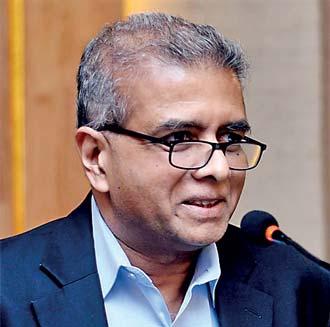
Dr. Hans Wijayasuriya |
A fundamental shift from traditional, process-heavy public procurement to an agile, outcome-based model is paramount to accelerating Sri Lanka’s digital economy, according to Chief Advisor to the President on Digital Economy Dr. Hans Wijayasuriya.
Dr. Wijayasuriya identified the current procurement system as a “major cause of failure” hindering the nation’s technological advancement.
“In the government sector, traditional procedures and multiple rounds of objections mean it can take a year to procure an IT system, by which time the technology has moved on and the problem has changed as well,” Dr. Wijayasuriya said, while speaking at the Annual Business Forum of the Sri Lanka America Society in Colombo this week.
He argued that this antiquated approach stifles innovation and prevents the public sector from leveraging cutting-edge solutions.
Sri Lanka’s digital economy currently constitutes a mere 3-4 percent of its total economy, approximately US$ 3 to US$ 4 billion. The government has set an ambitious target to quintuple this figure to 15 percent, or around US$ 15 billion, within the next five years.
To achieve this transformative growth, Dr. Wijayasuriya emphasised the need for a radical change in mindset and processes.
The proposed solution is a move towards outcome-based procurement.
“Outcome-based procurement is where you put on the table not the solution, but the problem,” he explained. This model invites innovative companies from a pre-registered pool to propose solutions, with the best one selected through trials and proof-of-concept processes. This agility, he noted, is essential for a fast-evolving field like technology.
Beyond procurement reform, Dr. Wijayasuriya outlined a multi-layered strategy to build a robust digital ecosystem. Central to this vision is the development of shared, horizontal digital public infrastructure (DPI) rather than siloed, vertical systems.
Key pillars of this infrastructure include the Sri Lanka Unique Digital Identity (SL-UDI), deemed the most important foundational element for secure digital transactions and interactions.
Additionally, a National Federated Data Exchange will facilitate seamless and secure data sharing between government institutions with user consent, eliminating the need for citizens to physically visit multiple offices for services. Finally, an eLocker and Digital Signatures system will enable the issuance and storage of verifiable digital credentials, such as academic certificates and driving licenses, on mobile devices, promoting a paperless environment.
He noted that this foundational layer will be built on a “cloud first, AI first, and mobile first” principle to ensure scalability, intelligence, and inclusivity. The government aims to create a marketplace of Application Programming Interfaces (APIs), allowing private sector developers to easily plug into this public infrastructure and build innovative applications for various industries.
“The idea is that we will build up to this year, and we create a marketplace of APIs so that a software developer can come in, use the plug point to all of these capabilities, and build applications,” Dr. Wijayasuriya said.
Meanwhile, he stressed that technology is only “20-25 percent of the challenge,” with the remaining 80 percent lying in change management, fostering the right mindset, and establishing robust governance. This includes building trust through strong cybersecurity, data protection, and clear regulations such as the forthcoming Digital Economy Authority Act and the Cyber Security Act.
Dr. Wijayasuriya drew a parallel with the liberalisation of the telecommunications industry in 1996, which spurred billions in foreign direct investment and created a world-class infrastructure without any government investment. He said that a similar model of public-private partnership, where the government acts as an enabler through policy reform, could be applied to the digital economy.
By focusing on delivering a “super return on investment” through productivity and innovation, he opined that Sri Lanka can achieve transformative growth even within its current “very tight fiscal space.”
21 Jul 2026 3 minute ago
21 Jul 2026 9 minute ago
21 Jul 2026 41 minute ago
21 Jul 2026 45 minute ago
21 Jul 2026 49 minute ago