06 Aug 2025 - {{hitsCtrl.values.hits}}
 Over 100,000 arrested in past 7-months for drug offences
Prisons house 34,000 against 12,000 capacity
Rehab centres report low occupancy despite record drug arrests
government urged to invest in awareness programmes and community education campaigns
Rehab programmes are conducted under court orders
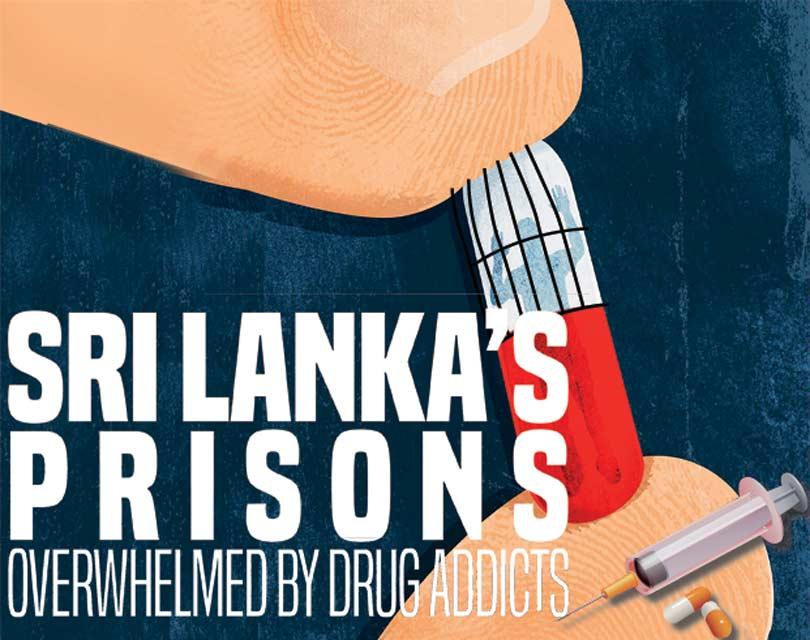
Despite intensified operations to curb drug-related crimes across the country, Sri Lanka is grappling with a growing crisis on two fronts, a surge in drug addiction and a critically overcrowded prison system that has far exceeded its holding capacity.
According to data released by the Public Security Ministry, over 125,000 individuals have been arrested since January 1 this year, with more than 100,000 arrests linked specifically to drug-related offences.
The rise in drug-related arrests points to a growing problem, adding further pressure to prisons that are already struggling with overcrowding.
Currently, Sri Lanka’s 36 prison facilities house nearly 34,000 inmates, though their official capacity is only 12,000.
Prisons Spokesman Commissioner Jagath Weerasinghe said that over 65% of the incarcerated population is imprisoned for drug-related offences.
This overwhelming number is putting a heavy burden on the prison system, which is already struggling with limited resources and security concerns.
Between January 1 and August 1, 2025, Police and security forces seized 930.1 kilograms of heroin and arrested 37,251 individuals in connection with heroin-related offences. During the same period, 1,398 kilograms of methamphetamine (commonly known as “ice”) were seized, resulting in 45,111 arrests.
In addition, 11,438 kilograms of cannabis were confiscated and 40,404 people were taken into custody for cannabis-related offences.
Despite continuous crackdowns, drug-related crimes are showing no signs of slowing down.
Commissioner Weerasinghe acknowledged that the prison overcrowding crisis is now out of control.
It was revealed that among the 34,000 inmates, approximately 400 are foreign nationals, many of whom have expressed concern about the inhumane conditions in overcrowded prison cells.
He also spoke about the lack of prison officers and the urgent need to find long-term solutions to both drug addiction and the strain on the prison system.
He said that Sri Lanka must shift its focus toward rehabilitation and prevention rather than solely relying on arrests and imprisonment.
He urged the government to invest in awareness programmes and community education campaigns to reduce drug dependency and prevent addiction.
“We need a strong mechanism to prevent drug addiction and educate the public about the dangers of drugs,” he said.
Meanwhile, the Bureau of Rehabilitation, which operates under the Ministry of Justice and National Integration, has said that it currently has the capacity to rehabilitate 1,120 individuals across its three centres.
However, only 638 people are currently undergoing rehabilitation, including 108 women.
The Bureau of Rehabilitation operates three centres in Kandakadu, Senapura and Vavuniya. Kandakadu can accommodate 500 individuals but is currently treating 280.
Senapura has a similar capacity and is currently rehabilitating 250 individuals. The Vavuniya facility, established specifically for women addicted to dangerous drugs, has space for 120 but is treating just over 100.
Rehabilitation programmes are conducted under court orders and typically last for six months. These programmes aim to support individuals struggling with drug addiction and reintegrate them into society.
The Bureau has called on the Ministry of Justice to instruct relevant institutions to make better use of these facilities and refer eligible individuals for treatment rather than incarceration.
07 Jun 2026 1 hours ago
07 Jun 2026 3 hours ago
07 Jun 2026 3 hours ago
07 Jun 2026 4 hours ago
07 Jun 2026 4 hours ago