20 Jun 2025 - {{hitsCtrl.values.hits}}
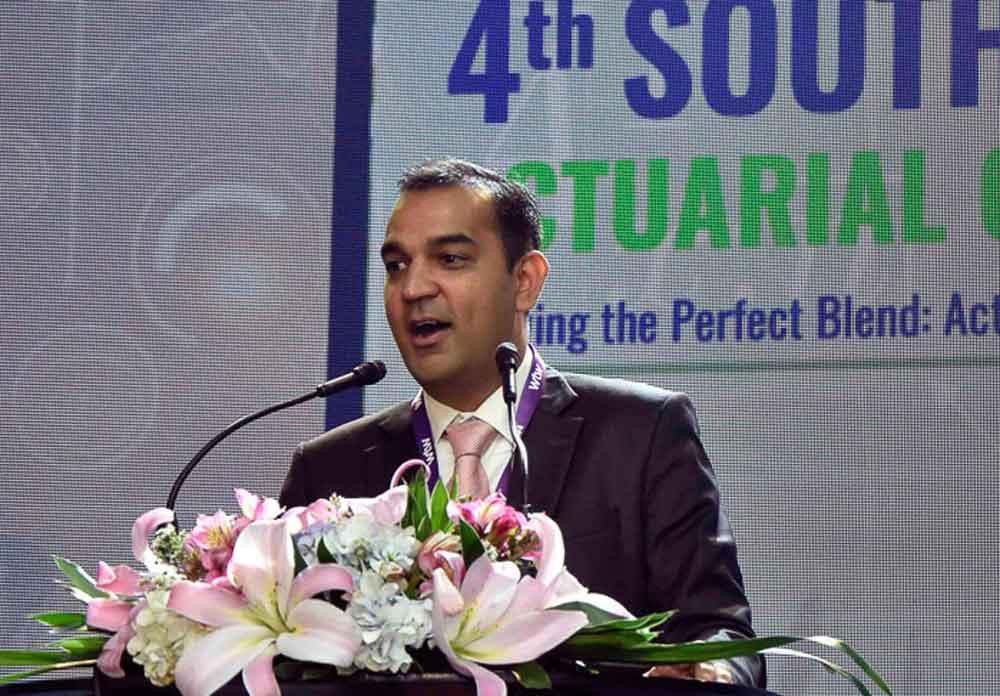
Kunj Behari Maheshwari
The insurance industry can serve as a powerful engine for Sri Lanka’s economic revival and stability, lessening the heavy reliance on taxation for funding national development, according to Willis Towers Watson (WTW) Head of Life Insurance for India & Sri Lanka Kunj Behari Maheshwari.
Maheshwari, delivering the keynote address at the 4th South Asian Actuarial Conference held in Colombo this week, called upon actuaries to be the architects of a more resilient Sri Lankan economy.
Addressing a congregation of actuarial professionals, Maheshwari emphasised the unique and often understated role the insurance sector plays in national financial ecosystems.
“One of the very important functions of our industry as insurance is the ability to collect small savings from a large number of people, not as tax but something that voluntarily is paid as a saving,” he said.
He elaborated that these collected premiums form a substantial pool of long-term, illiquid capital that can be strategically invested in critical areas such as infrastructure development and government programmes, thereby fuelling economic growth.
“Insurance companies, insurance industry, play an alternative role to meet the objective of economic development not via tax via collections in premiums,” Maheshwari explained. “They turn that all the way to the government. You can fund your infrastructure. You can fund large corporates to provide big economic programmes.”
This model, he argued, creates a virtuous cycle where the general populace not only contributes to national development but also benefits directly from the returns on these investments through their insurance policies. “This function is what creates economic stability. This function is what is needed in Sri Lanka so that the insurance industry can come together and develop that,” he noted.
Echoing his sentiments, Deputy Minister of Finance and Planning, Harshana Suriyapperuma highlighted that expanding insurance accessibility could significantly contribute to the country’s GDP growth.
The WTW head also highlighted the insurance sector’s capacity to act as a stabilising force during periods of high economic volatility, a phenomenon Sri Lanka has witnessed in recent years with fluctuating interest rates. By their long-term nature, insurance companies can absorb economic shocks and “counter-cyclically absorb that volatility while the rest of the economy is going crazy.”
He challenged the actuaries in attendance, whom he humorously referred to as evolving from “superheroes” to “master blenders,” to be mindful of their critical role in this ecosystem. He stressed the need for actuaries to build up reserves and advocate for capital regulations that allow insurance companies to remain steadfast during economic crises, rather than being forced to sell off assets and contribute to market instability.
“When you actually say I am going to put in some prudence in my reserves...that’s actually because we are building a more resilient Sri Lanka,” Maheshwari asserted. “That’s because when the next crisis that comes, we are not scampering away asking IMF for a loan. We have our own institutions that are able to support our economy.”
Pic by Nimalsiri Edirisinghe
06 Jun 2026 5 hours ago
06 Jun 2026 5 hours ago
06 Jun 2026 6 hours ago
06 Jun 2026 8 hours ago
06 Jun 2026 8 hours ago