24 Apr 2025 - {{hitsCtrl.values.hits}}
Sri Lanka has been commended for its quicker-than-expected recovery from the worst economic crisis since independence. However, the World Bank has echoed the growing concerns, cautioning that the island nation is still not entirely out of the woods.
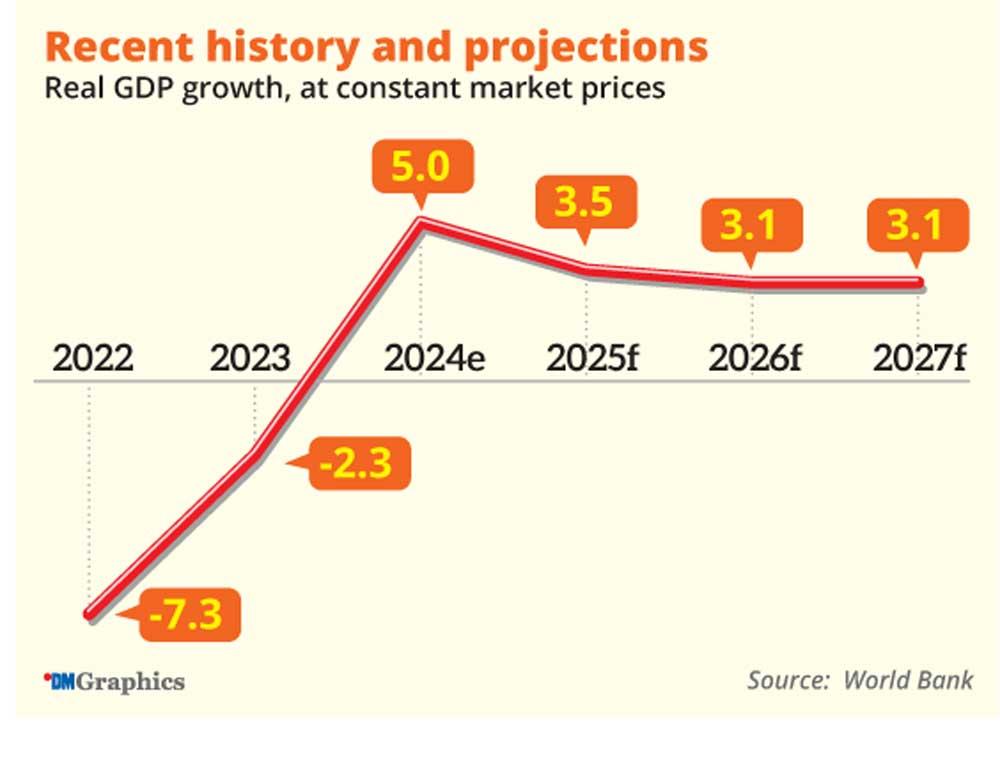
The Sri Lankan economy made a remarkable recovery in 2024, surpassing the growth expectations by recording a 5 percent growth. Despite the recovery, the medium-term growth is expected to be modest, reflecting the scarring effects of the crisis, structural impediments to growth and significant global economic uncertainties, the international lender said.
“While Sri Lanka’s economy is bouncing back stronger than expected, a significant portion of the population—about a third—remains in poverty or is at risk of falling back into poverty” - David Sislen
Exceeding the 4.4 percent projection in 2024 was driven by strong performances in industry and services, particularly in construction and tourism-related services. In 2025, growth is expected to moderate to 3.5 percent, reflecting the scarring effects of the crisis and structural impediments to growth, amid the global headwinds and unprecedented trade policy uncertainty.
The World Bank made these observations in its biannual Sri Lanka Development Update.
The report highlighted that despite the positive growth and fiscal performance, significant challenges remain. The economy is recovering but many Sri Lankans are still struggling. Household incomes, employment and overall welfare are still well below the pre-crisis levels and the poverty rate remained alarmingly high at 24.5 percent in 2024. The labour market continues to struggle, leading to increased emigration, as people look for opportunities abroad.
“While Sri Lanka’s economy is bouncing back stronger than expected, a significant portion of the population—about a third—remains in poverty or is at risk of falling back into poverty,” said World Bank Division Director for Maldives, Nepal and Sri Lanka David Sislen. “To ensure this recovery works for everyone, especially those who have been hit hardest, Sri Lanka can focus on policies that create jobs and support the poor.” For Sri Lanka, medium-term growth and poverty reduction depend on maintaining macroeconomic stability and implementing key structural reforms, amid an increasingly uncertain global environment.
The World Bank forecasts a moderate growth of around 3.1 percent for Sri Lanka in 2026.
Shifting to a higher growth trajectory through the successful implementation of reforms that enhance trade, investment, competition and female labour force participation, among others, is essential to ensure that all Sri Lankans benefit from the recovery. Looking ahead, the World Bank emphasises the continued need for policy reforms to maintain macro-fiscal and financial stability, boost competitiveness, increase productivity and expand job opportunities.
Meanwhile, regional growth is expected to slow to 5.8 percent in 2025—0.4 percentage points below the October projections—before ticking up to 6.1 percent in 2026.
This outlook is subject to heightened risks, including from a highly uncertain global landscape, combined with domestic vulnerabilities, including the constrained fiscal space.
14 Jul 2026 8 minute ago
14 Jul 2026 21 minute ago
14 Jul 2026 25 minute ago
14 Jul 2026 28 minute ago
14 Jul 2026 2 hours ago