Reply To:
Name - Reply Comment
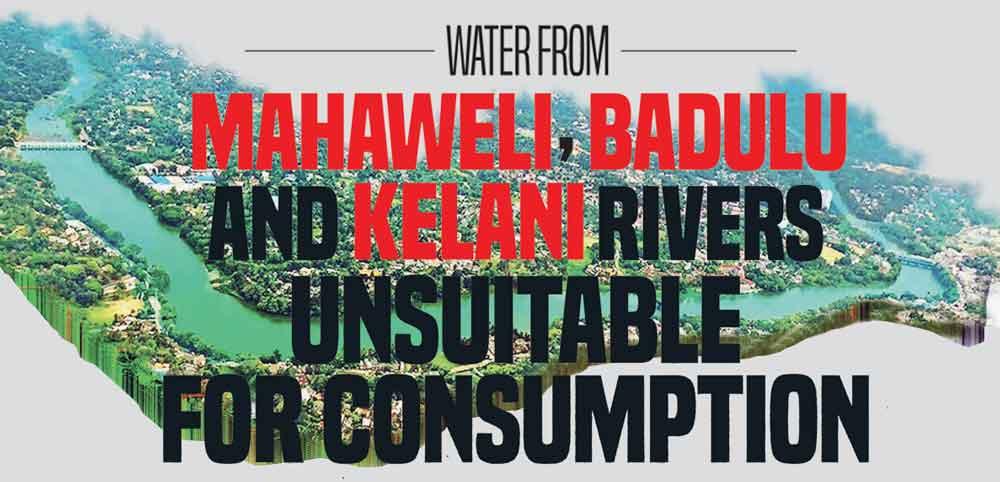
A study has discovered that in 15 water intakes tested along the Mahaweli River segment, bacterial contamination showed significant seasonal and spatial fluctuations in faecal coliform counts
By Prageeth Sampath Karunathilaka and Sudharika Gurusinghe
 Sri Lanka’s main water sources that supply drinking water have become polluted. Recent findings indicate that consuming water from these sources without proper treatment could lead to serious issues. A study conducted by Thilakarathna et al., in 2025 titled 'Spatio-temporal variation of microbial indicators of river water and treatment efficiencies of drinking water treatment plants along the upper Mahaweli River segment of Sri Lanka' examined the extent of this pollution, focusing on the how the presence of bacteria and other harmful substances in the water affects the water sources. Water samples from the Kelani, Mahaweli and Badulu rivers were subject to research during the analysis.
One of the objectives of the study was to assess the level of bacterial contamination in the Mahaweli River, the main supplier of drinking water to the hill country. The researchers tested both surface water and treated water from 14 drinking water treatment plants (DWTPs) located along the river segment of 60 km between the Kotmale and Victoria reservoirs. These tests measured total bacterial count (TBC), total coliform count (TCC), and fecal coliform count (FCC).
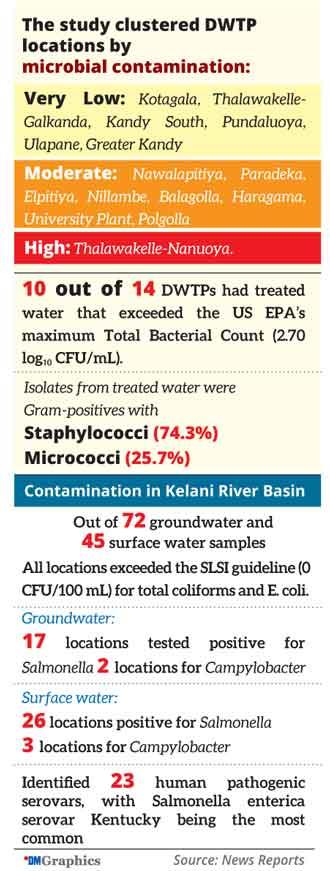
Testing of the surface water of the river confirmed significant contamination variations of TBCs, TCCs and FCCs between dry and wet season. This is due to point source discharges and drains that carry septic waste. The spread of bacteria also increased during the wet season due to the diffusion of contaminated bacteria with the runoff. The study was conducted clustering the locations of DWTPs into three (3) categories according to microbial contamination as very low (Kotagala, Thalawakelle-Galkanda, Kandy South, Pundaluoya, Ulapane, Greater Kandy), moderate (Nawalapitiya, Paradeka, Elpitiya, Nillambe, Balagolla, Haragama, University Plant, Polgolla) and high (Thalawakelle-Nanuoya).
Although the bacterial reduction efficiencies of water levels of many DWTPs (10 out of 14) were higher than 77.9%, treated water samples from 10 DWTPs exceeded the maximum TBC recommended by the US Environmental Protection Agency (2.70 log10 CFU/mL) for drinking water due to high bacterial load in the surface water. Isolates from treated water were Gram-positives with Staphylococci (74.3%) and Micrococci (25.7%). The study also revealed that total coliforms and faecal coliforms were absent in treated water, satisfying the SLS 614:2013 guidelines for drinking water. It recommended to improve the disinfection process of DWTPs to ensure the safety of drinking water, particularly during the wet season.
The study discovered that in 15 water intakes tested along the Mahaweli River segment, between the Kotmale and Victoria reservoirs, bacterial contamination showed significant seasonal and spatial fluctuations in faecal coliform counts due to runoff and drainages of septic waste and point source contaminations based on the land-use. Particularly during the rainy season, treated water frequently contained more total bacteria than recommended, indicating insufficient treatment technologies to cope up with high load of bacterial contaminants, according to the study.
Waterborne diseases is a global issue, causing over 2.2 million deaths annually. Another study conducted by the University of Peradeniya found that total coliforms, Escherichia coli (E. coli), Salmonella species, Shigella species, and Campylobacter species are present in both groundwater and surface water within the Kelani River Basin. Seventy two (72) groundwater and 45 surface water sampling locations were selected to collect water from the head, transitional and meandering regions of the Kelani River Basin for a period of one year (both dry and wet seasons). The results of the study revealed that the entire Kelani River basin was contaminated with total coliform and E. coli bacteria and almost all the sampling locations exceed Sri Lanka Standards Institute (SLSI) guideline value given for drinking water (0 CFU/100 mL). Further, in groundwater, 17 locations were positive for Salmonella species whereas only 2 locations were positive for Campylobacter species. In surface water, 26 and 3 sampling locations were positive for Salmonella species Campylobacter species respectively. In this study, 23 different human pathogenic serovars were isolated and the Salmonella enterica serovar Kentucky was identified as the commonest type. Accordingly, the result of the study revealed that the consumption of raw water from the Kelani River Basin is unsafe and there exists a possibility to cause gastrointestinal diseases.
Surface water from rivers unsafe
Similar results have been observed in a study conducted in the Badulu Oya area. Accordingly, the study conducted by the University of Peradeniya has found that 100 percent of the bacteria are destroyed during the provision made to produce drinking water. Therefore, these bacteria are not present in the drinking water. Despite this, surface water from these rivers remains hazardous for activities such as cooking, drinking, bathing and other human needs. Furthermore, exposure to these bacteria has been linked to prolonged illnesses, including fever, cough, cold, skin infections, dysentery, and diarrhoea. The study also highlighted that the strength of these bacteria contributes to drug resistance, making recovery more difficult.
A nationwide project was launched in Sri Lanka, with assistance from the World Bank and JICA, to mitigate environmental damage in water catchments through the intervention of the Water Supply and Drainage Board. One of its objective was to prevent bacteria from entering groundwater through latrine pits in estates and densely populated areas, which could eventually mix with rivers and streams. The sewage collected by gully bowsers is discharged into the catchment areas of the Mahaweli, Kelani and Badulu rivers. Another objective of this project was to minimise the infections caused by this contamination and safely release the treated water into the environment. The main objective of the project was to establish sewage treatment facilities in the Pradeshiya Sabhas and Urban Councils of Sri Lanka, transport the sewage to these plants via gully bowsers, treat it, and then discharge it.
Accordingly, Rs. 1 billion was provided under the World Bank and JICA assistance for the construction of wastewater treatment plants. (Title: Water sources under threat:) Another objective was to reduce the harmful effects on public health and the environment caused by the incomplete wastewater treatment projects of the Water Board.
However, the study conducted by the University of Peradeniya has revealed that the waters of the Mahaweli and Kelani rivers remain highly polluted. A key contributing factor is the failure of many water treatment projects in Sri Lanka to meet their fundamental objectives of disease prevention, water safety, and environmental protection. Additionally, treated water discharged from these systems has been found to contain highly toxic and persistent substances, including Antibacterial Resistants (ABR) and Per- and Polyfluoroalkyl Substances (PFAS), posing further risks to drinking water quality.
Untreated waste containing PFAS and ABR has been a major contributor to pollution in key water sources such as the Mahaweli and Kelani rivers. This issue is caused by the fact that many wastewater treatment plants are located near these rivers, leading to the direct release of wastewater into them—even when treatment projects are implemented at a cost of Rs. 1 billion.
Wastewater treatment plants
The National Water Supply and Drainage Board, with assistance from the World Bank and JICA, has constructed wastewater treatment plants in Thalawakele, Weligepola, Ibbagamuwa, Ruwanwella, Badulla, Monaragala, Mullaitivu, Kilinochchi, Bandarawela and Chilaw. While these wastewater treatment facilities were useful projects, many of them have faced severe criticism. Reports indicate that several treatment plants, particularly those in Badulla, Bandarawela and Monaragala are failing to function properly, resulting in the discharge of untreated wastewater into nearby rivers.
Although the World Bank and JICA have provided financial support for these projects, poor planning, mismanagement and a lack of legal oversight have put these funds at serious risk. If such failures persist, funding agencies like JICA may lose confidence in Sri Lanka’s ability to implement effective development projects. This could make it increasingly difficult for the country to secure international assistance for future initiatives aimed at improving water safety and environmental protection.
The reference list for the research study is as follows ;
Thilakarathna, P.T.A., Fareed, F., Athukorala, S.N.P., Jinadasa, R., Premachandra, T., Noordeen, F., Gamage, C.D., Makehelwala, M., Weragoda, S.K., Fernando, B.R., Zhang, Y., Wei, Y., Yang, M., and Karunaratne, P. (2025). Spatio-temporal variation of microbial indicators of river water and treatment efficiencies of drinking water treatment plants along the upper Mahaweli River segment of Sri Lanka. Environmental Pollution, 367, 125628. https://doi.org/10.1016/j.
Attempts were made to inquire about the issue for the Chairman of the Water Supply and Drainage Board. However, this official was unavailable for comment. Instead, the Director of the project, Udaya Ranatunga was contacted. He said: “Not a single project has failed. Can you name even one? Claims that the projects in Yatiyanthota, Badulla and Bandarawela have failed is misleading. In fact, the Bandarawela project hasn’t even been built yet, so any reports suggesting it is operating are false. It has not been handed over, and they are in the process of bringing in sewage. As for the projects in Badulla and Bandarawela, we will review their status and address any shortcomings. However, the Yatiyanthota project did encounter issues because the Pradeshiya Sabha didn’t fully understand how to manage it. They lacked the initiative to see it through, which led to its failure. We will need to assess why these projects faced challenges and I will provide further updates after reviewing the other two projects.”
A spokesperson for the Water Supply and Drainage Board (WSDB) confirmed that some engineers from the WSDB, involved in this project, have established private businesses using project funds. Reports indicate that these individuals have taken on roles as consultants, planners, or field managers for these projects. Such actions—providing consultancy for their own projects—have led to the misuse of critical resources for personal gain and also undermined public trust in the institution. Additionally, there are allegations that some individuals involved in such questionable activities have even invested in vehicle sales using these funds. Given these concerns, it is imperative that these projects undergo strict quality control and oversight.
A spokesperson for the Bandarawela Municipal Council commented on the matter and praised the wastewater treatment plant. “This initiative is a good one, but the project has not yet been officially handed over to us. There were issues in Badulla, where environmental concerns arose. The sewage treatment process hasn’t been carried out properly, which has led to delays in obtaining environmental licences from the Central Environmental Authority. We have advised the Water Supply and Drainage Board, as well as the officials responsible for this project, to secure the necessary environmental licences themselves,” the spokesperson added.
A spokesperson for the Badulla Municipal Council commented on the matter, stating that the project needed to be upgraded. “The project hasn’t been officially handed over to us yet by the company. It was created by Water and Supply, Sanitation Improvement Project (WaSSIP), and currently, only 70–80 percent of it is operational. However, further improvements are needed. Since this project falls under the responsibility of the Water Supply and Drainage Board, it is up to WaSSIP to ensure a proper and complete handover. While partial implementation has begun, there are significant shortcomings. One major issue is the lack of an environmental data report from the Central Environmental Authority, likely due to these deficiencies. We have requested the report, but the treated water still contains excessive levels of nitrate and phosphate, exceeding the permissible limits. A total of Rs. 142 million was spent on this project and the planning failures have contributed to its poor execution. As a result, the project is not being implemented properly and the project has not been properly handed over to us. Water from this facility is discharged into the Badulu River via the drainage system, impacting the environment since the sewage is not fully treated.
“Due to the failure of the Badulla project, we made a request to address its shortcomings before it is handed over to us. However, sewage treatment is continuing, and the treated water is being diverted to a composting site. Eventually, during the rainy season, this water accumulates in nearby reservoirs,” added the spokesperson from Bandarawela Municipal Council.
The Secretary of the Ruwanwella Pradeshiya Sabha Rasangika Pathirana commenting on the matter accepted that there were issues with the water treatment plant. “We ensure that the sewage collected using gullies from Ruwanwella, Yatiyanthota and Deraniyagala Pradeshiya Sabha areas is properly treated and disposed of. Initially, there were issues with our treatment plant, particularly with the chemicals used in the sewage treatment process. However, these issues have now been resolved, and the plant is operating at full efficiency.”