
Reply To:
Name - Reply Comment
 The new format of the ERPM is modeled on internationally recognised assessments such as the UK and Australian exams
The reforms were initiated following years of review, expert consultation, benchmarking with international best practices and feedback from independent medical educationists. The SLMC’s role is regulatory not promotional
The UK’s PLAB and Australia’s AMC exams are regarded as gold standards for evaluating the readiness of international medical graduates to practise medicine aligning with Sri Lanka’s system
By Nirmala Kannangara
 Following the controversial changes brought by the Sri Lanka Medical Council to the Examination process to register for Medicine Practice in Sri Lanka, a wave of concern is sweeping across Sri Lanka’s medical professionals. Senior doctors warn that these changes could expose the lives of patients to danger because they lower the standards of future doctors entering the country’s health care system.
The ‘Examination to Register to Practice Medicine in Sri Lanka’ (ERPM) is held to evaluate the quality of the theoretical and clinical skills of foreign MBBS graduates. This exam is considered to be comprehensive and reliable, which ensures that foreign medical graduates- who are trained abroad- are safe, skilled and ready to treat patients in Sri Lanka. However, from the planned changes to this important exam by the Sri Lanka Medical Council (SLMC) from July this year, there will be no way to evaluate the skills of future doctors. Experts believe these changes will certainly weaken the treatments given to patients from unqualified or poorly trained doctors.
“These changes have been introduced not to benefit the patients, but to benefit SLMC member’s children, most of whom are foreign medical graduates. As the ERPM is a tough exam and difficult to pass easily unless they have the necessary knowledge and experience, SLMC has brought these changes ignoring the objections raised by Consultant Specialists. As the SLMC members are aware how tough ERPM exam is, they do not want their children to repeat the exam,” the sources said on conditions of anonymity.
The objective of the ERPM is to assess the core knowledge in clinical subjects with particular reference to problems prevalent in Sri Lanka and the skills and competencies required to bear the responsibilities as a provisionally registered medical practitioner.
Purpose of exam
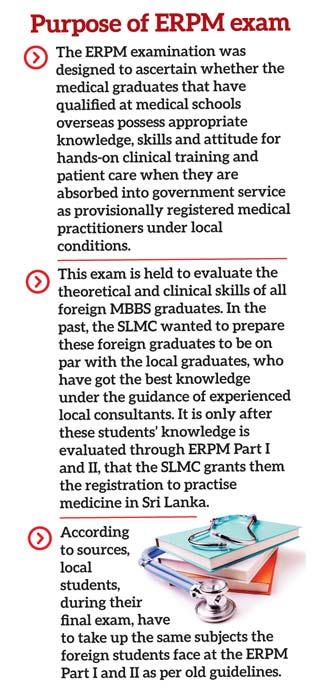
The ERPM examination was designed to ascertain whether the medical graduates that have qualified at medical schools overseas possess appropriate knowledge, skills and attitude for hands-on clinical training and patient care when they are absorbed into government service as provisionally registered medical practitioners under local conditions.
This exam is held to evaluate the theoretical and clinical skills of all foreign MBBS graduates. In the past, the SLMC wanted to prepare these foreign graduates to be on par with the local graduates, who have got the best knowledge under the guidance of experienced local consultants. It is only after these students’ knowledge is evaluated through ERPM Part I and II, that the SLMC grants them the registration to practice medicine in Sri Lanka.
According to sources, local students, during their final exam, have to take up the same subjects the foreign students face at the ERPM Part I and II as per old guidelines.
“This exam is more objective, comprehensive and structured. It aims to ensure that the examination is appropriate and conforms to the local need. It provides greater accuracy and is relevant in testing the core knowledge of common communicable and non- communicable diseases and their prevention, ability to make provisional diagnosis and plan the initial management, ability to adapt to the facilities and resources available in the hospital, to gain basic knowledge of the healthcare structure and the medico-legal system in Sri Lanka and the responsibilities of medical practitioners,” sources claimed.
According to these medical professionals, solving patients’ medical issues and the management of emergency cases in particular are mandatory skills that should be included in the assessment of all care- providers. With the new changes implemented to the ERPM examination, prospective future doctors will be deprived of becoming knowledgeable professionals and their accumulated knowledge will never put them on par with local students.
“The foreign MBBS graduates should acquire and demonstrate adequate theoretical knowledge and clinical skills equivalent to those of local graduates to ensure their productivity and competency as house officers. Implement subject wise minimum passing criteria to ensure balanced competency across all subjects. We have requested the SLMC to allow these foreign MBBS graduates to complete subjects separately, similar to local merit list practices to promote faire assessment and reduce stress. All our views have been ignored by the SLMC as their only objective is to pave the easiest way for their children to get through the ERPM exam,” sources said.
ERPM Part I consists of Medicine and Pediatrics papers which comes under the medical track, General Surgery and Obstetrics/Gynecology papers under the surgical track and Psychiatry/ Community Medicine/ Forensic Medicine papers under Psychiatry track.
“Like how local students have to get through all these subjects at their final MBBS exam, the foreign graduates too have to pass these subjects which have theory components with true/false multiple choice questions. However, under the new guidelines, SLMC is going to combine marks of Medicine and Pediatrics papers, General Surgery and Obstetrics/Gynecology papers and Psychiatry/ Community Medicine/ Forensic Medicine papers. If a candidate scores exceptionally well in Medicine and scores poorly in Pediatrics in the medical track, under the new system, the SLMC will consider that this candidate has got through both subjects. It is the same with surgical and psychiatry tracks as well. When a student scores exceptionally well in one subject, the SLMC should consider that the candidate has performed well in that particular subject, but not in other subjects, where they have scored lesser than the pass mark. But how can they combine the marks students have scored from all subjects in one track and consider them as qualified candidates? This method allows the candidates to get through the ERPM Part I without gaining proper knowledge. If so how can they treat patients during their internship? By changing the guidelines, the SLMC deliberately exposes the patients’ lives to great risk,” the sources said.
The sources further revealed how foreign medical faculties deprive foreign students from examining their pregnant mothers and children.
“This is dangerous because foreign graduates do not get adequate clinical knowledge in Pediatrics and Gynecology as those countries give only a limited time for foreign students to check on their children and pregnant mothers. They only get knowledge in medicine and surgery. The proper knowledge in Pediatric and Gynecology is vital, but due to restricted time given to check on children and pregnant mothers, it is a must that they obtain this knowledge once they return to the country. Apart from that their skills ought to be assessed. A weak foundation could expose patients to serious risks. Some candidates have told us personally that they do not get hands-on experience abroad due to language barriers or other restrictions. They rely on practical training in Sri Lanka,” sources said.
ERPM Part II is the clinical skill assessment track which is known as Viva. Candidates should pass Medicine, Pediatrics, Surgery, Obstetrics/ Gynecology clinical tests to complete the Viva component.
According to sources, by substituting long and short cases in the Viva component with the proposed Objective Structured Clinical Examinations (OSCEs), it weakens the evaluation clinical skills of the foreign graduates and there will be no room to judge the candidates’ overall knowledge and communication skills which are vital for safe and effective patient care.
As per the old format, the Viva component consist of three paths; they are to access the candidates’ ability in Long Cases, Short Cases and Emergency knowledge.
Producing doctors who are unprepared
 “In Long Cases, examining a patient is crucial and very important. A patient is provided for each candidate and he/she has to talk to the patient and take his medical history. They should have the necessary knowledge to take the patient’s medical history, to communicate with the patients, critical thinking and the ability to formulate management plans. By replacing this with the OSCE method, it diminishes the depth of assessment skills. In short Cases, it is essential for assessing hands-on clinical skills and diagnostic knowledge. By replacing this part with OSCE, compromise the ability to evaluate clinical and diagnostic skill of a candidate. In Short Cases, a patient is provided, but the candidate has to diagnose the sicknesses without talking to the patient, but it has to be done either by examining the patient with the stethoscope or examining the patient’s body externally. The last component in the Viva section is to assess the knowledge of emergency management. This skill is vital for doctors who work in peripheral hospitals during internship and post-internship. In the new format this component has been removed. The SLMC is taking a risk by producing doctors who are unprepared at any given emergency incident,” sources alleged.
According to sources, although requests have been made to the SLMC to retain the components of the previous guidelines (long cases, short cases and emergency viva) as they align closely with local MBBS final exams, all such attempts to put the system in order have fallen on deaf ears.
The removal of Long Cases makes it harder to assess students’ overall knowledge and communication skills, which are vital for safe and effective patient care. Producing doctors with inadequate knowledge and clinical skills endangers patients and will weaken the overall quality of healthcare, sources maintained.
“The examiners get the opportunity to test the candidates’ ability to talk to patients, make decisions, and give proper treatment—as if candidates are treating patients in a hospital. But now, all these aspects have been removed and have been replaced with OSCE, which only tests a few basic skills of the candidates but not the abilities of candidates as to whether they can treat the patients independently. As Long Cases and Short Cases will be taken away from ERPM Part II, without the ability to take the patient’s medical history and clinical discussions, we may never produce new doctors who truly understands how to care for a patient, make the right decisions or respond during an emergency,” sources claimed.
According to sources, the SLMC is attempting to underscore that these changes are meant to bring the exam in line with systems in countries like the UK and Australia.
“But in those countries, doctors go through many steps after their exams before treating patients. Candidates are not provided with government jobs soon after their final exams. In Sri Lanka it is totally different. Once passing the ERPM, the doctors are absorbed into government service and sent for internship to a government hospital. That is why the exam should be tough, practical and highly clinical,” sources pointed out.
|
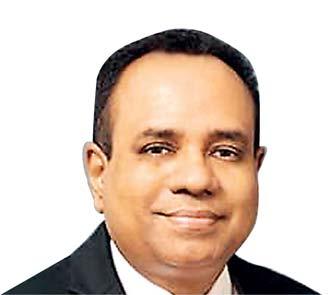
Prof. Vajira |
Although it is alleged that the old ERPM exam was considered to be comprehensive and reliable-which ensured that foreign medical graduates, who are trained abroad are safe, skilled and ready to treat patients in Sri Lanka- President SLMC Prof. Vajira Dissanayake said that the introduction of a modernised EPRM is a bold step taken in strengthening the quality of medical care in Sri Lanka. While adding that that the modernised EPRM was aligned with international best practices, Prof. Dissanayake’s dedicated some of his time to answer questions posed by the Daily Mirror.
Excerpts of the interview.
Q However with the new guidelines that will come into effect with the July exam, can the SLMC give an assurance that they can evaluate the candidates’ skills and competencies required to bear the responsibilities as a provisionally registered medical practitioner?
Yes. The new format of the ERPM is modeled on internationally recognised assessments such as the UK and Australian exams. It is explicitly designed to assess whether candidates are safe, skilled and competent to begin supervised clinical practice. The two part structure stats with Part I. It comprises multiple choice questions (MCQ) based assessment of applied knowledge which test core clinical knowledge and decision making. Part II OSCE is based on assessment of clinical and communication skills; it provides a comprehensive, objective and standardized evaluation. These assess hands- on clinical skills, professionalism and communication in real life simulated settings. This model is used by nearly all developed countries to ensure public safety and professional accountability.
Q Is it true that these changes have been introduced not to benefit the patients, but to benefit offspring of SLMC members, most of whom are foreign medical graduates?
This is categorically false and deeply misleading. The reforms were initiated following years of review, expert consultation, benchmarking with international best practices and feedback from independent medical educationists. The SLMC’s role is regulatory not promotional. These changes serve patients first by ensuring all doctors entering the Sri Lankan system regardless of where they were trained, meet the same high standards of competency, safety and professionalism.
Q How can the SLMC combine the marks students have scored from all subjects in one track and consider them as qualified candidates in ERPM Part I?
Modern assessment theory supports the integration of multi -disciplinary clinical knowledge into a single applied knowledge test. The revised Part I includes single best answer MCQs that span multiple disciplines, testing how well candidates can synthesise knowledge and apply it in clinical settings. This mirrors real-world medical practice where doctors must draw on integrated knowledge to manage patient care effectively. Scoring across a single track is more consistent with global standards and reduces variability in examiner subjectivity.
Q Is it true that these changes are meant to bring ERPM in line with systems in countries like the UK’s PLAB and Australia’s AMC?
Yes. That is precisely why they should be welcomed. The UK’s PLAB and Australia’s AMC exams are regarded as gold standards for evaluating the readiness of international medical graduates to practise medicine aligning with Sri Lanka’s system. This will ensure that our licensing standards are internationally benchmarked, our patients are treated by doctors who have passed through transparent, standardised and validated assessments and our graduates are better prepared for global medical practice and post graduate opportunities. This move is long overdue and reflects educational maturity and commitment to public safety.
Q As per the old format, Part II -the Viva component consist of three paths- to check the candidates’ ability in Long Cases, Short Cases and Emergency knowledge. By substituting the first two paths with OSCE and removing the emergency path, do you expect that the SLMC can evaluate candidates’ overall knowledge in clinical and communication skills which are vital for safe and effective patient care?
Absolutely. OSCEs are the most objective and validated method for assessing clinical and communication skills. Unlike long or short cases, OSCEs – use standardised patients and pre-determined checklists, eliminate examiner bias and variability and cover a wide range of scenarios, including emergencies, ethics and breaking bad news. Most importantly OSCEs have proved in multiple studies to predict that real world clinical performance is more reliably than traditional oral Viva.
Q If the SLMC thinks OSCE skills are deemed necessary, why can’t this be added as a separate component rather than replacing the critical evaluations?
The goal is not to add complexity, but to enhance validity, reliability and fairness. Replacing inconsistent Viva formats with OSCEs allows SLMC to apply a uniform standard for all candidates, ensure such student is assessed in the same way across similar competencies and reduce examiner variability and candidate disadvantage. OSCEs are comprehensive and modular, allowing simulation of everything from acute emergencies to everyday consultations within a controlled equitable format.
QBy removing the emergency path in Part II, isn’t the SLMC taking a risk by producing doctors who are unprepared at any given emergency incident?
Not at all. Emergency scenarios are not being ignored- they are being integrated into the OSCE in a structured and more reliable way. For instance OSCE stations may include management of chest pain, initial response trauma and recognition and treatment of anaphylaxis. Unlike a Viva, that may vary greatly depending on the examiner or case presented, OSCE emergency stations are standardised and scored objectivity using validated rubrics. This ensures better preparedness of doctors.
Q Will these changes weaken the treatments given to patients from unqualified or poorly trained doctors?
On the contrary, these changes are specifically designed to strengthen the assessment process. The use of validated MCQs and OSCEs enhance rigor and transparency, ensure all candidates meet a minimum standard for safe practice and removes subjective biases and outdated oral exams that lack standardization. Doctors who pass under the new system will be more uniformly trained, more accountable and more prepared for the challenges of modern healthcare. Ultimately patients will benefit from care delivered by professionals who have cleared a globally aligned and scientifically sound licensing system.