Reply To:
Name - Reply Comment
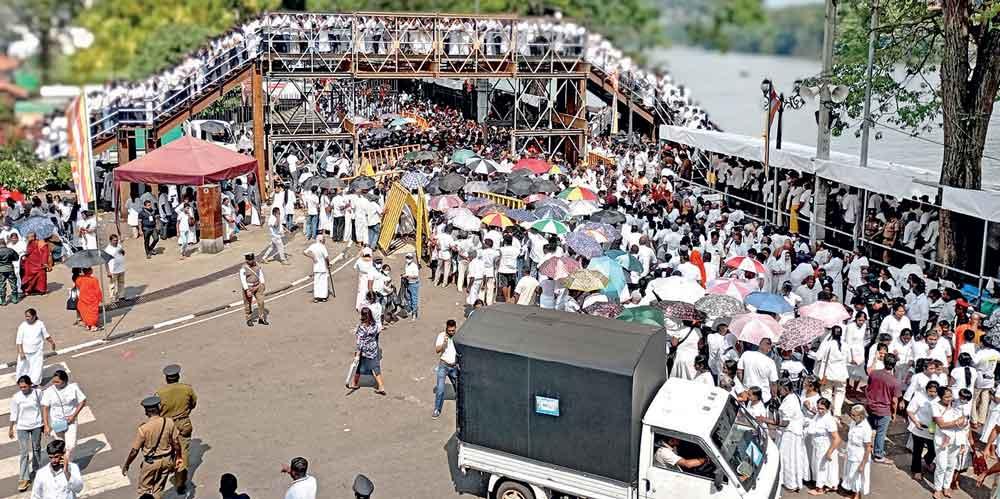 Over one million devotees participated in the worship of the tooth relic during the expositionary period but of the one million, only 600,000 manage to participate, leaving 400,000 who had to wait in long queues to not be able to worship them, according to police estimates
 Despite knowing that millions would gather in the city at once, officials proceeded without proper planning. The officials who organised the Dalada exposition had no proper plan to provide hygienic facilities to the people who came to Kandy city, or to ensure that they could worship properly
Individuals in the VIP queue were allowed to worship the Tooth Relic by entering through the queue designated for persons with disabilities. This led to a situation where a large number of individuals with disabilities were unable to reach the relic site. On the final two days, nearly 20,000 people are reported to have worshipped the Tooth Relic via VIP access
By Prageeth Sampath Karunathilaka and Sudharika Gurusinghe
The Dalada exposition, held after 16 years, offered a rare opportunity for the general public to pay homage to the Sacred Tooth Relic. The last Dalada exposition took place in 2009, during the final phase of the war and under the presidency of former head of state Mahinda Rajapaksa. This year, the exposition began at 3:00 p.m. on April 18 and concluded as scheduled at 5:30 p.m. on April 27. The 10-day event was organised at the request of President Anura Kumara Dissanayake. Speaking at the opening ceremony, the President Dissanayake stated that the relic exposition would help restore the country’s fading civilisation and foster a religious and cultural revival.
According to historical accounts, after Gautama Buddha’s Parinirvana (death), his body was cremated, and—except for the four tooth relics, the Lalata Dhatu, and the Griwasthi Dhatu—his remaining bodily relics were broken into small pieces in accordance with his wishes.
The four Tooth Relics are said to reside in Tavatimsa Deva World, Gandhara Desh, Kalinga Desh and the Naga world. In an article written for the Budusarana online edition, Ven. Welivita Soratha, Senior Lecturer at Sri Lanka Bhiksu University in Anuradhapura, notes that two of these four relics are currently located in Sri Lanka. This is supported by texts such as the Dalada Sirita, Dathavamsa and Dalada Poojavaliya. According to the Thero, the right Tooth Relic, which once resided in the Naga world, was brought to Sri Lanka by a monk named Mihindu, a student of Mahadeva Thera, during the reign of King Kavantissa. It was enshrined in the Somawathi Chethiya built by King Giriaba in honour of his wife.
The other Tooth Relic is enshrined at the Sri Dalada Maligawa in Kandy. This relic, originally housed in the Kingdom of Kalinga, was entrusted to Princess Hemamala and Prince Dantha to protect it during the war. The royal couple brought the Tooth Relic to Sri Lanka in the 4th century, specifically in 310 AD, during the reign of King Sri Meghavarna (Kithsirimevan). Since then, the Tooth Relic has become a symbol of state sovereignty and has been venerated with great reverence and ceremonial grandeur.
Four hundred thousand devotees left heartbroken
According to Pradeep Nilanga Dela, Diyawadana Nilame of the Sri Dalada Maligawa, the 10-day exhibition concluded successfully. Over one million devotees participated in the worship of the tooth relic during the exposition period. Of them, more than six hundred thousand were able to directly pay homage to the Tooth Relic. However, police estimates indicate that approximately four hundred thousand devotees waiting in queues were unable to do so. It was also estimated that between 20,000 and 21,000 devotees worshipped the Tooth Relic each hour.
 The Kandy Municipal Council has announced that 600 tons of garbage were collected in Kandy city during the Dalada exposition
The most alarming issue was the serious risk of contamination in the watershed of the Mahaweli River
President Dissanayake stated that the relic exposition would help restore the country’s fading civilisation and foster a religious and cultural revival
The Kandy Municipal Council has announced that 600 tons of garbage were collected in Kandy city during the Dalada exposition. According to the Council, the waste included urine and faeces disposed of in plastic bags. The overall volume of garbage increased significantly due to the haphazardly organised dansalas (alms giving).
The Public Health Inspectors’ Association also recently warned of the potential spread of serious infectious diseases among the large crowds gathered for the Dalada Pilgrimage. Association President, Upul Rohana, highlighted the risk of outbreaks of illnesses such as diarrhoea, dengue, and chikungunya. The Municipal Council further reported that the amount of garbage collected on a single day during the Dalada exposition was equivalent to the average monthly waste collection in Kandy. They also noted that the city lacks sufficient space to manage and dispose of this volume of waste properly.
Meanwhile, visitors from Katugastota and Kandy Lake side who came to worship the Tooth Relic faced a severe lack of toilet facilities. Many stayed in temples and mosques, while others remained on the road. Due to the inadequate sanitation, many were forced to relieve themselves in roadside drains, along both banks of the Mahaweli River, and in the Kandy Lake (Kirimuhuda). As a result, the drainage systems around Kandy became contaminated with human waste, leading to a strong stench and several health concerns. The most alarming issue was the serious risk of contamination in the watershed of the Mahaweli River, which supplies drinking water. This is because the waste was washed into the river during the rains that occurred while the Tooth Relic exhibition was taking place.
This raises the question of whether the authorities have considered the impact of sewage on the drinking water supply in and around Kandy. Despite knowing that millions would gather in the city at once, officials proceeded without proper planning. The officials who organised the Dalada exposition had no proper plan to provide hygienic facilities to the people who came to Kandy city or to ensure that they could worship properly. Pilgrims from Katugasthota only walked a distance of 200 metres in their queue from the 21st to the 24th. The lines continued to grow, and many people were unable to even approach the temple for worship. This was due to the inclusion of police officers, other security personnel, and officials of the government who were added to the queue.
Many pilgrims had been waiting for days without proper rest. They were exposed to harsh sunlight and rain. As a result, numerous devotees fell ill, suffering from fever and skin infections. These concerns were also confirmed by the Public Health Inspectors’ Association.
Meanwhile, although the general public waited their turn in long queues to worship at the Sri Dalada Maligawa, separate VIP queues were also observed. These were designated for the relatives, friends, and acquaintances of local dignitaries, top-level police officers and government officials, as well as for prominent businessmen in Kandy. As a result of these VIP queues, over 30,000 people belonging to the general public reportedly lost the golden opportunity to worship the Sacred Tooth Relic during the final two days of the exhibition. Official statistics indicate that approximately 150,000 people had gathered in the three main public queues.
Individuals in the VIP queue were allowed to worship the Tooth Relic by entering through the queue designated for persons with disabilities. This led to a situation where a large number of individuals with disabilities were unable to reach the relic site. On the final two days, the 26th and 27th, nearly 20,000 people are reported to have worshipped the Tooth Relic via VIP access. Meanwhile, at least 150,000 people were present in all three main queues over the last few days. Around 68,000 and 70,000 people from the general queues worshipped the Tooth Relic each day. Senior police officers in Kandy stated that more than 100,000 people worshipped the relic daily. If this is accurate, it suggests that the remaining worshippers—beyond those in the public queues—must have had accessed the relic through VIP channels.
Accordingly, only 120,000 to 130,000 worshippers could reach the relic. This means that approximately 30,000 people in the queues were ultimately unable to worship the Sacred Tooth Relic. This unfortunate situation occurred despite the President’s clear request that everyone in the queues be given the opportunity to worship. It reflects a serious disregard for the President’s directive to end VIP queues —not only by the custodians of the Dalada Maligawa but also by various officials. Although elite groups in Kandy continued to organise VIP queues, as the Commander-in-Chief and Minister of Defence, the President’s recommendation should have been enforced by the tri-forces and the police at the very least. However, this did not happen. It was a common sight to see relatives being taken through VIP queues in official Air Force and police vehicles.
A high-ranking police officer in Kandy was also seen distributing passes to his female friends to worship the tooth relic near Rajaveediya. Audio recordings reportedly exist of this officer calling his friends, inviting them to collect the passes, and even complimenting them. Government officials in Kandy were no different—they too misused their positions to grant access for their relatives, friends, and personal acquaintances. Meanwhile, due to police negligence, the general public faced significant inconvenience. As family members came together to worship the Sacred Tooth Relic, many of them lost their way after being separated due to the queue being broken and directed in different ways. Monks involved in organising and promoting the event had to intervene, asking police officers to stop such practices. As a result, many elderly individuals who had come to pay homage to the Tooth Relic lost their way, and their bags were found abandoned in various places. When devotees returned after worshipping, many were unable to locate their belongings. Additionally, due to the crowding, exhaustion, dehydration, and illnesses, nearly 600 people required medical attention. Ambulances were seen admitting about six patients to the hospital every hour.
Meanwhile, reports emerged of a scam targeting people at the end of the queue on Katugastota Road. Victims were misled into believing they would be moved to the front of the queue. Witnesses stated that people were charged Rs. 1,000 each, taken in a three-wheeler for about 500 metres further, and then simply reinserted into the queue at a different point. Although police officers were informed about the incident, the public felt that no proper action was taken.
When asked about the situation, Director of the Kandy General Hospital, Dr. Iresha Fernando, stated that 600 patients were admitted for treatment during the 8 days of the Tooth Relic exhibition.
This newspaper contacted the Kandy Water Supply and Drainage Board Laboratory and spoke with Darshani Ilangangedara, who confirmed that there were no issues with the drinking water provided to the public. She stated that water was supplied only after a proper testing process.
We also inquired at the office of the Kandy Senior Superintendent of Police regarding the conduct of the police during the exhibition. When questioned, Kandy Divisional SSP Anuruddha Bandaranaike acknowledged that a large number of devotees had worshipped the Tooth Relic. However, when asked about the distribution of VIP passes on Rajaveediya, he stated that he was unaware of such incidents. He added that Divisional SSPs were tasked with protecting the Tooth Relic and suggested contacting them for further details.