Reply To:
Name - Reply Comment
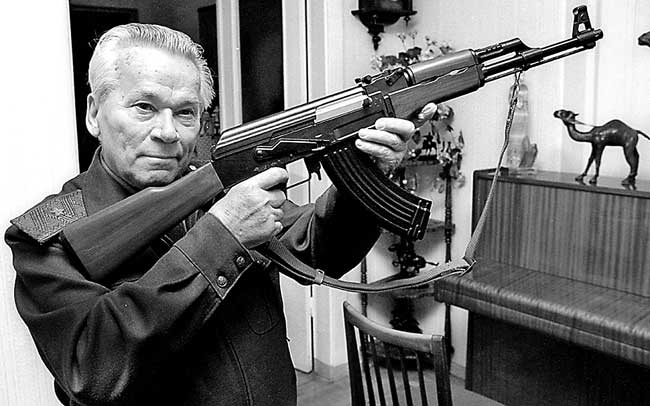
.jpg) The death of Russian designer Mikhail Kalashnikov at 94 in December was noted worldwide. I wonder if anyone would have noticed if he had designed the safety pin instead of the assault rifle which bears his name.
The death of Russian designer Mikhail Kalashnikov at 94 in December was noted worldwide. I wonder if anyone would have noticed if he had designed the safety pin instead of the assault rifle which bears his name.
This isn’t an attempt to take away the credit due to him as a brilliant weapons designer. Celebrating his 90th birthday at the Kremlin, then Russian president Dmitry Medvedev praised the designer for creating “the national brand every Russian is proud of.”
It isn’t known if any Russian leader ever feted Tolstoi in a similar manner for writing the novel every Russian can be proud of. Nor if Leonid Brezhnev would have said something similar about the music of Dmitri Shostakovich, the last great Russian classical composer with 15 symphonies and numerous other works to his credit.
But literature consists of words, while weapons fire bullets. While one can argue that the 20th century was shaped (for better or worse) by books and ideas (both Das Kapital and Mein Kampf come to mind), the clash of those ideas was conclusively won by people firing guns (Hitler’s book, by the way, is still published and read by .jpg) people in places such as India). These ideas may live on even after the AK-47 becomes an anachronism. If these or other ideas lead to a gigantic ideological clash ever again, that too, will be resolved by weaponry – with Kalashnikov’s invention, or its successors, playing a big role.
people in places such as India). These ideas may live on even after the AK-47 becomes an anachronism. If these or other ideas lead to a gigantic ideological clash ever again, that too, will be resolved by weaponry – with Kalashnikov’s invention, or its successors, playing a big role.
I have never fired a gun (an increasingly rare condition in the modern world), but I was an admirer of weaponry during my impressionable youth. It’s an increasing awareness of what happens at the receiving end which helped me to outgrow this fascination. That youthful view, along with some early radical chic, made me an admirer of both Mikhail Kalashnikov and his proverbial invention – Avtomat Kalashnikova 1947, or AK-47 as it is widely known.
Today, I’m no longer an admirer. Rather, I’m trying to find their proper place in human history and civilisation. In the process, one could become quite cynical. I now hold the view that the safety pin has been more important to civilisation than the AK-47. But how many people can name its inventor?
Young Kalashnikov was wounded while serving as a tank commander fighting Hitler’s forces in World War II. He designed weapons while recuperating from his wounds. His early weapons designs were not accepted for production. In 1947, aided by a small team, he produced the AK-47. He was still only a sergeant.
In this, he is a typical product of the early Soviet system. Mikhail Timofeyevich Kalashnikov was the son of a peasant, of the kind extolled by Tolstoi for essential humility and humanity, and by the Soviet regime for sheer propaganda value. He came from a large family, and they lived in remote Siberia. He was entirely a product of the Soviet system, unlikely to criticise Stalinist excesses, and didn’t suffer from any of those terrible purges, while many of the ex-USSR’s top designers, scientists, artists, writers and musicians did.
Kalashnikov may have liked firearms even as a child. As a young man, he was once wanted by the police for illegal possession of a pistol, and had to flee home. Later, he worked as a railway clerk, again in remote Kazhakhastan. In 1938, he began his military service, and designed a simple but successful device to calibrate the performance of tank engines.
Simplicity was the hallmark of his designs. Being largely self-taught may have influenced this side of his personality. But it was in fact a hallmark of post-revolutionary Soviet design of everything from cameras to transport and weapons. Westerners have seen this factor as a sign of backwardness. (It isn’t just a Western attitude. The third world, including Sri Lanka, has a ‘hi-tech’ lobby which shares this contempt for Russian products.) The Soviets saw it as a strength. When Hitler planned his invasion of the ex-USSR, the presumed inferiority of Soviet weapons, industry and equipment was a deciding factor. It proved to be a disastrous miscalculation.
Like the T-34 medium tank which shocked the Germans so much, the AK-47 was ahead of its time, brilliant in its simplicity, robust, reliable, easy to maintain and cheap to mass produce. They are, like the Soyuz spacecraft, typical products of what the Americans like to call Russia’s ‘brute force technology.’ The Germans prided themselves on the sophistication and quality of their military equipment. But there is an old Marxist saying -- “quantity has a quality of its own” -- and Nazi Germany learned this lesson dearly between 1941-45. For every destroyed German tank, gun or aircraft, the Soviets could produce a dozen.
The AK-47 isn’t the world’s first assault rifle. That credit goes to the German sturmgewehr, put to limited use by Nazi special forces during WWII. The availability of shorter high-velocity rifle bullets made such designs inevitable. An assault rifle is a weapon capable of both semi or fully-automatic fire, using the gas produced by the fired bullet to actuate a piston which unlocks the bolt by rotating it. It wasn’t a new idea, but kalashnikov’s genius was to produce a weapon which was efficient, reliable and cheap to mass produce, one which rarely jams even in the worst possible conditions.
Western writers are fond of describing the AK-47 as “every guerilla’s favourite weapon.” But ‘favourite’ presumes a choice. The 90 million or so AK-47s, copies and derivatives used by the former Warsaw Pact, Chinese and third world armies, and rebel movements from the PLO, the Viet Cong to the Sandinistas and Samora Machel’s fighters (not forgetting both sides to Sri Lanka’s civil war), saw it as the ideal weapon due to the above mentioned factors of price, ease of maintenance and reliability.
Mikhail Kalashnikov once deplored its use by criminals and child soldiers. But that’s the price you pay for designing a weapon of mass destruction (the AK-47 and its derivatives have undoubtedly killed more people the world over than nuclear bombs). As for the safety pin, it probably hasn’t killed anyone, but no one has ever feted its inventor.
That’s how it goes down human history.