Reply To:
Name - Reply Comment
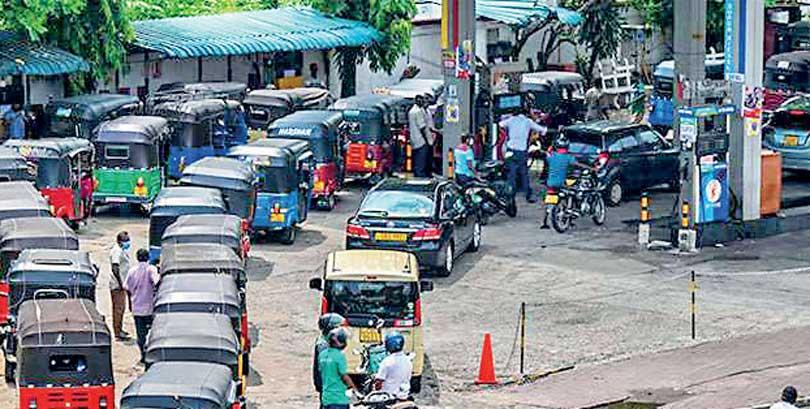
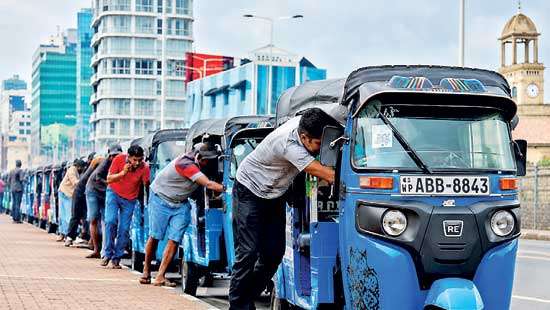
Fuel queues returned following the introduction of the QR code system in early March to manage fuel stocks as a result of the Middle East crisis.
File Photo
 This government in contrast, has not done a major harm commensurate with Yahapalanaya. Instead, the economy under it is in autopilot.
Now, without decisive measures for economic liberalisation and public investment, Sri Lanka is heading to economic doldrums reminiscent of the Yahapalanaya era.
 Government’s critics warn, some with smug satisfaction, that Sri Lanka is yet again heading towards an economic crisis reminiscent of the one during the Gotabaya Rajapaksa administration. Some insist the country is already there or faring worse– their barometer being the oil prices now which are as high as then. Cost-reflective energy pricing in the backdrop of the Middle East crisis may not be the most appropriate measure for economic health. In any measure, the government’s decision to stick to the pricing formula – even though it might have been compelled so due to the commitments under the IMF programme – should be commended. In fact, politically influenced fuel subsidies of the past were a major factor in the foreign exchange crisis, and left the CPC with USD 3 billion losses in its balance sheet when the funfair ended in fuel queues.
The economic free-fall under the Gotabaya Rajapaksa administration may not be the fitting comparison to where the country is heading under the current government. There is a better one: Yahapalanaya, or the good governance government of 2015- 2019. Yahapalanaya is remembered for one thing: inertia - (It was the same culture of inertia and indecision that created permissive conditions for the Easter Sunday attack).
However it was more pronounced in the economic front and revealed the much hyped claims of UNP as competent economic managers as a crude joke. Yahapalanaya took over after a decade of 6.5 per cent annual growth, South Asia’s highest, and immediately flattened it to 4 per cent and by the time it left, the growth was negative. It sowed the seeds of a debt crisis with extensive commercial borrowing, and marked the beginning of yet another lost decade.
There is probably one difference between the Yahapalanaya and the current administration. The Yahapalanaya began its term, first thing in the morning, delivering a fatal blow to investor confidence. It suspended multi-billion-dollar projects, mainly Chinese-funded and some Indian, infrastructure development projects, simply to appease its foreign backers and civil society busybodies, who themselves were bankrolled by the same foreign backers. Impact was devastating and might explain the low economic growth that followed. Sri Lanka is still struggling to recover the lost investor confidence.
This government in contrast, has not done a major harm commensurate with Yahapalanaya. Instead, the economy under it is in autopilot. That does not sound like a major accomplishment, either. Mercifully, the worst fears, such as the prospect of the government prematurely leaving the IMF programme, did not materialise. Instead, it has faithfully adhered to its commitments. That discipline should be commended, but beyond that, there is precious little to show.
A government is expected to play the role of a catalyst in economic development. However, despite the government having failed to do so, the economy grew at 5 per cent last year. That windfall of an economic recovery after a massive compression do not last longer.
Now, without decisive measures for economic liberalisation and public investment, Sri Lanka is heading to economic doldrums reminiscent of the Yahapalanaya era.
The IMF has projected the economic growth for this year to slow down to 3 per cent, largely owing to negative external factors. The Central Bank has warned inflation would hit 7 per cent due to high energy prices. The current account is under stress due to a large oil import bill and lower tourism receipts.
The adverse external factors are not the government’s fault; however, they also call upon the government to take proactive measures to generate growth. Why the government has so far failed in that count deserves deliberation.
The common argument that corruption had hollowed out economic development is at best partially true. The countries that attract most foreign direct investment– Vietnam now or East and South East Asian economies during their high growth years – were not the paragons of virtue. The measures to root out corruption and establish a degree of transparency in economic affairs are commendable. However, such measures would have little overall impact in turbocharging economic growth, unless they were accompanied by investor-friendly economic reforms, and manifest government measures to play the catalyst of economic growth.
Sri Lanka has so far failed to create quality job employment for its youth. Instead, the country’s largest single contributor to foreign remittance is its migrant labour force. Also, for a country that is conspicuously lacking a swelling demographic pressure like India, Sri Lanka has curiously failed to upgrade its workforce, despite enjoying higher-than-average social indicators. Sri Lanka can leapfrog its economy by providing state-of-the-art technical and vocational education to all school leavers who fail to qualify for public universities. To that end, local technical colleges, which operate under various authorities, need to be integrated under a single authority and upgraded to international standards with international cooperation and local chambers of commerce. When there is a competent tech workforce, sans suffocating red tape, foreign investors would come.
Where the government agencies have a historically poor track record in enticing foreign direct investment, the government should allow the local and foreign investors to set up and operate export processing zones, and even Freedom Cities. It could invite Indian tech firms, which contributed to mammoth USD 420 billion service exports last year, to set up economic zones, backed by enhanced skilled labour mobility through something similar to H1B visas. Indians would surely love to work from here, if one is to believe social media posts of Indian tourists ravishing Sri Lanka.
At the same time, the government should cut down its corrosive role by simplifying the investment process.
Local talent and start-ups cannot be fostered without investment. The government can set up a venture capital fund –with substantial capital allocation– to provide seed capital to early-stage start-ups in exchange for a stake. And it can capitalise such a venture by divesting non-strategic SOEs, which are nothing more than job banks for supporters of successive governments.
The government should ask what is holding it back from doing any of these things. Its defenders would argue it’s barely one and a half years in power. But that is more than enough time to make others feel it has an economic vision. For a comparison, much-decried J.R.Jayawardene liberalised the economy, set up free trade zones and completed much of the colossal Mahaweli development program within his term. (Then he brought the whole thing down with complicity during Black July, which is a different matter)
The government should get its act together. If it failed, it would be remembered as yet another failure than Yahapalanaya had been. And worse still, it could sow seeds of the next economic crisis.
Follow @Ranga Jayasuriya on X