Reply To:
Name - Reply Comment
.jpg)
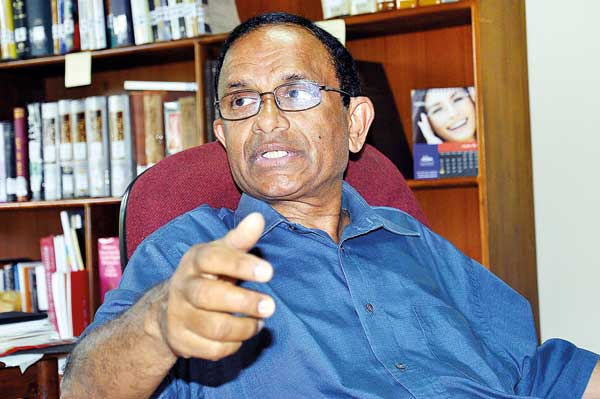
.jpg) Dr. Jayampathy Wickramaratne, President’s Counsel, spoke to Daily Mirror on the executive presidency, earlier attempts to abolish it, proposals made by the National Movement for Social Justice (NMSJ) led by Ven. Maduluwawe Sobitha Thera and the recent proposals made by the United National Party. Dr. Wickramaratne was a Senior Advisor to the Ministry of Constitutional Affairs and was a member of the team that drafted the Constitution Bill of 2000 and also officiated as Secretary to the talks the People’s Alliance Government had with various political parties prior to the presentation of the Constitution Bill. He is a member of the NMSJ as well as of the Lanka Sama Samaja Party. Following are some excerpts from the interview Daily Mirror’s Hafeel Farisz had with Mr. Wickramaratne.
Dr. Jayampathy Wickramaratne, President’s Counsel, spoke to Daily Mirror on the executive presidency, earlier attempts to abolish it, proposals made by the National Movement for Social Justice (NMSJ) led by Ven. Maduluwawe Sobitha Thera and the recent proposals made by the United National Party. Dr. Wickramaratne was a Senior Advisor to the Ministry of Constitutional Affairs and was a member of the team that drafted the Constitution Bill of 2000 and also officiated as Secretary to the talks the People’s Alliance Government had with various political parties prior to the presentation of the Constitution Bill. He is a member of the NMSJ as well as of the Lanka Sama Samaja Party. Following are some excerpts from the interview Daily Mirror’s Hafeel Farisz had with Mr. Wickramaratne.
Q:What exactly do you see as the major flaws in the present constitution?
I think the main problem is the executive presidency. Firstly, it is an executive presidency without any safeguards that are usually found in other constitutions. For example, in the United States there are congressional committees which oversee the administration. Appointments to the Judiciary, even to the Cabinet of Ministers and appointments to important posts are all vetted by the Senate, by congressional committees. Also, there is a lot of oversight by these congressional committees. In the United States, the difference is that members of the Cabinet are not drawn from the congress. For example, Hilary Clinton to become Secretary of State resigned from the Senate and went before the Senate and got its approval before she was appointed.
So the President cannot lure legislators to come over to his side like in Sri Lanka where opposition MPs are offered Cabinet posts to cross over. Legislators of the President’s own party are very independent. 1/3rd of the Senate is elected every two years and the whole House of Representatives, over 450 members, are elected every two years. The voting records of the legislators come under scrutiny. The political culture is different where the voters consider the voting records of their future representatives. Therefore, they act independently. When President Nixon was to be impeached, his own Republican Party members went against him and when President Clinton was impeached, some Republicans opposed it.
Excesses on the part of the executive are pointed out curbed, resisted and criticised by the members of the President’s own party.
In the United States, candidates from the President down to the local level are not appointed by the party hierarchy; rather they are elected by the party members through primary elections. So, the elected representatives can afford to be independent.
In Sri Lanka, the situation is completely different; we can never produce an “Obama” for example. The political culture here is very different from what exists in developed countries.
Thanks to the 18th amendment, we have a strong Presidency. One of the few safeguards, namely the two-term limit was taken away. Impeachment is not a practical safeguard as we saw in 1991. Article 35 specifically states that the President cannot be taken to court even for a violation of fundamental rights. So, I think we have the strongest presidency in the democratic world.
I don’t think you can reform the executive presidency in Sri Lanka because our political culture is different. I think the best form would be to go back to the parliamentary system of government, of course with certain safeguards. Not just go back to the pre 78 parliamentary style, but the 17th amendment can be suitably changed even to fit into a Westminster style of government, so that there are safeguards.
There should be certain safeguards, for example, in the appointment of certain key positions of administration. This would contribute to good governance and national consensus on various issues. What we should aspire to is for national consensus.
The executive Presidency is responsible for a majority of the problems this country is facing. Then, we have the devolution of power, which has its inherent weaknesses and has to be strengthened.
I’m in favour of the Proportional Representation System, but it has completely been distorted in this country due to the “manape”( preferential vote). As a result of this, only people who have money or those who can raise money, and those who are in the pay of businessmen will come forward for elections.
Before 1978, there were ordinary vedamahattayas, school teachers, lawyers who came forward for elections but now such people don’t come forward as they can’t afford it. So the best thing is to have a mixed system, where overall it is Proportional Representation, but you have your own MP for the area. That can be done. It happens in Germany.
Then fundamental rights; our fundamental rights are limited to civil and political rights and their scope is quite narrow compared to modern international standards and our own obligations. We also need to include social, economic, cultural rights, women’s and children’s rights, not merely as declaratory principles of policy but as enforceable fundamental rights. It is the modern trend. It is being done in other countries and it works well in other countries.
The administration and the judiciary should be free from political interference.
Q: Do you believe the masses can push for such reforms, like in Egypt or Libya?
People understand such things. But in third world countries people have the idea of fear or rewards; this is a huge problem in Sri Lanka at present. People go along with the existing governments either for fear or for rewards, more so in Sri Lanka during the last few years.
But that doesn’t mean there is no criticism. If the government thinks there is no criticism, they are living in a fool’s paradise. When there is a real chance for a change in government people will air their views and take decisions. Until then, whatever the government in the centre is, so will the provincial councils and local governments be.
In 2001, when Chandrika was President and Ranil were Prime Minister, at the local elections that was held, the SLFP lost the Bandaranaike stronghold of Attanagalla in a fair election; nobody complained it was unfair and that speaks for itself.
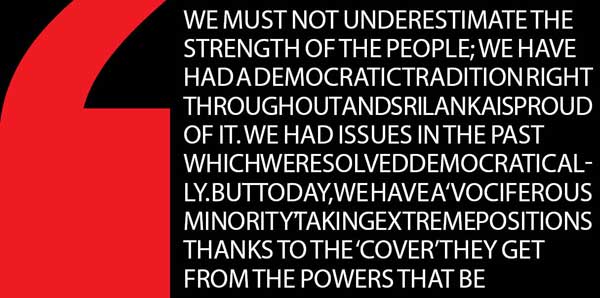
We must not underestimate the strength of the people; we have had a democratic tradition right throughout and Sri Lanka is proud of it. We have had our ups and downs. But today, we have a small but vocal minorities taking up extreme positions thanks to the cover they get from the powers that be.
Q:What are your views on the National Movement for Social Justice?
It is a collection of people with different political ideas. We have a ten-point programme, that is the long-term programme but in the short term, we think what is important is to introduce and put forward immediate demands, like the total abolishment of the executive presidency and the bringing back of the 17th amendment, independent commissions, etc.
I think the best thing is for this government to realise that the people are for the abolishing of the executive presidency and that it is in the best interest of the country as a whole to do so. I’m sure such a bill will be passed unanimously by Parliament supported by the whole opposition as the 17th amendment was passed. That is the best thing that can happen.
Now if that does not happen and this government does not do that, then I don’t think that at the rate things are going you could stop the abolishing of the executive presidency becoming the main issue at the next presidential elections.
Q:But the abolition of the executive presidency has been the issue in repeated presidential elections, wasn’t it?
People have every right to doubt the statements of politicians. In 1994 this was tried out. Chandrika made a mistake by promising to do it within one year. It couldn’t have seen done, because she only had one-vote majority in Parliament originally and she was supported by the PLOTE, TULF, TELO, CWC and SLMC and various parties, some from outside and some from within the Government. She had wide support from the minority parties.
I was involved in the constitutional process and I can say this because I have seen what happened.
The minority parties, the Tamil and the Muslim parties at that time thought the executive presidency was a safeguard for them. And they thought with Chandrika it was ‘double safeguard’.
So they said they would support the abolition of the executive presidency only if in the same amendment there was also power sharing, devolution, etc. So Chandrika, if she brought a bill only for the abolition of the executive presidency, the UNP would have supported it from the opposition, and abolished the executive presidency, and she would have lost the support of the minority parties and would not have been able to make constitutional changes for devolution.
And of course the UNP dragged the select committee process from 1995 to 1997; it ran for more than two years. It was not managed well. It dragged on. When the bill was finally brought in 2000, it was rather late. And at that time UNP scuttled it.
The whole process could have been managed well and it shouldn’t have been allowed to drag on. You can’t make revolutionary constitutional changes in the sixth year, in the last year of Parliament; you have to do it quite early.
Chandrika as President and the whole Cabinet is responsible including people who were in charge of constitutional reform. Chandrika had been re-elected in late 1999 and there was this interim provision for her to continue as executive president for six years and that was foolish of the People’s Alliance to have done that. I must say it was not discussed adequately.
I told the people to whom I could speak that the UNP was not going to accept this and they would not accept six years, but my requests fell on deaf ears.
Finally, when the UNP and the PA agreed on all the other issues and this was the only outstanding issue, then the PA sat down to discuss it seriously. Everybody agreed that there should be a transitional period. At that time I was the secretary to all these talks, the secretary for talks within the PA and the PA and the Tamil parties and the PA and the UNP which happened in 2000.
The PA decided to offer to reduce the period to three years finally agreed, even two years, and by then eight months of her second term had already passed. A particular day was fixed for that and if I remember correctly that day Chandrika was in Kandy to present the proposals that the PA and the UNP had agreed to the Mahanayakes.
She was getting late, so she called Rathnasiri Wickremanayake who was the prime minister at the time and asked him to start the meeting. And I know she also said that we had agreed to reduce it to two years, but if the UNP insists to bring it down to one year.
That day Mr. Ranil Wickremasinghe did not come, Mr.Karu Jayasuriya led the UNP team. And Mr. Wickramanayake said the President is getting late but let us start the meeting and then Mr. Jayasuriya, as instructed by his party no doubt, got up, took the files and said “Sorry, we now think the proposals should be placed before the Maha Sangha” and walked out.
I ran around the Cabinet table, not that I could have stopped him, and said “Sir, don’t do this. Only the UNP can support a constitution from the Opposition, the SLFP would never support you from the Opposition.” He said, “Jayampathy, it is too late now”.
And I know that the following day the President telephoned a top UNP leader, I don’t want to give the name, and said “Let us re-start talks now, I’m prepared to reduce it to one year. Eight months had gone and that means only four months were remaining.” She told me that she had called and that top UNP personality later confirmed to me that she had made the offer. But there was no response.
Then we presented the bill on our own, though we didn’t have much chance of success but we did our duty. These are things that are little known.
We shouldn’t have waited till 2000 to present this proposal. That process, I repeat, there were serious mistakes on the part of the President, the PA, the whole Cabinet including officials like me- we were all responsible. That it got dragged on.
Q:Should we go on criticising about what did not happen in 2000?
I don’t think we should do that. We can learn from the mistakes and I am sure the UNP will also do the same.
The UNP has come out with proposals and I’m happy that they have taken a clear stand on the abolishment of the executive presidency. They have presented three options; one is for an elected head of state with very limited powers, but still executive powers are to be shared between the head of the state, the prime minister and the cabinet, etc.
I don’t think that is a good arrangement, because when you have a head of state with even limited powers but elected directly by the people, at crucial moments he could use those powers claiming that he is directly elected, as a mandate, and therefore in practice convert a parliamentary form of government into a semi- presidential form of government.
The second proposal is to have a directly elected prime minister. They tried it in Israel. You could have a situation where the Prime Minister is directly elected but doesn’t have a majority in Parliament. It can happen. Then the legislative process gets strapped, the budget cannot be passed. Even in Israel they abandoned it after three years.
So the best thing is to go back to the parliamentary form of government. We had it before 1978, we were used to it, but with additional safeguards like the 17th Amendment, etc.
The UNP’s proposals for devolution are extensive. They have accepted the Tissa Vitharana, APRC proposals and other proposals and that’s a very good development. I think a new Constitution should provide for extensive devolution but have enough safeguards to maintain the political and economic unity and the territorial integrity of the country. Let there be safeguards but also provisions to ensure that the centre cannot misuse these safeguards.
But I think, a new fully-fledged constitution, if we start discussing will be difficult to have broad consensus. It will have to come in stages.
I think the executive presidency should be abolished first, limit the cabinet, have the 17th amendment back even with the parliamentary form of government, democratise the whole system, independence of the judiciary ensured and the independence of the police and public service and then you have a more democratic framework and then you can look at the other issues.
Let the new parliament take over all the headaches of the country, including the ethnic issue, fundamental rights and all the issues.
Q:Do you think this is possible with this government?
With this government, it depends on the pressure from the people. If there is pressure from the people, if the government thinks that making abolition of the executive presidency the single issue at the next election, it will not be in their best interests.
Then it will automatically happen. It will be the single issue at the next election. There is a possibility that all forces will get together, from the TNA to the JVP including people in the government who are opposed to the executive presidency, they may agree on a limited political platform to abolish the executive presidency. That can happen.
Q: Do you think any President will give up powers?
This is a valid question. A constitutional amendment should be drafted and that should become the manifesto of such a candidate. It must be presented to the people. Take the past. We have had such leaders. From the left it was Colvin R. De Silva, Sarath Muttetuwegama and Vijaya Kumaranatunga. Each of them would have done it and gone to parliament. Dudley Senanayake would have done it, Anura Bandaranaike would have done it, Mrs. Sirimavo Bandaranaike would have done it. They all would have done it. So why should we think there is nobody?
It also depends on political pressure, parties have to work it out in such a way that people will have confidence in them and the candidate who is presented.
All of this need not happen if the government abolished the executive presidency itself. I’m against a half-way house such as a so-called reformed presidency. It will not work in our political culture. We should go back to the parliamentary government system with safeguards.