Reply To:
Name - Reply Comment
.jpg) By Kamal Nissanka
By Kamal Nissanka
When notices were sent to the Hon Speaker, the President and the members of the Select Committee impeaching the Chief Justice by the registrar of courts, the Speaker and the leader of opposition were vociferous about the notion of supremacy of parliament and they seemed not to heed the Supreme Court request/order to appear before or submit objections on pending cases against them. They by now should know that only the President of the country under the constitution is immune to litigation. If the parliamentarians concerned had thought that they were also citizens of Sri Lanka as us, they would have readily abided by the Supreme Court directive until the constitutional issue before the court is finally determined. Unfortunately Hon Speaker further kept a step forward and related a speech delivered by Mr. Anura Bandaranaike, then Speaker of Parliament in 2001 upholding the idea of parliamentary supremacy when there was an stay order against the then Speaker.
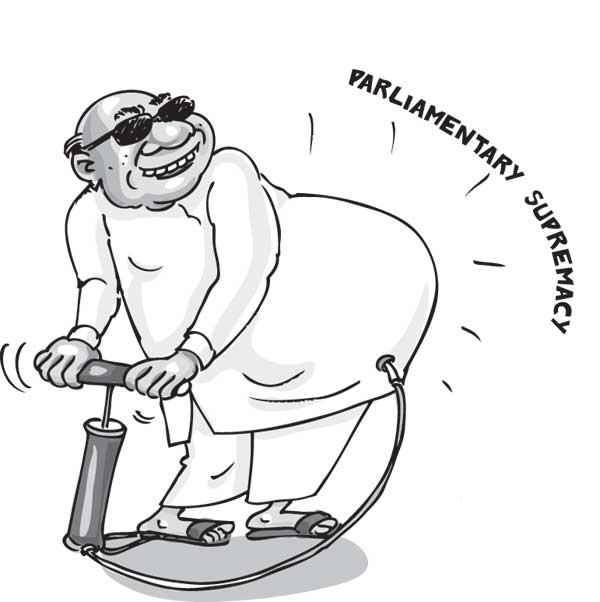
Now if one goes to the root of the logic behind the Speaker’s speech one can understand that what the Speaker believed was that parliamentary supremacy could not be infringed by other outside body. It is worthy at this stage to note that belief of parliamentary supremacy is a notion evolved in the United Kingdom where there is no written constitution. In short parliamentary supremacy can be defined as the power of parliament to make laws and unmake laws.
The 1978 Constitution which has lasted for over 30 years now is somewhat different from the two earlier constitutions. The founders of the Constitution have clearly deviated from the British tradition of constitutional theory. Prof.A.J. Wilson, former professor of Political Science, University of Peradeniya declared that the 1978 Constitution had been extensively influenced by the present French Constitution. The 1978 Constitution took a quasi-federal nature with the introduction of 13th amendment and parliament lost some of its powers regarding some subjects and lost soul supremacy over legislation.
The 1978 Constitution explicitly says that executive power shall be exercised by ‘the President of the Republic elected by the people “(not by parliament). So this is also a clear deviation from the British tradition of parliamentary supremacy. True that ministers who are also said be in the executive branch are chosen from the parliament but they are subordinated to the President who can keep any ministry or department under him. They do not enjoy the prestige they had under the British tradition. The President through the cabinet can make the parliament his appendage and the dignity of the parliament is completely eroded, added by the PR system of electoral method which allowed all sorts of anti-social elements to enter into parliament. Parliament is further devalued because the President can dissolve it after one year of an election.
The position of judiciary is made explicit under the 1978 Constitution. According to the Article 118, the Supreme Court is the ‘highest and final court of record’ in the Republic. It has jurisdiction in respect of constitutional matters, for the protection of fundamental rights, consultative jurisdiction, and jurisdiction in election petitions including the election of President. It also has jurisdiction whether to determine a bill was consistent with the constitution. This jurisdiction can invoke by the President or any other citizen. Its determination is sought of regarding urgent bills which the cabinet thinks to pass urgently for national interest concerns. It has jurisdiction to determine the validity of the expulsion of a member from a political party. It has a role to play in the impeachment of a President of the Republic. Therefore it is very clear that the Supreme Court under the present Constitution is a very powerful body that is endowed with important national responsibilities. Further the Constitution has endorsed the idea of an independent judiciary.
Standing orders cannot be considered as law by any learned person in the legal profession. Under our legal system laws are legislation, decided cases, customs and may sometimes international covenants. Standing orders are procedural regulations. Further they cannot be formulated against the provisions of the constitution. Rules and regulations are there in various corporations, companies, societies to conduct their day to day activities. Can an outsider be brought to face trial on the basis of these regulations? Is that justice? Is that rule of law?
When there is matter before the Supreme Court to be decided, specially a matter of interpretation it is the sacred duty of all law abiding persons to obey its directives. Under our constitution people are sovereign and the constitution is supreme not the parliament. This is what is called constitutionalism, a legal philosophy derived from the famous case in the United States of America, Marbury Vs Madison, 1 Cr. 137 (1803) decided by John Marshall ,CJ. The decision held that:
“Congress does not have the power to add to the original jurisdiction of the Supreme Court; thus, the available remedy mandamus, was unconstitutional... So, if a law be in opposition to the constitution; the court must ...decide that case ...comfortable to the constitution disregarding the Congress...”
In conclusion it could be said that the idea of parliamentary supremacy which both the Hon. Speaker and the Leader of the Opposition attempted to uphold in a holy manner is an outdated and obsolete political-legal concept which has no relevance in the present constitutional framework of Sri Lanka.