Reply To:
Name - Reply Comment
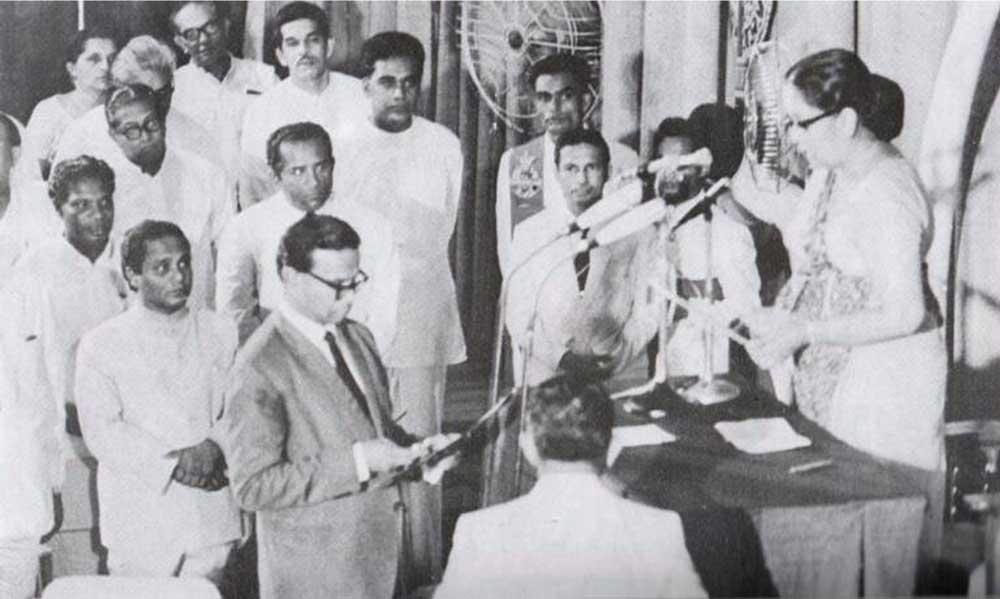
On May 22, 1972, the adoption and enactment of the new Constitution was certified, henceforth marking the establishment of the Free, Sovereign and Independent Republic of Sri Lanka
 Today, the 22nd day of May, is the 53rd anniversary of the Republic of Sri Lanka. It is not a national holiday. The government has chosen not to celebrate it. It has instead preferred to honour the 4th of February, the day on which, through the good grace of the British monarch, Ceylon graduated from a Crown Colony into a British Dominion. I do not seek to belittle the efforts of D.S. Senanayake and Sir Oliver Goonetilleke, who, in the midst of a world war, succeeded in securing the self-governing status of Ceylon. Our neighbour, on the other hand, celebrates its Republic Day, 26th January, with spectacular cultural pageantry, while also marking August 15th as Independence Day.
On May 12, 1946, King George VI, by an Order-in-Council issued at the Court of Buckingham Palace, provided a Constitution “for the Island of Ceylon”, and expressed the “sympathy” of His Government, “with the desire of the people of Ceylon to advance towards Dominion Status”. On December 10, 1947, a Bill passed by the British Parliament and assented to by the King provided that “as from February 4, 1948, His Majesty’s Government in the United Kingdom shall have no responsibility for the government of Ceylon”, and “Ceylon shall be included in the definition of ‘Dominion’ in British statutes”.
Contrast that with the events that followed the general election of 1970. On July 19, 1970, the elected members of the House of Representatives met at Navarangahala, a theatre hall in Colombo, on the invitation of Prime Minister Sirimavo Bandaranaike and proclaimed themselves the Constituent Assembly. In the months that followed, under the direction of the Minister of Constitutional Affairs, Dr. Colvin R. De Silva, they proceeded to draft a new constitution. On May 22, 1972, in the presence of a large and representative gathering that included the Judges of the Court of Final Appeal and the Supreme Court, the adoption and enactment of the new Constitution was certified, and the Free, Sovereign and Independent Republic of Sri Lanka came into existence.
What took place on May 22, 1972, was an exercise in autochthony. The government of the day had a comfortable two-thirds majority in the House of Representatives. With that majority, the government could have comfortably proceeded in the conventional manner and replaced the 1946 Constitution with a new Constitution that declared Ceylon to be a Republic. But, for the architect of the new Constitution, it was unthinkable that the Dominion of Ceylon should break its ties with the British Crown and declare itself a Republic through the exercise of powers granted by the British Crown through the 1946 Order-in-Council issued from Buckingham Palace. As the new Constitution declared at the outset, “Sovereignty” is in the “People” and is inalienable. Sovereignty no longer flowed from the British Crown. From the perspective of Dr. Colvin R. de Silva, it was through an essentially revolutionary process that the people of Ceylon should completely sever their connections with the British Crown.
Dr Colvin R. de Silva was uncompromising; nothing would divert him from his revolutionary journey. It was a bold, idealistic, even romantic exercise in autochthony. J.R. Jayewardene, the Leader of the Opposition, shared the excitement of the exercise. He expressed himself thus:
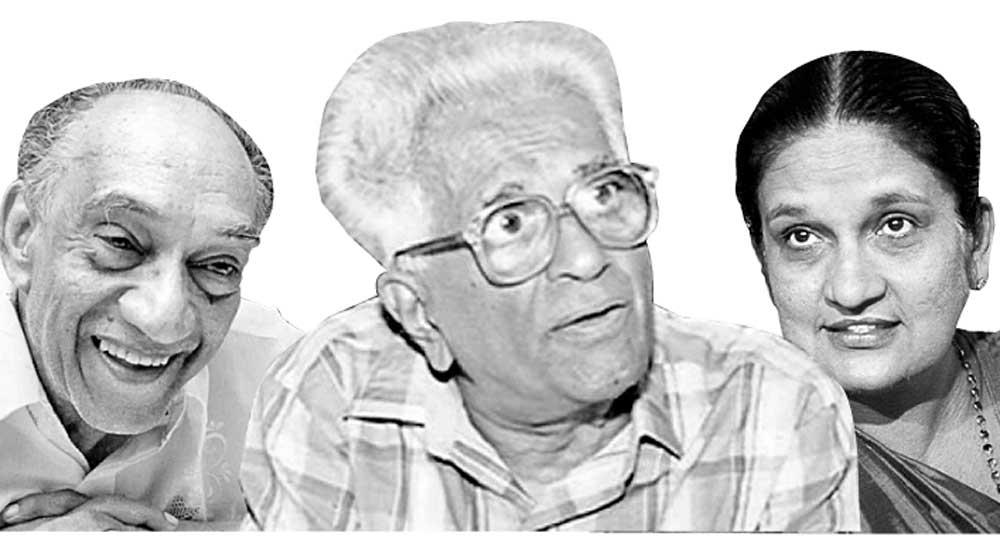
Government architects then Prime Minister Sirimavo Bandaranaike and Dr Colvin de Silva, with opposition support from J.R Jayewardene, established the Republic of Sri Lanka in 1972
“If, however, the victors and the vanquished – the vanquished on this side – agree to make common cause in enacting a new basic law by means of a legal revolution, there is no law that says you cannot do so.”
While I did not agree with some of the features of the 1972 Constitution, I was privileged to have played a small part in helping to steer the process successfully through a minefield of legal and constitutional obstacles, and the wholly unexpected insurgency that broke out like a whiplash in all its fury on April 5, 1971.
Why do we choose to ignore the 22nd of May – the anniversary of the day on which this country made that unique unilateral Declaration of Independence, and emerged as the Free, Sovereign and Independent Republic of Sri Lanka?