Reply To:
Name - Reply Comment
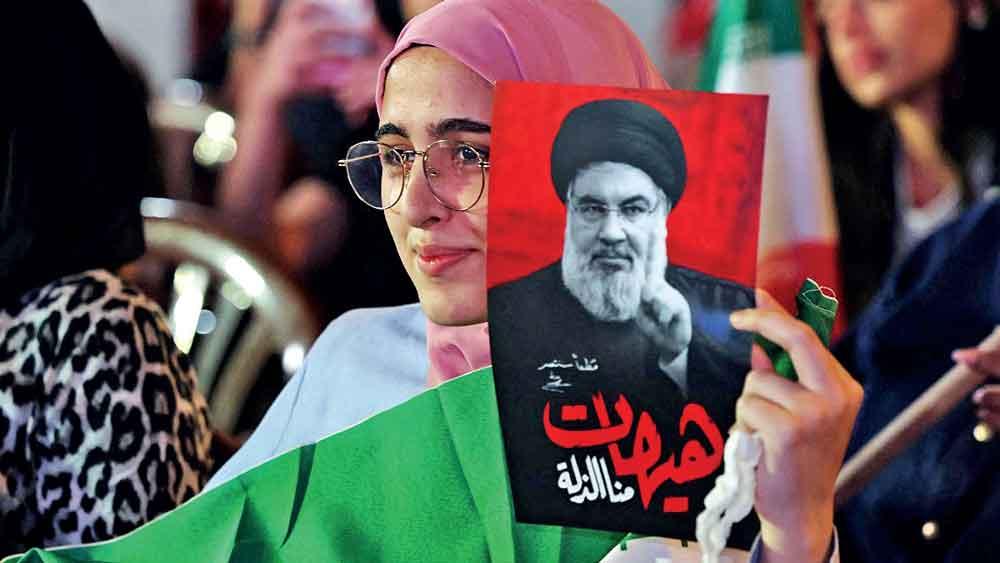
A Hezbollah supporter taking part in an anti-US and anti-Israel protest in Beirut’s southern suburbs on Wednesday. AFP
 Although US President Donald Trump insists he is in control of the war, this week’s escalation — sparking fears of a resumption of the war— demonstrates that Israeli Prime Minister Benjamin Netanyahu has his say and way.
Trump may be pressing for a deal to end the conflict, and Iran may be prepared to make concessions for peace, but Netanyahu knows how to scuttle it. If the war’s trajectory favours Israel, it not only secures Netanyahu’s political survival in the October election but also advances the Zionist ambition of weakening West Asian nations to achieve their goal of Greater Israel.
Whatever progress the US and Iran achieve on the peace front, Netanyahu undermines it with brute force, constant escalation, manufactured crises and arm-twisting US leadership. It has become a familiar pattern: whenever Washington and Tehran approach a deal, Israel intervenes to sabotage peace. The latest escalation comes as a Qatari delegation was in Iran, fine-tuning a possible deal.
Trump recognises Israel’s manipulative strategy but ultimately falls into its trap, as seen in this week’s US military escalation against Iran. Trump may lash out at Netanyahu with profanity, and his advisors may urge him to prioritise America’s interests, yet his actions ultimately serve Netanyahu — at the expense of the American working class, burdened by rising fuel prices and living costs. His actions only give credence to claims that Israel has a hold on him. It may be the Epstein file or the Zionist lobby’s undue influence on US politics or both.
His actions have also sparked a pressing question: who controls whom? On social media, the debate has gone mainstream, with many Americans — particularly progressives — asking whether Trump is making America great or Israel great.
Growing discontent has led Trump to claim in media interviews that he is not controlled by anyone; he alone controls the war and will soon secure a peace deal.
Since the April 8 ceasefire, Trump has been asserting that peace is within reach, yet each claim has been undermined by a fresh violation. Israel, driven by its appetite for war, cannot be happier. Meanwhile, the rest of the world — especially developing countries — watches millions slip into poverty as foreign reserves deplete and economic growth slows.
As the conflict aggravates, it threatens to devastate not only West Asia but the wider world. Not all nations can absorb the shock. The wealthy may endure it, but the poor are doomed.
Far from issuing a powerful appeal for peace, neither the United Nations nor the G77 — representing some 130 developing countries — has taken effective measures to mitigate the war’s impact on poorer nations. The US-Iran peace process remains at the mercy of the warring parties themselves. Countries such as Pakistan and Qatar play limited diplomatic roles, yet there is no concerted global effort to end the conflict, even as poorer nations suffer most and become its greatest collateral.
The inaction of Third World nations contrasts sharply with their active peace-making role during the Cold War, when they played a key role in ending crises such as Hungary in 1956, the Suez conflict the same year, and other flashpoints. Today, the greatest handicap of the Third World is a leadership vacuum — unlike the halcyon days of the Non-Aligned Movement, when leaders of India, Egypt, Indonesia, Sri Lanka, Ghana, Tanzania, and Yugoslavia collectively promoted world peace and championed the developing world’s cause. Sadly, no leader in the G77 has appealed directly to Trump, explaining the economic blows poor nations endure and their hopes for peace to revive their economies.
It may be wishful thinking to expect the self-centred Trump administration to act altruistically and end the war for the sake of developing nations. Empathy has little place in Trump’s foreign policy. Will a man who has slashed US humanitarian assistance programmes and imposed tariffs at will on poorer nations care about the war’s disastrous consequences for them?
Regardless, Trump escalates the war, believing escalation is the best path to de-escalation. This policy, sans its de-escalation goal, aligns with Netanyahu’s mission to destabilise the region.
Lebanon, where Iran-allied Hezbollah militia is resisting Israeli aggression, was understood to be part of the April 8 ceasefire deal. Israel disagreed. Had the US pressured Israel to comply, peace between Washington and Tehran might already be a reality, with oil and gas flowing freely through the Strait of Hormuz. Instead, lacking the courage to rein in Israel, Trump followed Netanyahu’s agenda, enabling Israel’s genocidal campaign in Lebanon. As a result, the peace process was undermined, and tensions in the Strait of Hormuz escalated into attacks and counterattacks between the US and Iran. Yet both sides avoided labelling the flare-ups as a resumption of war.
The dangerous escalation of the past two weeks pleases Netanyahu. He gets what he wants. Iran had warned Trump that if Israel attacked Beirut, the peace process would collapse and Iran would strike Israel. To save the peace talks, Trump urged Netanyahu to spare Beirut and even warned Israel that it would have to fight alone. Netanyahu defied him. Trump did nothing. Iran attacked Israel, prompting retaliation.
Moreover, the US, amidst tit-for-tat strikes between Israel and Iran, attacked Iran, unprovoked, demonstrating that despite differences, Washington intervenes whenever Israel is attacked. The US excuse was that Iran had downed a US Apache helicopter in the Strait of Hormuz — a charge Iran denied. The US then bombed Iranian cities along the coast, and Iran retaliated by hitting US bases in Kuwait, Bahrain, and Jordan, with reports claiming several F-35, F-16, and F-15 jets have been destroyed.
The US launched a second wave of strikes deep inside Iran on Wednesday. In response, Iran announced a complete blockade of the Strait of Hormuz, driving up oil and gas prices. Trump halted further exchanges, claiming he had spoken directly with Iranian leaders who asked him to stop bombing. He warned, however, that he reserved the right to strike again. Iran dismissed these claims.
The biggest miscalculation Trump made was underestimating Iran’s willpower to fight. As we have noted before, the greatest strength of Iran’s strategic culture lies in its embrace of suffering. In enduring hardship, Iranians relive the memory of Karbala — a key event in Islamic history, when the Prophet Muhammad’s grandson and his unarmed supporters were massacred by a tyrant from the Umayyad dynasty after a long and painful siege, during which even children were denied water.
The more suffering the Iranians are inflicted with, the more deeply they identify with Karbala, and the stronger their resolve to resist oppression.
Thus, Iran is not a nation the US can subdue with military power. Yet Iranians are also rational and peace-loving. All they ask for is peace built on mutual respect, but many of their proposals to end the war have been spurned by Trump, who escalates the conflict without realising he is only prolonging it.
Trump’s military moves towards escalation have further complicated the search for peace. Iran has now completely closed the Strait of Hormuz as a way of pressuring the US. The world cannot remain idle while the global economy hurtles towards ruin. As the war escalates, peace efforts also should escalate.