Reply To:
Name - Reply Comment
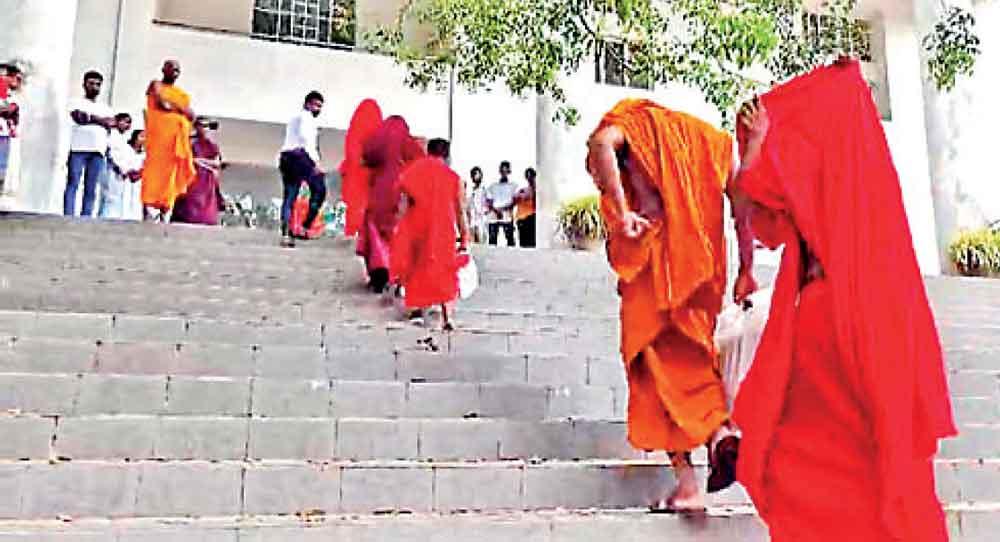
The monks allegedly involved in drug trafficking appearing in court
 We are never short of scandals. The latest concerns a Buddhist monk – the chief prelate of eight of the holiest Buddhist shrines in Sri Lanka, no less.
And many have already forgotten the last one concerning Buddhist monks -- 22 young Buddhist monks and a 23rd organiser monk were arrested at the Bandaranaike International Airport in Colombo, Sri Lanka, trying to smuggle in over $3.45 million worth of Kush and Hashish. This was in late April, barely a month ago.
These are ongoing court cases, and people accused of crimes are not guilty till a court finds them so. But, it is interesting comparing the public reaction to these two cases. They are worlds apart. When the story broke, the shockwaves were entirely different.
In the Anuradhapura case, there were two camps – those outraged by the monk and his alleged sexual abuse of an underage girl, and those outraged by the very fact such an allegation was levelled at such an illustrious personage.
It doesn’t need a census to figure out that the second camp was by far the bigger, the majority. The first was a vocal minority. The outrage levelled at them was overwhelming, but fortunately they were not overwhelmed. The war between these camps will only grow more intense when the court case gets under way. The same disparity between the two camps is blatantly evident in the legal help that was volunteered to accuser and accused. The monk’s legal supporters number more than thirty, including some formidable reputations while the lawyers who offered help to the victim were mostly state-sponsored, with no big names among them.
Now let’s compare this situation to the drug scandals. This time, the outrage wasn’t divided into two opposing camps. It was unanimous. There were no lawyers volunteering legal aid to the accused monks, and so many voices were demanding their expulsion from the clerical order. The Sangha hierarchy immediately vowed to do so. It was unanimously agreed that the accused monks had disgraced the Sangha and Buddhism.
In Ven. Hemarathana’s case, he has reportedly been removed from his high-ranking position, but no one is saying publicly that he has disgraced the sangha and religion. Rather, It’s those who spoke against him who got accused of disgracing the Sangha and Buddhism. One of his legal representatives recently stated that this criticism amounted to an assault on Buddhism. But let’s try and see this from a purely legal standpoint.
What is more serious in the eyes of the law? Sexual crime, or drug trafficking? Laws against these crimes differ from country to country. In Sri Lanka, possession and trafficking of narcotics ranging to cannabis to heroin is seen with great severity, and can land those convicted from a few years in prison to a life term (commuted death sentence), along with fines.
Now when it comes to rape, penalties generally range from seven to 20 years of rigorous imprisonment, plus fines and mandatory compensation paid to the victim.
Stricter penalties, including a minimum of 10 years imprisonment, apply to statutory and aggravated rape cases. Clearly, legal punishment for rape is lesser than it is for drug trafficking. There are currently 48 individuals on death row for drug-related offences in Sri Lanka. But, as far as can be determined, there are none there convicted of rape, unless it’s rape and murder. While the exact breakdown for rape is not published, the majority of the overall death row inmates are convicted of murder and serious drug-related offences.
Sex with an underage girl (below 16 years) is considered to be statutory rape, which is serious.
A government statement released in parliament in May 2012 said that of the 1,450 female rape cases reported in 2011, child rape accounted for 1,169. But, according to the National Child Protection Authority (NCPA), the situation is far worse than what is being reported to the police, and the authority estimates that over 20,000 cases of child abuse may have occurred in the first half of 2012.
The Anuradhapura case has stirred a hornet’s nest, with activists claiming that the reported cases are only the tip of the iceberg.
The public’s ambivalence regarding rape in this Buddhist-majority country is very clear. When drug trafficking is committed by laymen, it is an unpardonable offence, no matter what the offenders’ religion may be.
When monks are accused of drug trafficking (they have not been found guilty yet) it is even more unpardonable, a heinous crime.
When rape (whether concerning adults or underage girls) occurs, public opinions seem to be more divided, with victims often accused of colluding with those accused. This has already been done in the Anuradhapura case, with charges levelled at the victim’s mother, too.
When the accused happens to be a Buddhist monk, the ambivalence is replaced by outraged certainty – it can’t happen, the victim is lying, it’s a plot to defame Buddhism.
Another factor to consider is the accused’s social standing. His exalted position in the order puts him in the ranks of the elite, and the political and legal elite rushed to his defence when the news first broke. Everywhere, the theory is that the elite can’t do wrong, though there is overwhelming evidence, including the Epstein files and the Vatican cases, to prove otherwise. In the enlightened West, they are doing their best to suppress the Epstein files.
Getting back to the drug scandal, all those monks including the organiser were very ordinary members of the Sangha – hardly the elite. The media has a derogatory term to describe a Buddhist monk who has disgraced the order – ‘cheevaradhariya.’
All twenty three became cheevaradhariyas overnight, even though none have been proven guilty in a court yet. There were pictures of the contraband seized by the customs. The customs doesn’t pass verdict, but the media and everyone else has assumed this to be an open shut case.
No one has dared to pin that nasty label on the former prelate of Anuradhapura. His defenders would argue that the evidence against him isn’t so ‘open and shut.’ But here is lies the damning ambivalence of the Sri Lankan psyche. Whether its drugs or sex, the elite simply can’t do wrong.