Reply To:
Name - Reply Comment
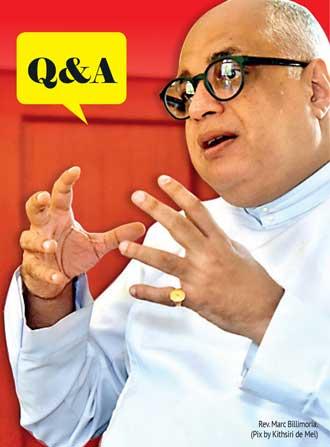
 Celebrating 175 years in Sri Lankan education, S. Thomas’ College Mount Lavinia has gifted some of the most important citizens to the country’s history, heritage and development. As ‘the school by the sea’ celebrates dodransbicentennial (refers to the 175th anniversary), Daily Mirror had a conversation with the immediate past Warden, of S.Thomas’, who himself is a proud product of this hallowed institution. The 20th Sub Warden of the college and then moving onto becoming the Warden in 2015, Rev. Marc Billimoria was a student from 1980 to 1990. Immediately after leaving school, he started as a teacher at the school. Billimoria joined the Church of Ceylon as a clergy and was ordained as a Priest on December 21, 2002. Rev. Billimoria shared some of his experiences and thoughts about being a student of the college and the importance of education.
Excerpts of the interview
with Rev. Billimoria.
 Q Education is an important aspect in everybody’s life. Being an educator and a teacher at one of the well-known education institutions in Sri Lanka, how do you see education in the current context and how important is it for the country?
I think education is what will decide the future of the country. Because it is our children and our youth who are the future and unless they are educated to take on the challenges of the future, then there is not much that we can talk about. But when I refer to education, I refer to it in the broadest sense; where we look at education for life, where young boys or girls are taught the lessons that are important to live a life beyond what’s in the books and the classroom. So for me, education would have to include so many things; not just what’s considered as book learning and exams, but sports, societies and clubs, other involvements and different things that will produce an all-round product that will go out into the world and basically influence the world to be a better place. The potential in education is to change society and the transformation is something that we need to hold on to as educators.
Q You started as a teacher here and now you have entered the history books as a former warden. We now see that when you say education, as you rightly said, some people pass exams, but at the end of the day, when they go to the society, they don’t know the way they could resolve and also all of a sudden we see people who fail exams, but they do wonders in the world. So what is this miracle?
I think it’s because our education system is very old and requires reform. I think it does not adequately address the natural skills and aptitudes of our children. The system requires everyone to be the same. It’s what we call a standardised system, so you have a standardised syllabi, you have standardised textbooks, you have standardised teacher guides, you have standardised exams and standardised examination evaluation. Everybody is measured at the same level.
Some students are academically inclined, and they will pass their exams well. Others are not academically strong, although they may pass exams adequately or sometimes find it difficult to pass it. But they are more adept to the realities of life.
Their adaptability and their creative spirit are little bit more than some who are only focused on academia. So what we should aim at in our school system is to not have standardisation, but to take note that all children are different, that all children learn differently and they learn at different levels. But at the end of the day, what we need from our children going out into the world is the ability to adapt and face the challenges of the world with resilience, courage and all that is required to face the new world.
So I think some children who don’t do too well at school exams end up doing very well in life because their ability to integrate and adapt to the rigors of the real world tend to be a little bit better than some of those who are only focused on learning. But our system, unfortunately, is a system of standardisation. We expect everyone to do the same without realising that not every child is the same.
Q And what practical measures have you taken? What is happening in these circumstances as far as you know?
Well, being a private school, even though we are a government approved private school, while we prepare our boys for government exams, we also have some freedom to do other things in the school that build the other side of what we are looking for. So we have even introduced extra things for example a programme called the Sound Mind Sound Body Programme which my predecessor introduced.
It’s a syllabus that prepares children and young people from Grade 1 right up to Advanced level as to how to live in community, prepare them to deal with relationships and prepare them to respect each other. The basic principle is respect. It teaches how to respect yourself, how to respect others, how to respect your elders, how to respect the community, how to respect even differences because, as I said, we are in a multicultural, diverse society. So how do we learn to respect each other despite our differences? So we have that programme.
Plus through our sports, we give leadership the credit. Because when people take up sports, they take up leadership, that’s a credit. Clubs and societies, we have 50 plus clubs and societies in the school. And through those clubs and societies there is development of leadership, working together in teams, problem solving and critical thinking. These are things that you don’t get in the classroom. Classroom is syllabus; A to Z, term 1 to term 3. You finish, you do exams, that’s it. But all these other things come through. We have 28 sports and other things like bands and orchestra and drama, you name it, it’s here. There is a possibility of catering to the needs of the students. So through those activities we try to build the other side of what education must be. For me, my vision for education is the same vision that our founder Richard Chapman had. Chapman’s idea of education was that it’s not just book knowledge, it’s not just for the intellect, but to prepare the character of the future man. And he said it is to establish his principles, to make him good as well as wise. No point having a person with all the book knowledge if he is not a good human being.
So all the things that we do here through all our other activities, extracurricular activities and cultural activities, is to make them all-round products. Our students can go out into the world and make a positive, wholesome contribution.
Q And as you rightly said, it was 174 years ago. And this year marks 175. So how are those values important now? Have they been changed or expanded?
I don’t think it has changed. I think they have gone through the different societal fluxes. Whenever society has had their challenges, we have moved on. But one thing which has remained constant here and I think many of our old boys who are out there will agree with me, is that our school has always been an inclusive community. From the very beginning it was started to be a training college for Anglican priests. So the emphasis was mostly on having Christian students. But very early in the time, non-Christian students also started enrolling. Now in the present climate, we have evolved into a community. We are a Christian school, but we are a multicultural school in which everybody is included equally.
So for example, when we appoint a head prefect, we don’t see whether he is a Christian, Buddhist, Muslim or a Hindu. We just see what sort of qualities he is carrying if presented with leadership. So even our staff appointments are not made based on any racial or religious biases.
We see whether those people are suitable to lead. Of course, being a Christian institution, our top leadership, the head has to be from the Anglican Church or a church that is related to the Anglican community. But apart from that, everything else is equal opportunity. We value that diversity and that is something that has come all along from the beginning. There has never been discrimination based on race, ethnicity, religion, caste or class.
Q Yet there is an allegation that this school is only for a certain class of people or elite section of the society?
Yes I know people think that we are an elite school, but actually that is in the minds of people looking at this school from outside. We have a beautiful spread of different communities in the school which we celebrate as part of our ecosystem. The chapel is the heart.
But even for a non-Christian child, the chapel is special. I’ll give one example. In the 80s, we purchased a new electronic organ for the chapel and to get that down, they needed some financial guarantors. Three old boys came forward to offer guarantors and all three were non-Christians. They didn’t need to do that for the chapel but the chapel, even though it’s a Christian place of worship, has been special to even the non-Christians. Because the school has not discriminated whether they are Christian or not.
So I think that is something that we value very much with regard to our ethos in the school. And something that we hope we will be able to contribute to our nation. As for our integrated community, the differences that exist in the outside world don’t really influence us in the school. And we hope, therefore, that when our boys walk out into the world, they will be free of prejudice and free of narrow-mindedness and that they will be people who will embrace people from different walks of life in the society.
Q This is a school dedicated to boys. Any plans in the future to expand it?
Well, that’s an interesting question. If I were to stay for a little longer, I would have definitely pushed for that. Because I think the time has come for us to integrate fully. We have girls in the nursery and I would have loved to have introduced girls in the primary school. At least up to grade 5 and then slowly over the years, push it up even further.
When I was headmaster at S. Thomas’ College, Gurutalawa, we had girls going right up to Ordinary Level and we had a boarding section for them as well. I think the time has come for us to be co-ed. But there are lots of challenges in going down that road. We have sister schools who are providing that service and we don’t want to have a bad situation where we will be having a co-ed system where they will lose out. So there are lots of challenges. It’s not easy. But the ideal vision is that someday we
should be co-ed.
And that has to be given some thought going forward; even if it’s not at the present time. But we have made a start with the nursery.
QHow did you end up becoming a teacher?
Well, I entered education because of my warden at that time. He had an amazing capacity to identify talent in boys that even the boys had not identified themselves. I remember one day he told me, he knew that I wrote well because I was writing articles for the school magazine. Then he asked me what my plans were after leaving school and responded saying I had not made any plans. He invited me to teach. That was in 1990. I thought the man had to be mad.
I have never had that gift. When I started only I realised that he saw something which I didn’t see. So, I started my teaching career in 1992. And then in 1999 I went to train for the priesthood and I didn’t think that I would return to education. In 2007, the school in Gurutalawa was experiencing a challenging time. It was almost closed down. Lots of indiscipline, lots of problems and even buildings were in a bad state. It was a terrible story. And the Bishop of Colombo at the time, Bishop Duleep de Chickera, who also was the sub-warden here when I was in school, asked me one day, do you think you would like to go back and work in a school? So, I said, Bishop, I have never thought about it because I gave up on teaching to become a priest.
He said, I have this problem in Gurutalawa and I need a person with some vision to go there and work. I said, I would like to go and see the place. So, my wife, two children and I drove to Gurutalawa one morning in 2007.
And I tell you, I was ready to run away from there when I saw the place. It was such a mess and I thought to myself, how can a school like this exist? Anyway, that day we also met a very senior priest who had been working in that school for many years and he just told me one thing. “What this school needs is a headmaster who has a love for children and a love to see them blossom”.
And I took up the challenge. I was there for four and a half years. When I took over the school, there were less than 200 children and when I was leaving there were over 550 children. Slowly we built from the base. We looked at every building and started renovating slowly.
Every month we had to balance our income with our expenditure. My first priority was to pay the teachers. So we used to sit, go through how much money we had in the bank and slowly do that.
When I took over the school, there was no savings. When I left the school, we had so many millions as savings and then of course I was brought here to be the sub-warden.
Q One last question. Is there any specific model for Anglican education and the church?
Well the Anglican Church runs eleven schools now in this country. They had many more before the takeover in 1962. But these eleven schools remain. I think one of the things that Anglicanism offers is a type of Christianity which emphasis on the all-round development of a person.
The Christian understanding of the human being is that every person is created in the image of God. And I think the Anglican emphasis is building a culture where that image of God is respected in everyone: Inclusive understanding.
You can be different to me. But I am a human being and I exist because of you and you exist because of me.
We depend on each other in our common humanity. I think that is a very Anglican Christian understanding and without that the world will be a different place. I mean all our religions teach it; one way or another. Whatever language we use, the principle is the same.
You know we are all human beings together in this common home. We need to be able to live together with our existence. In that sense this is the most wonderful place as a country with so many religions. Our problem has been that we have forgotten our commonness. But in schools we can still build that. If schools don’t build that then where is it going to be built?