Reply To:
Name - Reply Comment
 After bombing the deep underground nuclear facilities of Fordow and then loudly musing over the regime change of Iran, America’s President Donald Trump on Tuesday mediated a pre-dawn ceasefire between Iran and Israel.
The ceasefire seemed to save the Ayatollahs of Iran what they most valued: A tyrannical clerical regime of which offensive capabilities have seriously degraded, but not its suffocating hold over the Iranian people.
|
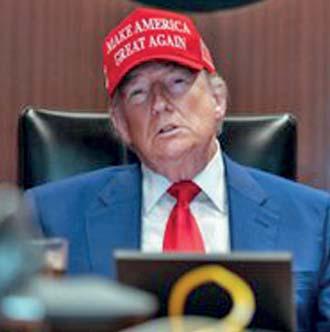
President Trump in the Situation Room during the tumultuous days. (Source: @WhiteHouse on x.com) |
However, Trump also helped avert a global economic crisis arising from a protracted conflict. Iran’s closing or mining of the Strait of Hormuz, through which 20 per cent of the world’s oil and gas pass, could have led to a supply crunch and skyrocketing prices.
About 20 million barrels of oil pass through the Strait of Hormuz, a main maritime choke point of which narrowed point is barely 33 km wide, and 82% of oil and gas passing through the Strait is destined for Asia. The Resultant inflation in the global economy, already impacted by Trump’s trade war, would have a severe economic impact, leading to stagflation in the most affected countries.
The other spillover effects, such as the decreased remittance from the workers in the Middle East, would aggravate the economic woes of many Asian and African countries, including Sri Lanka, which is recovering from the worst-ever economic crisis.
Sri Lanka’s petroleum imports in 2024 were estimated at $4.3 billion. A ten per cent hike in the global oil market prices could have cost an additional $400 million, as much as the government spending on the Aswesuma welfare scheme.
The impact of the easing of violence was immediate: As the fears over a supply crunch eased, after Iran chose not to obstruct the Strait of Hormuz following American bombings of its nuclear facilities, oil prices dropped dramatically by 7 per cent on Monday and by another 5 per cent yesterday.
The ceasefire came into effect hours after Iran carried out a largely performative and symbolic missile attack on the American airbase in Qatar, which houses 10,000 American troops.
Tehran telegraphed the missile launch—11 missiles, each for eleven MOP bombs (30,000 lbs Massive Ordinance Penetration bombs the US dropped on Iran’s nuclear sites), and all the missiles were intercepted by the American air defence systems.
Instead of retaliating to what he called a “weak response” by Iran, Trump posted on his Truth Social account that Iran has ‘gotten it out of their system’ and that “perhaps Iran can now proceed to peace and harmony in the region”.
The ceasefire, details of which are sketchy, came into effect at 12 am Eastern Time. However, it appeared increasingly fragile as Israel accused Iran of firing missiles after the ceasefire was announced. Iran had lobbied for a ceasefire through Qatar, though Iran’s Revolutionary Guards claimed that America came begging for the ceasefire. Irony in these claims, which are designed to placate the local audience, is that the ceasefire has saved the IRGC and the regime apparatus from near-complete destruction.
Trump said in his Truth Social account: “Israel and Iran came to me, almost simultaneously, and said, ‘PEACE!’. I knew the time was NOW. The world and the Middle East are the real WINNERS. Both Nations will see tremendous LOVE, PEACE and PROGRESS.”
The ceasefire might have been influenced by Trump’s concerns over a growing rift in his MAGA base, where leading voices such as Steve Bannon and Tucker Carlson have decried the American involvement in the Israeli-Iranian war, let alone a regime change in Tehran.
The concerns over the global economy may have also prompted Trump to rush it, as Iran had threatened to obstruct the Strait of Hormuz.
However, it was also Trump’s inadvertent gift to the Mullahs and their autocratic apparatus of power, which had been seriously degraded by the Israeli airpower. He had saved a regime that chants ‘death to America’ every day- largely intact to regroup and rebuild. Trump had earlier vetoed the killing of Supreme Leader Ayatollah Khamenei.
Winner and Losers of the conflict
The comprehensive winner of the 12-day conflict is Israel. It achieved its stated objective- neutralising Iran’s nuclear facilities and nuclear know-how, rolling back the Iranian nuclear program by years. Though Iran, which is said to hold 500 kg of uranium enriched to 60 per cent, may return to build a bomb clandestinely, unless it is brought under the strict supervision of the IAEA.
Israel seriously degraded Iran’s military capabilities and dismantled air defence, establishing near absolute air superiority over Iranian airspace, decapitating the Iranian Revolutionary Guard Corps high command and destroying missile stockpiles, nuclear facilities and missile launchers.
Throughout the conflict, Iran failed to offer an effective response to the Israeli military power. Its proxy forces, Hezbollah in Lebanon, Hamas in Gaza, Shia militias in Iraq and Houthis in Yemen, were either immobilised or watched on the sidelines.
The destruction of Iran’s Ring of Fire effectively saw major political changes in the Middle East. In Lebanon, the new president, who was the country’s former army chief, has vowed that only the national forces, not Hezbollah, would have the monopoly on national security. In Syria, the regime of Assad fell, though an Islamist regime filled the vacuum. The brief 12-day war is the culmination of a shadow war that began with the Hamas attack on Israel. Israel has prevailed, dismantling its enemies, reshaping politics in its neighbourhood and establishing a clear military superiority.
Consolation Prize
The clerical regime of Iran is the consolation prize winner. A protracted war would have degraded its ability to rule and decapitated its religious leadership. Iranian allied observers have often claimed such a vacuum could lead to anarchy without a clear alternative leadership. However, Iran, even under the rule of Ayatollahs, had moderate governments, such as that of Mohammed Khatami, except that the moderates were always at the mercy of hardliners, and were often disqualified from running for political office by the cleric-ruled Guardian Council.
Now the hardliners of Iran are given a second chance, which is unlikely to turn out any different from the previous reign of terror.
Losers: Iranian people
In most opinion polls of social attitudes, Iranians emerge as surprisingly most liberal and least anti-sematic in the Middle East. However, people of Iran are captives of a messianic religious regime for well over four decades. In the most recent mass crackdown in 2020, the regime killed 500 protestors when the people took to the streets against the suffocating morality laws. Such a regime is devoid of legitimacy to rule, but Donald Trump had thrown it a lifeline. Had the Israelis been allowed to degrade further the regimeaffiliated military infrastructure and leadership in a significant way, that would have created a less threatening and more permissive environment for a public campaign within Iran for a change of the old guard. Instead, chances are that the weak and paranoid regime would tighten its grip on the people.
The Long term
Iran is an unfinished business. The centre of gravity of the malignance of Iran is the founding ideology of the messianic clerical regime. Iran’s effort to acquire the nuclear bomb, support for regionwide terrorist groups and sheer terror on its people are all products of that ideology.
Unless and until that regime is forced out, all the dreaded aberrations it manifests would remain. The ceasefire throws a lifeline to the regime, which may now seek a nuclear bomb in secrecy.
There may be another analogy of how this would play out in the long term: American intervention in the Gulf War, which defeated Saddam Hussein’s Iraq, but let the regime of the Iraqi dictator continue, only to return a decade later to depose it.
Follow @RangaJayasuriya on X