Reply To:
Name - Reply Comment
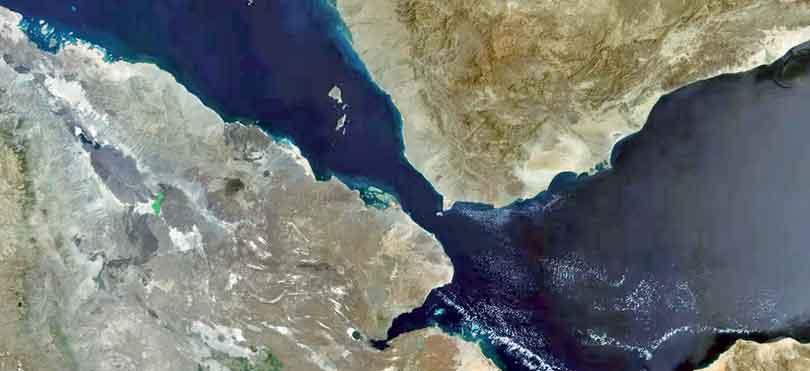
Satellite view of the Bab al-Mandeb Strait. Gallo Images/Orbital Horizon/Copernicus Sentinel Data 2026
 For two weeks running, the United States has been conducting daily bombing raids across Iran. In response, Iran has been firing drones and missiles at US military bases in Kuwait, Bahrain, and Jordan, inflicting significant losses on the US. When this war will end defies common-sense apprehension.
The escalation resembles a war of attrition, in which each side seeks to gradually wear down the other through sustained losses in military power and morale, rather than achieving a swift, decisive victory. Such wars end when one side no longer has the resources or will to continue fighting.
The will to fight, even while suffering losses, is found in abundance in Iran’s strategic culture—shaped by Shiite Islam’s martyrdom ideology—but whether it has the necessary resources to face a prolonged conflict with the world’s number one military power is a question only the final outcome of this war will answer.
The two sides appear to be preparing for a forever war. Iran’s preparations began as far back as 2003, when it felt the need to reinforce its defenses to avoid becoming another Iraq under the mighty US military. To conquer Iraq, the US-led coalition took only weeks. After heavy aerial bombing decimated Iraq’s military assets, the ground invasion began with the help of the Kurds in the north and the tacit support of the Shiites in the south, for Saddam Hussein’s tyrannical rule had antagonised the two main ethnic groups, which together formed 80 per cent of the population.
Iran’s ethnic composition was different. It is overwhelmingly a Shiite-majority country, with minority Sunni Arabs accounting for less than two per cent of the population and Kurds about five per cent. The US military strategy of divide and conquer did not—and will not—work. In times of adversity, Iranians rally behind the national flag, setting aside whatever anger or disagreements they have with the government, which struggles to uplift their living standards due to crippling US sanctions.
Much of the state’s revenue has gone into bolstering the country’s defence in anticipation of US aggression, even though it is economically painful.
Iran has still not exhausted its missile and drone arsenal, despite daily use. Its attacks have become more precise, with missiles destroying US military radars and posing a serious threat to more than 50,000 US troops stationed across the Gulf region.
Equally devastating is Iran’s weaponisation of the Strait of Hormuz. It accuses the US of failing to honour the Memorandum of Understanding signed on June 17/18, particularly Clause 5, which Iran claims explicitly grants it control over the strait. Ships that do not obey Iran’s directives are attacked, prompting US President Donald Trump to warn on Wednesday that for every Iranian strike on a ship in the Strait of Hormuz, the US will destroy a vital bridge or power station in Iran.
Trump is escalating the war of attrition to a dangerous level. Iranian attacks have already damaged power and water desalination plants in Kuwait in response to attacks on Iran’s power stations. The nature of this ongoing war of attrition is such that if Iran is denied power and water, US allies in the region will also face shortages. Such an eventuality spells disaster for the world economy, particularly for developing countries, which yearn for low oil prices and depend on workforce remittances—a vital source of income to sustain foreign reserves and avert a balance of payments crisis.
A related crisis—long dreaded since the war began—is brewing in the Bab al-Mandeb, also known as the Gate of Tears, in the Red Sea. About 15 per cent of the world’s maritime trade passes through this vital chokepoint between Yemen and the Horn of Africa. This includes cargo crossing the Suez Canal and oil exports from Saudi Arabia’s Red Sea port at Yanbu, the endpoint of its East–West pipeline built to lessen dependence on the Strait of Hormuz.
Executing their threats this week, Iran-backed Houthis, who rule the northwestern part of divided Yemen, attacked Saudi tankers in response to what they claim was a Saudi strike on Sanaa Airport. Brent crude was nudging close to US$100 per barrel yesterday. Houthi attacks on Saudi tankers are likely to draw Pakistan into the conflict under the terms of a bilateral defence deal.
It is amidst such dangerous escalation—one that could cripple the world economy and destroy the lives of billions in poor countries—that US War Secretary Pete Hegseth this week sought congressional approval for a record-breaking US$1.5 trillion defence allocation and US$88 billion in emergency funds for the Iran war, which, according to him, has already cost more than US$37.5 billion. With US$1.5 trillion, global poverty could be ended five times over, given the United Nations Food and Agriculture Organisation’s estimate of US$267 billion required to eradicate poverty through empowerment programmes. When morality declines, priorities become distorted.
However, the money is unlikely to come anytime soon because of a Senate gridlock arising from the hospitalisation of Republican Senator Mitch McConnell, who heads the defence subcommittee. Moreover, polls show 68% of Americans believe the Iran war is “not worth fighting”.
The war’s unpopularity among US citizens favours Iran. By pushing oil prices to levels that will leave the American middle class fuming with anger and Trump’s Republican Party vulnerable to losing Congressional control in the November midterm elections, Iran believes it can end the war on its terms.
But Iran’s strategic advantage over the Strait of Hormuz may diminish sooner or later, with efforts being redoubled to build more pipelines across Saudi Arabia to the Red Sea and across Iraq and Syria to the Mediterranean. Even if the Bab al-Mandeb becomes dangerous for shipping, tankers can still use the Suez Canal and the Sumed pipeline through Egypt. Yet these alternatives come with high transport costs and longer transit times to reach Asian ports. Imagine oil tankers taking a route through the Suez, then the Mediterranean, and then the Atlantic Ocean along Africa’s west coast before reaching Indian Ocean ports. Such detours would make oil prices prohibitive for Asian economies.
In another related development, the Trump administration and Saudi Arabia have signed a nuclear deal that enables Saudi Arabia to enrich uranium without international inspection. Fears are already being expressed about a potential Saudi bomb, though the US companies involved in building and maintaining the reactors are restricted from sharing technology with Saudi Arabia.
The deal was initially linked to Saudi Arabia’s recognition of Israel, but it now appears the Trump administration has dropped that condition. The strategic importance of the deal lies in Saudi Arabia’s ability to produce nuclear weapons if Iran were to develop them. The question, however, is whether Israel will allow a Muslim country—however servile it may be to the Zionist state—to possess nuclear weapons. In 1981, Israel bombed and destroyed Iraq’s nuclear reactor, which was being built with French assistance.
Despite the escalating war of attrition, backchannel diplomacy is underway, with mediators Qatar and Pakistan in touch with both the US and Iran. The task at hand appears not to be finding a win–win solution, but rather avoiding further aggravation of the lose–lose position in which the two countries—and the entire world economy—currently find themselves.