Reply To:
Name - Reply Comment
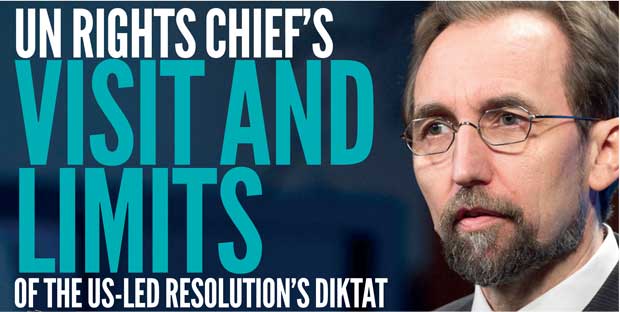
While the Human Rights Council’s official position on Sri Lanka may not have changed, UN Rights Chief Zeid Ra’ad Al Hussein’s interactions during his four-day visit to Sri Lanka reflected a certain change in tone and approach. This must mean something, seeing that he is the UN’s key Human Rights official. There seems to have been a shift in attitude which hitherto had been judgemental, making Sri Lanka feel imposed upon.
Shortly before he arrived, Sri Lanka’s President (still an executive president) told the BBC in an interview that he would not allow the participation of foreign judges in an accountability mechanism as called for in the resolution. This is in spite of the Foreign Minister having acceded to Sri Lanka’s co-sponsorship of it in Geneva. The acrimony caused, and the potentially destabilizing effect of a perceived threat to sovereignty posed by the issue of the proposed hybrid court may not have been lost on the High Commissioner (although it seems to have escaped the Foreign Minister). Responding to journalists questions during his end-of-mission press conference, he said “After all, in the end it is the sovereign right of Sri Lanka to make determinations in respect of its future ...” There had been no such acknowledgement in the rights body’s previous interactions with Sri Lanka on the issue of alleged war time abuses.
War crimes not mentioned
Al Hussein’s manner throughout his visit was patient and respectful. His terminology did not mention ‘war crimes,’ only assertions that the findings of the OISL Report (report of the Office of the High Commissioner’s Investigation on Sri Lanka) merited further criminal investigation. He acknowledged to reporters that there was a ‘public position’ on the issue of a hybrid court, which he said was ‘entirely normal.’ His concern was that the needs of victims ‘on all sides’ should be addressed, and that was why international participation was suggested, he said. His inclusion of Sinhalese and Muslim victims also at every point was significant because the assumption of the OISL Report was that the victims of the 30-year war were solely Tamils.
The Rights Chief stated that he had met victims of the LTTE, such as family members of those assassinated, mothers of children who were abducted or recruited, Northern Muslims who were forcibly evicted, mothers of soldiers who never returned and war widows ‘from both sides.’ His inclusion of these categories was acknowledgement that Tamils did not have a monopoly of victim status, so to speak. And his reference during the Q&A even to incidents from the period of the JVP insurgency showed a departure from the narrow compass of understanding that previously focused the spotlight merely on the ‘last phase of the war.’ One would hope that these changes also point to a more dispassionate and balanced appraisal of Sri Lanka’s troubled past, even if they do not add up to admitting that the OISL Report was biased and that the HRC resolution was interfering.
Al Hussein admitted to reporters that he did not recommend a referral of Sri Lanka’s case to the UN Security Council because he knew what a slim chance there was of getting a resolution past the veto-holding powers (implicitly referring to Russia and China). He also accepted that it would be difficult to have a Bill passed in Sri Lanka’s parliament (on the contents of the resolution).
HRC resolutions can’t be enforced
Part of the explanation for the High Commissioner’s more laid back approach this time around could well be the reality that HRC resolutions in fact cannot be ‘enforced.’
“The HRC cannot pass legally binding resolutions, nor does it have its own enforcement mechanisms” writes Rosa Freedman, a specialist in international law and human rights who lectures at the Birmingham University... “Human rights issues can only be legally enforced through such bodies with legally binding powers or enforcement mechanisms such as the UN Security Council, which occurs very rarely. Moreover, decisions at such bodies to legally enforce human rights are made according to the political strength of individual members.” (‘The UN HRC – a critique and early assessment’ – Routledge, 2013)
If the western powers that sponsored the resolution fall in line with the Rights Chief’s toned down approach to Sri Lanka, it would not be out of any great respect for the UN. Their thinking is more likely to be dictated by realpolitik considerations. They now have a Western-friendly government in place in Sri Lanka, so why make things difficult for its leadership?
Julian Assange case
The degree of cynicism in the UK’s attitude towards the UN’s rights apparatus was made abundantly clear in its response to the recent finding by the UN Working Group on Arbitrary Detention in the case of Julian Assange. The whistle-blower of Wikileaks fame was holed up in London’s Ecuadorian embassy where he had sought asylum, fearing to step out for the past four years owing to the certainty of arrest by British Police, and the risk of eventually being extradited to the US. The Working Group (which comes under the Office of the High Commissioner) ruled that Assange was being arbitrarily detained and that he was entitled to compensation. Even as Al Hussein was in Sri Lanka to assess implementation of an HRC resolution of which UK was a main architect, UK’s Foreign Secretary Philip Hammond, in open contempt of the decision said “This is frankly a ridiculous finding by the working group and we reject it.”
The episode well illustrates Freedman’s comment on the manner in which the political strength of individual members influences the outcome of UN’s deliberations. If this is how it is in the Security Council, how much worse would it be in the Human Rights Council, a less powerful body?
Resolution not about human rights
The consequences for Sri Lanka if it fails to implement the resolution to the satisfaction of its western sponsors, remain unclear, as Palitha Kohona, Sri Lanka’s former Permanent Representative to the UN in New York has pointed out (‘UN resolution: the reality check’ - Sunday Times 01.11.15) While sanctions can no doubt be imposed unilaterally by individual powerful states, this would seem less likely in the context of the government’s ongoing love-in with the West. The concerns leading to the US to bring a resolution against Sri Lanka in the HRC were never about human rights in the first place.
They were more about bringing a strategically-located Indian Ocean island that was leaning dangerously towards China, into the US’s sphere of influence, and using international pressure to make it fall in line. They have more to do with the US’s ‘Pivot to Asia’ - a strategy to counter China, than with distress over alleged ‘war crimes.’ One only has to look at the human rights record, outside of their own countries, of the two main sponsors of the resolution, to see the hypocrisy behind its moral overtones.
By Lasanda Kurukulasuriya