Reply To:
Name - Reply Comment
The opposition should not make capital out of an issue which should have been settled in court
 Imagine that the recent incident in Trincomalee had happened inversely: A kovil, mosque, or a church is set up in Colombo, Galle, or somewhere in the South, and the Police storm the place, manhandle the clergy, and remove a statue of Jesus or Lord Vishnu. Social media warriors, NGO captains, and the Western embassies all would explode in outrage at this apparent act of religious indignation.
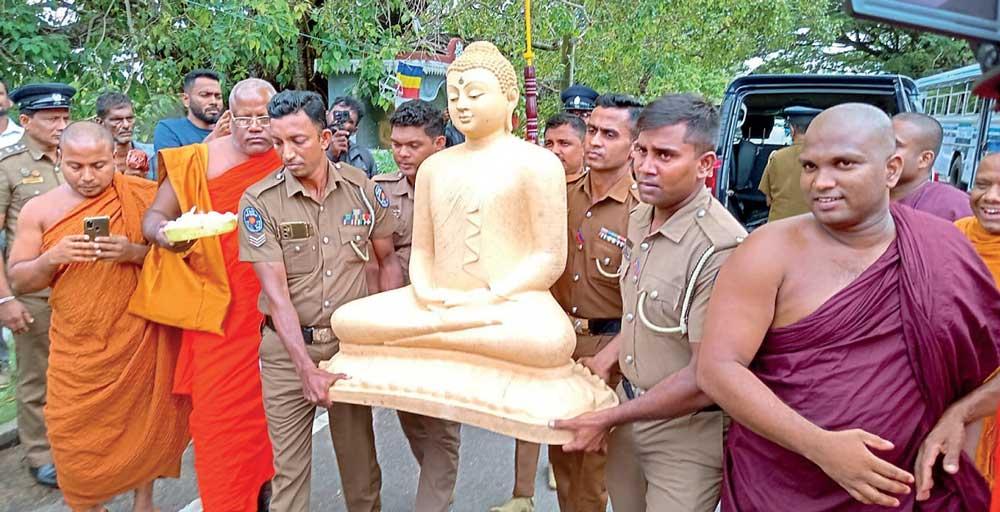
None of that self-righteous outcry was in display early this week, except that the incident happened at a Buddhist temple premises, where Police charged in and assaulted the monks who were laying a foundation stone for a Sunday school. As for the outrage, I have seen more when Mervyn Silva, the maverick conman of the Rajapaksa government, stormed a kovil and released animals meant for ritualistic slaughter.
The government claimed that the Trincomalee naval Police had intervened after a complaint by the Coastal Conservation Department alleging that an unauthorised temple was being built on land under its purview. Monks have objected, claiming that the classification is incorrect and that the temple was allegedly established in 1951 and granted a Sacred Land deed in 2014. The temple’s Sunday School was established around 1960, but officially registered in 1996. However, the Sunday School was destroyed by the Tsunami, and activities were not restarted until the recent attempt to construct the new building. It was also alleged that the deed for the sacred land had been revoked, after the election of the current government.
Following a public outcry, the Police returned the Buddha statue the following day, and the public security minister said in Parliament that the statue was removed ‘for protection’. That is a sad excuse, which implicates the locals in the multi-ethnic town, and seeks to hide its own failure in handling a delicate situation.
In the first place, the whole debacle appears to be a mishandling of a legal issue that should have been settled in court. However, the police intervention -- which the monks and some parliamentarians had alleged -- followed a phone call by a government minister, has now threatened to turn it into a racial conflict in a place with a toxic demography.
The Buddhist clergy, some of whom have an unholy obsession with putting up structures in every contested archaeological ruin, is partly to blame. They have, if not a moral, at least a legal obligation to follow the due course of the law. A cat-and-mouse game exists in some places, where monks appear overnight and set up an ad hoc structure, only to refuse to back down despite legal rulings, as seen in another disputed temple construction at the Kurunthurmalai archaeological site in Mullaitivu. This has neither helped Buddhism nor ethnic peace. However, these incidents are few and far between, and often amplified to create a fresh stream of post-war grievances.
Tension in Trincomalee, obviously, created a spectacle in Parliament where opposition MPs, some brazenly, tried to exploit the crisis. However, in general, their statements attempted to avoid stoking ethnic tension. There is a difference between stoking racism and stressing the obvious of Sri Lanka’s Buddhist heritage, and that it is a Sinhala Buddhist majority nation -- in the same way, as India, now grudgingly accepted, as a Hindu majority State, or America, a majority white Christian State. Occasionally, there were street-smart charlatans who negate this demographic reality ( like Mangala Samaraweera did once to much acclaim) or equally self-interested conmen, who hyperventilate on this heritage at the expense of minorities.
Deconstructing the state
Still, the Sinhala Buddhist historical and demographic reality of Sri Lanka cannot be negated without deconstructing the State itself. A vast number of Western European states have belatedly realised that trying to overlook and dilute the nation’s demographic heritage leads to complete social, institutional, and civilisational unravelling. A government has an obligation to defend and foster that heritage, though that should not come at the expense of the ethnic minorities.Nor should the recent incident be exploited for cheap political manoeuvring. When the Pohottuwa and the UNP hold a rally on November 21, the organisers have a responsibility to prevent it from becoming a naked racist dog-whistling competition.
Amidst the clamour, one might have missed the Tamil National Alliance’s (TNA) response, which might sum up what is wrong with Tamil politics. M.A. Sumanthiran, much vaunted liberal voice of Tamil politics, tweeted after the government was forced to reinstate the Buddha statue: “… The NPP government stands exposed as a racist, Sinhala Buddhist nationalist force, no different from any other government in the past. All Tamil members of the NPP, including Trincomalee MP and deputy minister, must resign forthwith.”
Evolution of Tamil nationalism
This is interesting if you have a grasp of the evolution of Tamil nationalism, then militancy, which finally morphed into suicidal terrorism. The early years of nationalist Tamil politics were marked by discrediting any Northern Tamil party or politicians who were part of the government. This led to a rat race among Jaffna-based elites to appear more tribal and nationalist than their competitors. By the 70s, the government allied Tamil MPs and politicians were earmarked as traitors, and what followed was the killing of Alfred Duraiappah, SLFP’s Jaffna Mayor, a first in a long line of assassinations.Undeterred, the Federal Party, eyeing the upcoming general elections, went ahead and passed the Vadukkodai resolution -- and was gifted with the most seats in the Northern and Eastern constituencies in the election. Amirthalingam et al. nurtured Tamil militancy, for which they later paid a heavy personal price.But before that, an LTTE ambush killed 13 soldiers in Jaffna, leading to Black July, and the TULF MPs chose to vacate their Parliament seats in opposition to the 6th amendment to the Constitution, which criminalised advocating a separate State within Sri Lanka.
Now, the TNA’s hold in its Tamil constituency is under strain as the NPP has eaten into its vote base, having secured nine parliamentary seats from the North-East. Sumanthiran, like his predecessors, is resorting to the old habits of Tamil nationalism that demonised Tamils affiliated with the government. This is a dangerous ploy, which over time bred a generation of suicide terrorists.Usually, it all began benignly, until they devoured their own community and then the nation.
Follow @RangaJayasuriya on X