Reply To:
Name - Reply Comment
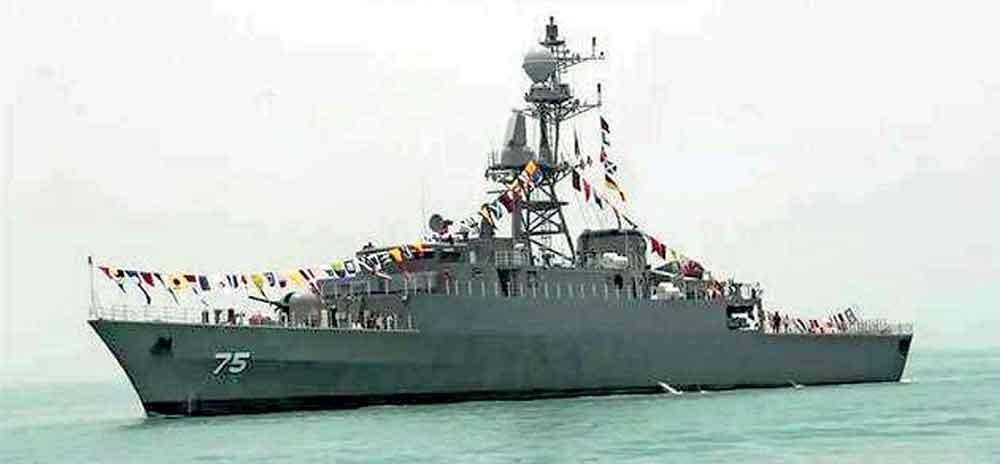
As the Iris Dena episode showed, the government has walked a carefully balanced path between two warring powers
 Non-alignment, in its basic sense, was the idea of keeping as far as possible from global power blocs and alignments that engulfed themselves in great-power politics
 High-flown diplomatic verbosity and larger-than-life personal egos are not necessarily prerequisites for striking a principled foreign policy position and being recognised for it, though most leaders and policy pundits in this part of the world tend to think otherwise.
Last week, as the chattering classes in Colombo were assessing the eloquence of Foreign Minister Vijitha Herath’s English, Sri Lanka proved yet again that a small nation, navigating a geopolitical tsunami, could still adhere to a principled foreign policy position; in our case, an ‘active’ non-alignment, while not making enemies with either party to the conflict – and by doing so, it could also become a minor celebrity in the international system -- or at least on Twitter and other social media landscapes.
President Anura Kumara Dissanayake last week revealed that Sri Lanka had refused permission for two American fighter jets armed with anti-ship missiles to land at the Mattala airport from March 4- 8. In the same vein, the government did not grant a request made on February 26th by three Iranian warships returning from a multilateral maritime exercise in Vishakapattam, India, to dock in Colombo Port between March 9 and 13. Before Sri Lanka responded, IRIS Dena, a guided missile frigate, was sunk by a US submarine on March 4.
Non-alignment, in its basic sense, was the idea of keeping as far as possible from global power blocs and alignments that engulfed themselves in great-power politics. Power blocs were a defining feature of the geopolitics of the Cold War and are emerging again with the rise of China and the resultant geopolitical rivalry.
However, non-alignment is not necessarily passive neutrality, and as Nehru, probably the most recognised architect of the idea, described it, a “positive, active, and constructive policy” aimed at collective peace and, by extension,at advancing the national interests of the country.
The Sri Lankan government’s approach to the geopolitical conundrum it was thrust into could be described as active non-alignment, in contrast to passivity.
After the sinking of the Iranian frigate IRIS Dena, Sri Lanka responded swiftly, sending search and rescue vessels which rescued 32 Iranian sailors and salvaged the remains of 87. Sri Lanka also intervened and provided sanctuary to another Iranian vessel, IRIS Bushehr, preventing another disaster.
The president defended those actions as guided by neutrality, while also contributing to peace and ‘saving lives.’
Non-alignment, much abused and over-hyped, had rarely been about non-alignment.
John Foster Dulles, then American Secretary of State, dismissed India’s non-alignment policy under Nehru as ‘little more than a sanctimonious cloak’ for policies that contradicted those of the United States.
Sri Lanka surely can not afford to offend an eccentric superpower. The reaction by the United States and Iran suggests Sri Lanka’s principled approach to the crisis is recognised for its commitment to collective peace and to fulfilling its obligations under international law.
The US special envoy for South Central Asia, Sergio Gor, visited Colombo last week and held talks with the President and other political leaders.The Iranian ambassador in Colombo had lauded Sri Lanka’s role in the crisis.
One should acknowledge that there was a greater deal of maturity and sanity behind the government’s approach to the crisis. That is a pleasant surprise for many well-intentioned Sri Lankans who held genuine reservations about the NPP government’s capacity, intellectual depth and ideological straightjacket.
A refreshing shift
That is also a refreshing shift in terms of Sri Lanka’s wider foreign policy, practised for generations, with its essential failure and all squandered opportunities also defended under the same policy of non-alignment.
Non-alignment had historically been a smokescreen for a succession of political leaders to prop up their inflated egos, replenish ideological loyalties that ran counter to national interests, and prop up domestic audiences at the expense of the country’s overall foreign policy interests.
Sirimavo Bandaranaike, one of the great champions of Third World solidarity, called out ‘rapacious West’ in a state visit to Mao’s China, while millions of Sri Lankans lived hand to mouth from the US food aid. Then, her government hosted the Non-Alignment Movement (NAM) summit in Colombo in 1976 while the majority of Sri Lankans languished in long queues for basic necessities. The only tangible outcome of the summit was an offer by the newly oil-rich Arab states to receive Sri Lankan domestic maids. If she had spent a fraction of her effort to build a Special Economic Zone similar to the then autocratic Korea or Taiwan, the destiny of the millions of Sri Lankans would have been better. Her government was the most ruinous in modern memory, and the average GDP growth for seven years was 2.5 per cent.
J.R Jayawardene, who salvaged Sri Lanka from economic stagnation, in turn trapped it in a major geopolitical consternation with India, then the main non-Warsaw bloc ally of the Soviet Union. To make matters worse, he tried to be cocky with mighty Indira Gandhi and called her ‘a sacred old cow’. The rest is history, and it took 25 years for Sri Lanka to reemerge from a Civil war fought by Indian-armed and trained Tamil militants.
R. Premadasa expelled Israelis and shut down the Israeli information section in Colombo while the country fought a nihilistic terrorist group in the North, and intriguingly, after it prevailed, another blood-curdling insurgency of the JVP in the South, partly thanks to Israeli security assistance. The affair was designed to pander to Muslim political parties. And when the terrorists were at the gates of Jaffna, Chandrika Kumaratunga sent emissaries to Tel Aviv for help and resumed diplomatic ties, reportedly after receiving concurrence from Yasser Arafat, not your ideal statesman.
Mahinda Rajapaksa, who won the war and rebuilt infrastructure with Chinese loans, later opted for a China-centric foreign and economic policy at the expense of Sri Lanka’s other major international partners. The policy was guided by his dynastic ambitions and ego prop that Beijing provided. However, distortions of that policy are reflected in the country’s inability to sustain economic growth, initially driven by loan-funded infrastructure development, and his steadfast refusal to implement necessary economic reforms and transparency, which in the long run contributed to the economic crisis.
While it is still premature to write paens for this government’s foreign policy, for the moment, it stands out as a refreshing shift toward foreign policy realism, which it had skilfully painted in lines of foreign policy moralism. That is clever diplomacy.
However, an active non-alignment can be stretched much further to advance our core economic interests. In the present international system of complex interdependence, international relations are first and foremost about international trade and investment. Sri Lanka should leverage its newfound global credibility alongside its geostrategic location to woo real transformative foreign direct investment, to cultivate a nexus in the emerging critical industries and convert it into a logistical and education hub. However, such policies need greater ease for business, a competent bureaucracy, and an ideological conviction in liberal market reforms. Unfortunately, though, the government’s ideological straightjacket on that count seems to be all too tight to shed immediately.
Follow @RangaJayasuriya on X