Reply To:
Name - Reply Comment
After a year in power, our new government now faces an age old problem. It’s nothing party-political, one of far greater importance than the nonsensical no faith motions opposition parties keep raising, in an attempt to embarrass the present regime of ‘poor little rich kids’ now in power.
The public awaits the day when the new broom they put in power a year ago, puts into operation plans which will sweep away repeated nightmares of monsoon rain-caused floods, which inundate their homes unfailingly every year. Fifty percent or more homes in Colombo which are adversely affected by monsoonal rains are situated in urban slums. Yet, it was and is these people, who are most adversely affected by rains who put the JVP-NPP combine into power by voting for it.
Since coming into power, the government has allowed itself to be distracted by strident cries of discredited former parliamentarians drawing red herrings across the social fabric. This time around, the government has in addition to its parliamentary majority also secured a majority of the local government bodies.
There can be no excuse therefore for the government if it fails to meet the challenge posed by periodic flooding.
We trust the government has silently been acting to ensure that the clogged city drainage system has been cleared. Those who ensured the victory of the JVP-led NPP local government bodies should not permit construction companies to build or fill lands set apart for drainage. Unfortunately, in some areas this corrupt practice is still talking place.
Colombo and its suburbs are dotted with tenement buildings -- typically small and poorly constructed-single-room styled dwellings. These ‘apartments’ are often rented to low-income tenants.The buildings are notoriously overcrowded, unsanitary, poorly maintained and often built on government and or railway department lands.
Even as the article is being written, local government (LG) officials are in the process of asking people to show ownership papers for illegally occupied lands. The fate of thousands of ‘illegal residents’ are now in the balance. Many say the government will provide them with alternate space. The reality -- nothing definite has been decided.
However, only one thing seems certain -- the government intends to strictly ensure that illegally occupied state lands are cleared of residents with no legal title. The fate of thousands of families hangs in abeyance, and no one seems to be sure of the fate which awaits this large body of people.
In the meantime the monsoon rains have commenced leaving the best laid plans (if any) of mice and men hanging fire. Sadly, once again, it is the poorer sections of society that will have to vacate their tiny homes. Large construction companies can be heard and seen building in areas reserved for storm drainage. Their activities continue uninterrupted.
This type of illegal activity is a legacy inherited from the past and present local government officials who accepted kick-backs for passing plans running counter to LG rules and regulations. Today, home owners living in proximity to the new high rise buildings find themselves falling victim to flooding during the rainy season as soakage areas are being filled up by construction companies.
Ranking officers of these companies are not ashamed to oil palms to achieve targets, and LG bureaucrats are happy to do their bidding to earn a few bucks more.
Sadly, these are not the only perennial problems handed down to our relatively new year-old government. Our public transport system is also in a mess -- caused by the mismanagement of state controlled Sri Lanka Transport Board (SLTB) and the Sri Lanka Railways (SLR).
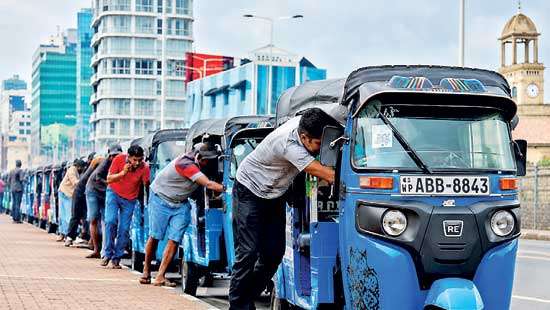
Rapid population growth has put a strain on the city’s transport system leading to inefficiencies in this sector which provide a comparatively cheaper from of transport. These inefficiencies are forcing commuters into the hands of alternate transport providers like tuktuks and other private transport providers who charge high rates often beyond the means of ordinary citizens. Often they are forced to use the latter due to a lack of an alternative.
To make matters worse, Over 50% of Colombo’s workforce consists of daily paid labour. The costs of food, medicines, education and clothing are way beyond the reach of the common man/woman. Public sector transport for them is essential. Thus, it is even more essential that the government lives up to its pre-election pledge to ease the woes of the poorer sections of the community.