Reply To:
Name - Reply Comment
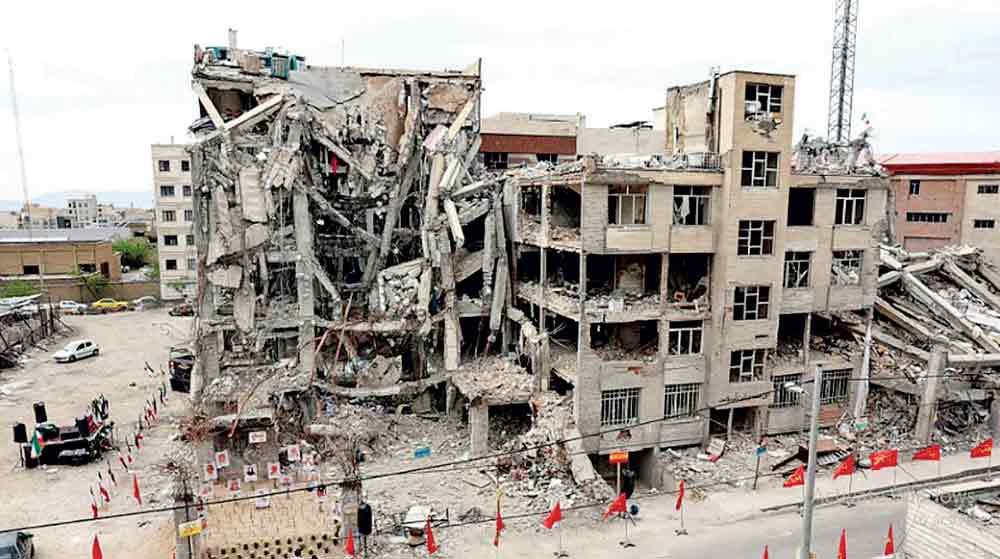
A building in Teheran destroyed by US-Israeli missile attacks
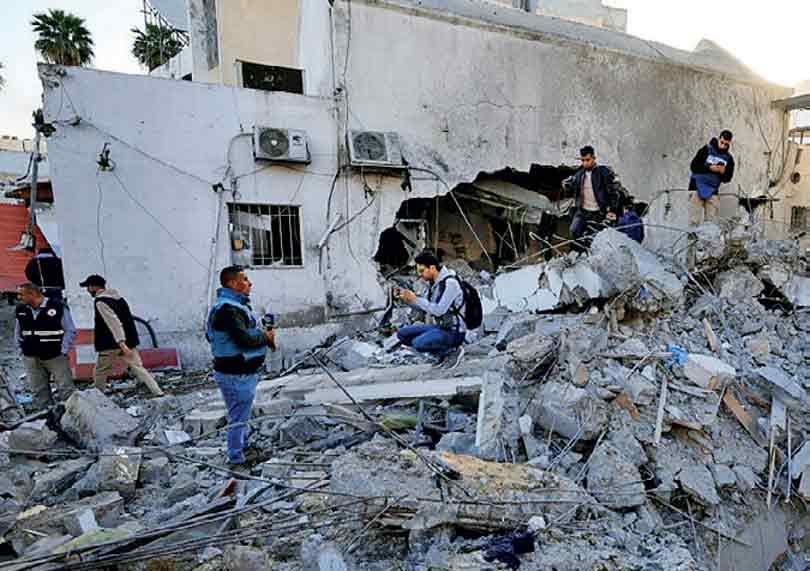
Palestinians inspect a site where medics said two Israeli missiles hit a building inside al-Ahli Hospital

The Middle East has today turned into a global tinder box. It could explode at any time, engulfing not only countries of the region, but also dragging the whole world into a nuclear inferno. Israel, carved out of what was once undivided Palestine, is central to the crisis.
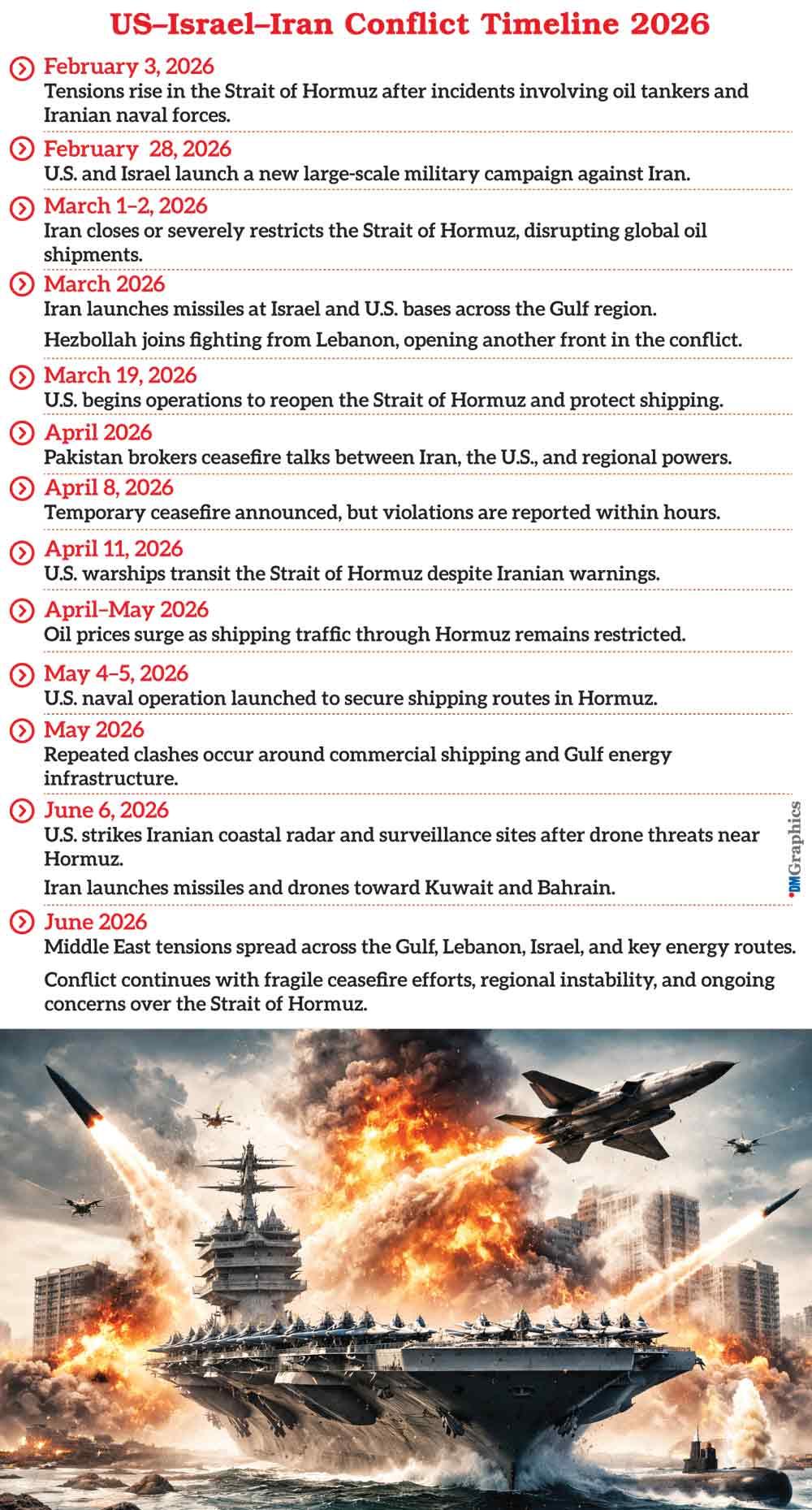
On February 28 2026, the US and Israel carried out sneak attacks on Iran even as negotiations between the US and Iran were in progress. The US used its military and naval bases housed in particular Arab states to carry out its foul attack on Iran. The strikes targeted the Iranian head of state, a Montessori girls school, nuclear facilities and military infrastructure.
In March this year, the New York Times reported it had verified damage to 22 schools and 17 health care facilities in Iran, a fraction of the devastation in the war so far.
In retaliation, Iran attacked Israel and US bases in neighbouring Arab countries. Both the US and Israel have in their arsenals nuclear weapons. Iran meanwhile is enriching uranium for a variety of civilian needs and strategic security interests.
The International Atomic Energy Agency (IAEA) has maintained that Iran has not reached a position to develop nuclear weapons in the near future. However, the US and Israel claim one of the goals of their attack on Iran was to prevent Iran achieving nuclear weapons capability.
The state of Israel itself was carved out of the undivided State of Palestine by the United Nations (UN) in 1948, with clearly defined borders to provide a homeland to the European Jewish community displaced by Nazi Germany’s attempt to eliminate the Jewish race in Europe.
Unfortunately, Israel has never accepted the UN defined boundaries. Months before it was recognised as a state by the United Nations, Jewish paramilitaries commenced a programme of attacking Palestinian towns and villages, burning, pillaging Palestinian homes, killing inhabitants including murdering women, children and the elderly in cold blood.
At the time of the UN Partition Plan in 1947, the Jewish population in Palestine was roughly 630,000 -approximately 33% (one-third) of the total population. The Arab majority accounted for the remaining 67%. Despite being a minority, the Jews were apportioned 55% of the land in Palestine.
The need to set up a separate state for the Jewish people arose from the fact that firstly, the West needed to rid itself of the ‘baggage’ of thousands of Jews housed in Nazi concentration camps scattered in different parts of Europe. The West did not want the continued presence of several thousands of displaced Jews in their countries.
Europeans did want the continued presence of the Jewish community in their midst. The ill-feeling West Europeans felt toward the Jewish community and people is best captured in Shakespeare’s play ‘Merchant of Venice’ where Jews are portrayed as cold-hearted loan-sharks.
More importantly, the need for plentiful supplies of oil was recognised by the West in the aftermath of World War II. European and American society is based on a concept of high-rise buildings, super market complexes and military domination; all of which need a continuous and plentiful supply of cheap oil to keep the wheels of the system running smoothly. The Middle Eastern countries (colonies of the West) were awash with oil. But the breakdown of the colonial system in the aftermath of World War II, and colonies demanding independence posed a serious threat to the supplies of oil on which the West was dependent.
Ex-colonial oil-rich states coming together to maximise control over sale, availability and cost of oil would be disastrous to the US and the West. Thus, the setting up of a client state at odds with its Arab neighbours in the Middle East, dependent on the West for its existence, became imperative to the West.
Dividing an already existing country and resettling outsiders on lands owned and belonging to an already existing population, automatically created flashpoints and raised tensions in the region. It was a perfect plan for the continued involvement of the West in the Middle East.
The division of Palestine into two states immediately dispossessed the original people of the land. The Palestinians recognised the incoming Jewish people who settled in their lands as occupiers. The new settlers -- heavily armed and trained with weapons provided by the US and West, saw the Palestinians as enemies and attacked them at every opportunity.
The neighbouring Arab countries correctly identified the division of Palestine, and the creation of a new state - comprising of former European citizens - as an imperialist plot for the continued involvement of the colonial powers in the region. They opposed the proposal, as did the Palestinian people who were never consulted on the matter.
Double standard
In 1948, the UN recognised the State of Israel in what was earlier the undivided state of Palestine. While the State of Israel was recognised by the newly set up United Nations Organisation (UN), recognition of the State of Palestine was withheld.
In the months before its recognition as a state, armed Jewish militias carried out brazen war crimes against unarmed Palestinian people, one example being the massacre at Deir Yassin. Over 600 Palestinian men, women and children were brutally killed in cold blood. Thousands of Palestinian families fled the land. Many of them resettled in what it today known as the Gaza Strip.
War broke out between Israel and the Arab states with the recognition of Israel by the UN. During the course of that war Israel occupied large sections of a number of Arab states such as Egypt, Jordan, Syria, Lebanon, and Iraq. It still occupies parts of these countries.
The recent genocidal attack on unarmed Palestinians in Gaza which began on October 2023 has left over 72,000 Palestinians dead, including at least 21,289 children, according to UNICEF. History shows that Israel’s genocidal attacks on Palestine’s Gaza Strip and in the West Bank is a continuation of the attacks Israel has perpetrated on Palestinians starting before its recognition as a state in 1948. The plan to keep the Middle East in a perpetual state of instability had fallen into place perfectly. Armed by the US and the West, Israel has continuously attacked Palestine. It now occupies and controls the whole of that country. It has also repeatedly attacked neighbouring Arab countries. Some of these countries were coerced into accepting US military bases for protection.
Iran, in the aftermath of the Islamic Revolution (11.02.79) proved to be the only ‘fly in the ointment’. It continues to back the Palestinian cause. It provides practical political, moral and material support to militant Palestinian armed groups fighting Israel. Iran also supports militarily and ideologically all Arab groups which come under US or Israeli attack. For these reasons, Washington labels Iran ‘a terrorist state, exporting terrorism’. Iran’s defiance to US demands and its continued open support for the Palestinian cause posed a challenge to US global domination.
The sudden and undeclared US-Israeli attack on Iran in February this year was about making a recalcitrant state fall in line. It was also about making an example to others who may think of challenging US diktat.
Unfortunately for the US, Iran did not capitulate. It retaliated, it successfully attacked Arab states housing US bases as well as Israel. The Iranian retaliation was devastating, causing terrible damage to those countries. In so doing, Iran shattered the myth of US-Israeli invincibility.
Anadolu Agensi reported that Iranian retaliatory strikes caused at least $800 million in direct damage to base infrastructure alone, with overall repair and replacement costs expected to exceed $5 billion. Thirteen US personnel also died during the conflict. The Middle East Monitor reported Israel’s Finance Ministry as estimating the cost of 40 days of war on Iran had cost his country around $17.5 billion!
In a strategic move, Iran closed down the Straits of Hormuz, through which over 20 percent of Middle East oil flows to the rest of the world. The immediate effect of this move resulted in a shortage of oil, escalating oil prices the world over, and a worldwide rise in the cost of living. In turn it led to international calls for a cessation of hostilities.
With the war showing no signs of ending and opposition to the war rising both within the US and internationally, Trump made desperate efforts to draw the NATO Pact countries into supporting his war. The latter however, refused to join, adding they were never consulted and were in fact opposed to the war.
Faced with rising opposition to his war in Iran in the US, and unable to muster support among his NATO allies to play an active role in the war, President Donald Trump sent an official letter to Congress on May 1, 2026, formally declaring that Iranian hostilities were “terminated”. However, skirmishes between US and Iran continue, but the full-fledged war has stopped. During this same period (Since October 2023 – May 2026) Israel conducted military operations in at least four other sovereign Arab countries -- Lebanon, Syria, Yemen, and Tunisia.
The US-Israel war against Iran has temporarily been called off and negotiations between the two countries are continuing. The US also organised a ceasefire between Israel and Hezbollah in Lebanon. But Israel continued its attacks on that country until the US President ordered Israel to stop, as both internal and world opinion was turning against the US-Israel actions.
Trump also ordered Israel to sign a ceasefire declaration with Hamas – a militant Palestinian organisation - in April 2023. Israeli authorities were determined to wipe out Hamas in retaliation for its co-ordinated incursions and attacks on Israeli border communities on 7 October 2023 which led to Israel’s genocidal attacks on all Palestinians.
Killings continue
However, Israel has been continuing its attacks on Palestinian civilian targets. It is using the distraction of the US-Iran war to cover its (Israel’s) murderous ongoing attacks on Palestinians, Despite the Trump brokered ceasefire. Israeli killings have continued apace in Gaza and Palestine’s West Bank.
UNICEF reported: “Since the signing of a ceasefire in April this year, more than 1,309 Palestinian children have reportedly been killed and 3,738 injured”. It is seven months since the signing of the ceasefire agreement between Israel and the Palestinian militant group Hamas.
To put it in context, the problems in the Middle East will not come to an end until the Palestinian problem is settled with justice to the long suffering Palestinian people.