Reply To:
Name - Reply Comment
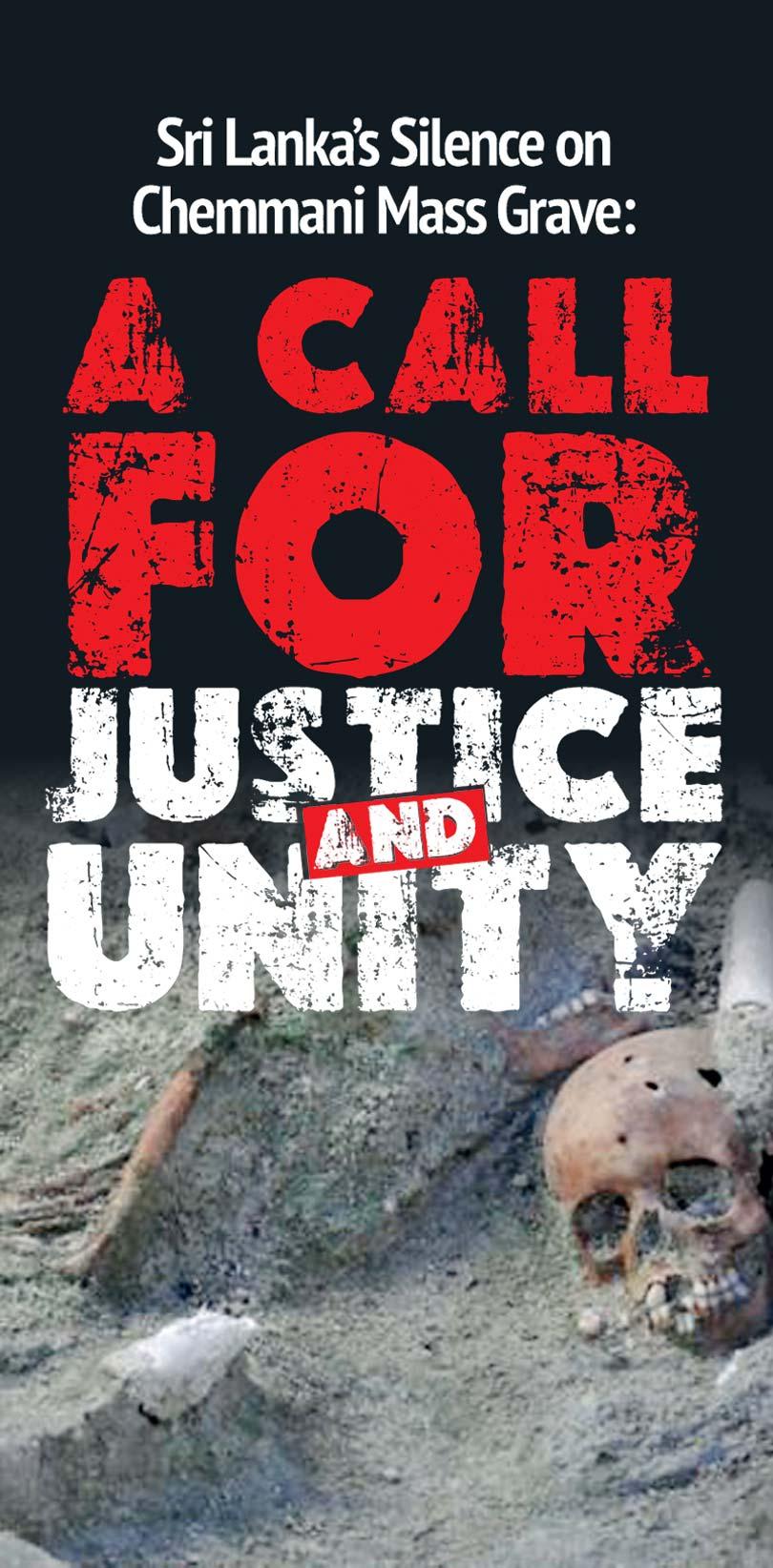 From unheard calls of justice to more exhumations to come forward in the future, the Chemmani-Sindubathi site stands as a reflection of the darkest times of this country
 In Jaffna’s Chemmani-Sindubathi site, 19 human skeletons have been unearthed, with more expected when excavations resume on June 26
In 1998, details came out that the Chemmani grave may hold 300-400 bodies allegedly due to mass killings as a result of Operation Riviresa, a military operation by the Sri Lankan Armed forces to recapture the city of Jaffna
By Damintha Gunasekara
Imagine a loved one goes missing: your child, sibling, spouse or parent, you would do anything in your power to bring them back, or at least find out what happened to them. Instead, your pleas fall on deaf ears. Governments and revolutions have come and gone, all promising justice, but ultimately failing to deliver. Yet, here you are, over 3,000 days later, still fighting.
In Jaffna’s Chemmani-Sindubathi site, declared a mass grave on June 8, 2025, 19 human skeletons have been unearthed, with more expected when excavations resume on June 26. This site has been linked to the disappearance of Tamils during the Sri Lankan military’s 1995-1996 reoccupation of Jaffna, potentially making this one of the nation’s largest mass graves. Yet, Southern politicians and mass media remain eerily quiet, deepening the pain of Tamil families and threatening Sri Lanka’s chance for unity and peace.
For years, families from the North and East–mainly Tamil mothers and wives–have protested, holding photos of their vanished loved ones, demanding answers. Recently, they marched again, urging that Chemmani’s excavation be conducted under international supervision and forensic standards, reflecting their deep distrust in the central government. Amnesty International echoes their plea, calling for sufficient resources, transparency with access for families and media, and protection of the site’s integrity. These demands are not just technical; they’re about restoring faith in a nation that has let these families down for decades.
The Chemmani graves, which were first exposed in 1998 by a soldier convicted in the 1996 Krishanthi Kumaraswamy case, may hold 300-400 bodies allegedly from military killings during Operation Riviresa – a military operation launched by the Sri Lankan Armed Forces to recapture the city of Jaffna. In 1999, 15 skeletons, some even blindfolded, were exhumed; however, justice stalled. The latest findings, 19 skeletons showing signs of brutality, renew calls for transparency, accountability, and justice for victims of enforced disappearances. The National People’s Power (NPP) government, led by an Executive President affiliated to the JVP, promised a secular Sri Lanka and a truth commission in its manifesto. Yet, its silence on Chemmani betrays this vision, ignoring a chance to heal wounds and prevent recurrence.
However, this stonewalling isn’t a new tactic; in fact, it has been used by several governments, and it is something all Sri Lankans are familiar with. During the JVP insurrections of 1971 and 1987-1989, Sinhalese families in the South faced the same agony, mourning loved ones lost to mass graves in Sooriyakanda and Matale. The Batalanda case, recently spotlighted by a foreign media interview, fueled public outrage but yielded no accountability for the insurrection-related atrocities. Sinhalese, Tamil, Muslim – we’ve all wept for our disappeared. Why, then, do we turn away from Chemmani? Facing our violent past isn’t division, it’s the path to unity.
Reconciliation is our shield against repeating the horrors of our past, and also the path towards economic recovery. Argentina’s 1983 CONADEP commission exposed 9,000 disappearances, leading to trials and 5% annual GDP growth. Colombia’s 2016 peace accord and, with a truth commission, curbed violence and drew in foreign investment. South Africa’s 1996 Truth and Reconciliation Commission rebuilt trust after apartheid, while Rwanda’s Gacaca courts tried 1.9 million genocide cases, fostering peace. These nations show that truth prevents bloodshed and fuels prosperity—lessons Sri Lanka must learn.
Past efforts, like the 2017 Office of Missing Persons (OMP), logged 14,000 complaints but lacked manpower and were stalled by nationalist backlash. The NPP’s inaction, despite its manifesto pledges, and the government’s April 2025 reluctance to fund Chemmani digs suggest a cover-up, further eroding trust in the North and East. In a world divided– Trump’s nationalist rhetoric in the US, European political polarisation, and Modi’s Hindutva– Sri Lanka has the potential to be an example of unity.
So, does that mean the Sri Lankan army is evil? No, in fact, our armed forces are perhaps among the best in the world and represent the only country to successfully win a counterinsurgency war, which is studied in universities across the world. They ended a 30+ year-long civil war and eliminated terrorism in our country—a huge triumph that countries with large militaries have not yet achieved. It’s because of their sacrifices that many of us are able to enjoy the lives we lead today and the freedoms that come with it, and we should never forget that. The desire for reconciliation and appreciation of our armed forces does not have to be mutually exclusive. Reconciliation is the way forward, and accountability for past wrongs remains essential for truth-seeking and genuine healing.
What if this were your family? What if the people elected to protect you and your rights have ignored your pleas for sixteen long years? Could you sit idly by and watch as a piece of history is swept under the rug? Today, many Sri Lankans demand justice for faraway Gaza while overlooking our own scars. The government must fund Chemmani’s excavation, ensure international forensic standards, and empower institutions such as OMP. By embracing the truth, as seen in countries like Argentina and Rwanda, we can rebuild trust, prevent repeating the same mistakes of our past, and forge a secular, prosperous Sri Lanka.
Silence is not an option; let’s stand with our Tamil brothers and sisters for justice and unity.