Reply To:
Name - Reply Comment
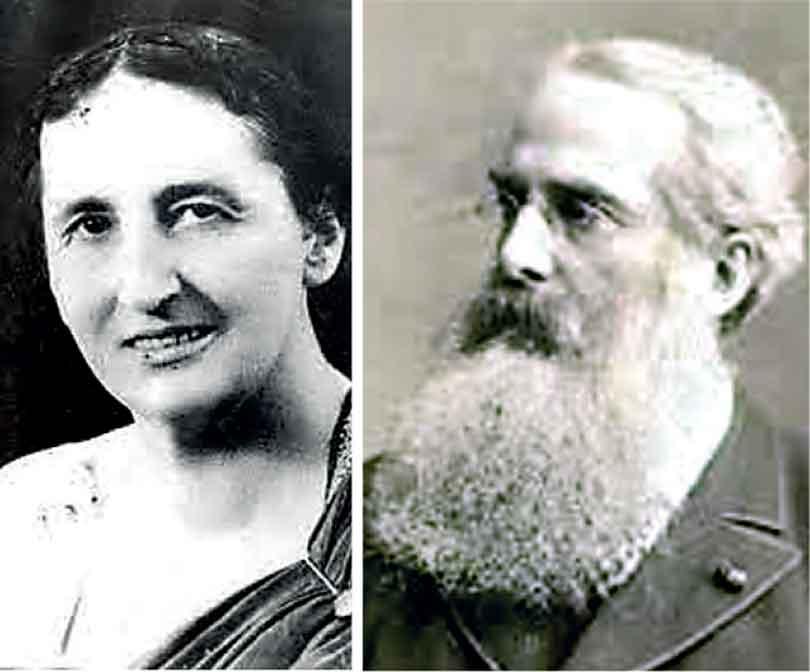
Olcott’s efforts went beyond education, as he sought to unify and codify Buddhist practices while Hilda was a transformative force in Sri Lanka’s intellectual and cultural landscape who left behind a lasting legacy
 The educational revival in the late 19th and early 20th centuries was influenced by Theosophists like Colonel Henry Steel Olcott and Hilda Muriel Westbrook. They worked to revitalize Buddhism, establishing schools that combined religious and secular education. Prominent schools founded through these efforts included Ananda College in Colombo, Dharmaraja in Kandy, Maliyadeva College, Kurunegala, Mahinda College, Galle, and Musaeus College, Colombo, Ananda Balika, Sri Sumangala Girls’, Panadura, Mahamaya College, Maliyadeva Girls’, Kurunegala and Sri Pushpadana Girls’ which provided educational opportunities for Buddhist students. Hilda Westbrook, after training at James Allen’s Girls’ School, joined Ānanda College, Colombo, as an English teacher in 1920. However, upon arrival in Ceylon, she was appointed Principal of Buddhist Girls’ College, later known as Visākha Vidyālaya.
After expelling the Dutch and securing sovereignty through the Treaty of Amiens (1802), the British consolidated control over Ceylon’s lowlands, suppressing local revolts. Their ambition, however, extended to the independent Kandyan Kingdom, a formidable stronghold.
British Invasion and Rebellions
The first British invasion of Kandy in 1803 ended in disaster, with their garrison annihilated. A second attempt in 1804 also failed. Learning from these defeats, the British exploited internal dissent among the Kandyan aristocracy, leading to the 1815 annexation of Kandy after King Sri Wickrama Rajasinghe’s capture. However, the aristocracy soon rebelled, realising British rule threatened their privileges. This discontent ignited the Uva Rebellion (1817–1818), uniting nobles and villagers against colonial rule. The British response was brutal—mass executions, scorched-earth tactics, and severe repression crushed the uprising.
Although a brief rebellion emerged in 1830, resistance evolved by the mid-19th century. The 1840 Crown Lands Ordinance dispossessed Kandyan peasants, deepening poverty and dismantling feudal structures. This hardship fuelled the Matale Rebellion of 1848, led by commoners like Puran Appu and Gongalegoda Banda, marking a shift from noble-led uprisings to popular resistance. Historian Dr. Colvin R. de Silva noted its lack of cohesive leadership, as feudal elites had been neutralized and a revolutionary class had yet to form. The rebellion was swiftly crushed, ending major armed resistance. However, it ignited social and political consciousness, paving the way for nationalist movements and eventual independence in 1948.
The Sri Lankan independence movement was a peaceful struggle for self-rule, distinct from many other anti-colonial movements due to its focus on constitutional reforms and negotiations rather than armed resistance. The process, often called a “peaceful transfer of power,” maintained continuity with centuries of colonial governance under the Portuguese, Dutch, and British. Beginning in the early 20th century, the educated middle class, through organisations like the Ceylon National Congress (CNC), pushed for greater political representation and autonomy. Nationalist leaders such as D.S. Senanayake, F.R. Senanayake, E.W. Perera, and Sir Ponnambalam Arunachalam worked within the colonial system to expand local governance.
The above prominent Buddhists in the temperance movement were jailed on trumped-up charges without evidence during the 1915 riots. Paradoxically, this injustice prompted Sinhala Christians and Tamil Hindus to rally in defence of their fellow countrymen, uniting them into a single national movement. In 1917, this growing solidarity led to the formation of the precursor to the Ceylon National Congress, with Sir Ponnambalam Arunachalam as its first president.
Sri Lanka gained independence on 4 February 1948, becoming a self-governing dominion within the British Commonwealth. After 24 years, on 22 May 1972, the country adopted a new constitution, severed ties with the British Crown, and became the Democratic Socialist Republic of Sri Lanka.
Olcott’s efforts went beyond education, as he sought to unify and codify Buddhist practices. In 1885, he created the Buddhist flag as a universal symbol of the faith and advocated for Vesak to be recognised as a public holiday. His work contributed to the development of “Protestant Buddhism,” a reformist movement that integrated Western rationalism, organizational structure, and activism into traditional Buddhist practices. This modernization countered missionary influence, bolstering Buddhist identity and confidence, and laying the foundation for later religious and nationalistic movements in Sri Lanka’s independence struggle. The Sinhala Buddhist revival gained momentum under Anagarika Dharmapala, who linked Buddhism with Sinhala ethnicity, transcending caste divisions. Influenced by Olcott’s “Protestant Buddhism,” Dharmapala emphasised a Pan-Sinhala Buddhist identity, which was intertwined with the temperance movement aimed at curbing the growing alcohol trade introduced by British rule.
The movement gained support from small businessmen and yeomen, who viewed it as resistance to both colonial exploitation and the anglicised elite, or Mudaliyars, who were seen as collaborators benefiting from colonial rule. The revivalist movement shifted power away from these elites and became a rallying point for the marginalised. By the early 20th century, leadership transitioned from populist figures like Dharmapala to more moderate, elite-driven leaders such as, F.R. Senanayake, D.S. Senanayake and S.W.R.D. Bandaranaike. These figures guided the movement onto a political path, contributing to Sri Lanka’s independence struggle and post-colonial nationalism.
A pioneer in women’s education, Hilda founded several schools, and in that same year, she met P. de S. Kularatne, a distinguished educationist and Principal of Ānanda College. Their shared passion for educational reform led to a deep connection, and within a year, they married, both embracing symbols of the rising nationalist movement. Was it her disillusionment with European civilization that led her to apply in 1919 for a teaching position at Ananda College, Colombo, advertised in a British Theosophical journal? In any case, Hilda Westbrook was interviewed by Sir D.B. Jayatilake, who was in England at the time on a constitutional mission. Recognising her potential, Jayatilake offered her the position of Principal at Visakha Vidyalaya, which had recently become vacant. Hilda accepted, and six weeks later, she arrived in Ceylon. At the time, married women were barred from holding the position of principal, so Hilda resigned from Visakha Vidyalaya. However, she remained dedicated to education, teaching at Ānanda College and taking on various tertiary-level roles while raising three children, including Jean Mayawathie, [the wife of Stanley Senanayake-IGP and mother-in-law of Rosy Senanayake]. By the mid-1920s, she had mastered public speaking in Sinhala, strengthening her involvement in the Buddhist education movement.
Hilda Westbrook Kularatne’s impact on Buddhist education matched that of her husband, P. de S. Kularatne, a pioneer of modern Buddhist schooling in Sri Lanka. In 1895, the year of her birth, fewer than one in twenty Buddhist women were literate. Today, Buddhist girls outnumber all other demographics entering Sri Lanka’s medical faculties. A century may be brief for an ancient civilization like Sri Lanka’s, but a lifetime for an individual. Hilda’s life, though cut short a decade before the biblical span, was filled with significant achievements, risks, and triumphs. Her defining virtue was courage—the rare ability to face danger and social hostility without wavering, driven by an unshakable belief in her ideals. She didn’t just hold ideals; she lived them. However, this unwavering commitment also brought disillusionment. Hilda struggled to accept human frailty and the failure of people to meet her high standards, both in herself and others. Hilda was more than an educator—she was a transformative force in Sri Lanka’s intellectual and cultural landscape, leaving a lasting legacy.
[email protected]