Reply To:
Name - Reply Comment
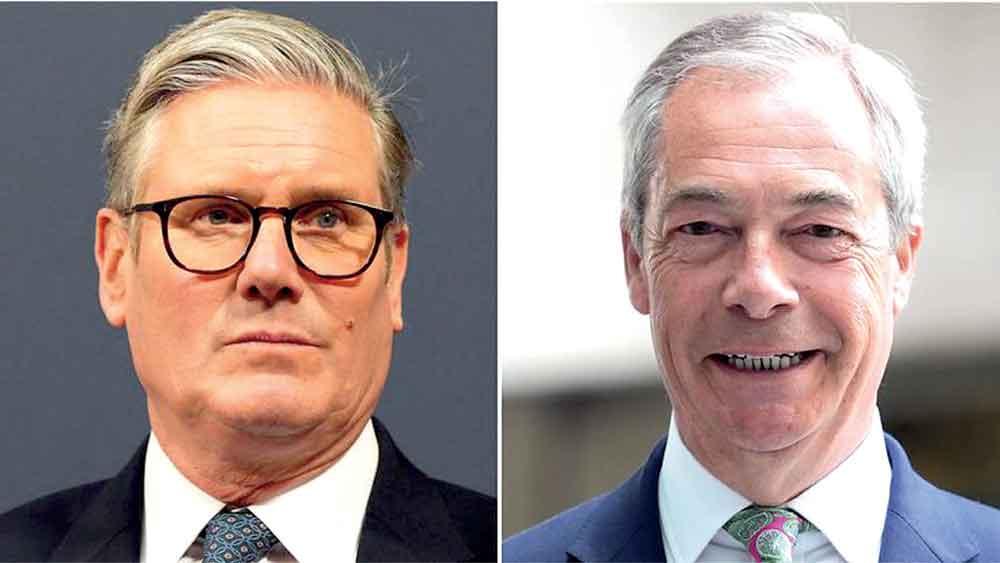
Keir Starmer vs. Nigel Farage: End of British liberalism?
 This is an era of political surprises. New parties have stormed the political arena, demolishing entrenched players in country after country. It all began in Sri Lanka in 2024, when the freshly minted National People’s Power (NPP) swept the polls. In Nepal, the Rashtriya Swatantra Party (RSP), dismissed as a marginal player, stormed the citadel of power in Kathmandu in March this year. It was led by 39-year-old rapper Balen Shah. Two months later, in Tamil Nadu, the fledgling Tamilaga Vetri Kazhagam (TVK) helmed by a brand new leader, film actor Joseph Vijay, proved all posters and pundits wrong by sweeping the State Assembly elections.
And now the UK is seeing the sudden surge of a new force, “Reform UK” founded in 2021. It is seriously threatening the decades-long monopoly of power enjoyed by the Labour and Conservative parties.
In all these countries, the cry has been for a change from the old order that was nothing but a circulation of elites. The same set of persons were taking turns to rule, making the same promises and not fulfilling them. It is this stale fare that people rejected. Changing demography also had a lot to do with the urge to seek or even force a change. As the older generation despaired helplessly, the young, Gen Z to be precise, took up the cudgels and led the charge.
Reform UK Prevails Over Labour
In the May 2026 local elections in the UK, the 2021-born “Reform UK” took control of 13 Councils and gained over 1,400 seats, becoming a significant force in many local Councils. The party’s success has now questioned the viability of Labour leader and Prime Minister Keir Starmer, and cast a shadow on Labour’s prospects in the 2029 UK parliamentary elections.
A year ago, the Labour Party had won the largest majority in Parliament in the 21st century and consigned the Conservatives, Labour’s historic rival, to its worst defeat. But now, after 15 months in power, Labour leader Keir Starmer has become the “most unpopular British Prime Minister on record” according to “The Independent”.
Pollster Ipsos found that only 13% of voters said that they were satisfied with Starmer. Reform UK – the upstart hard-right party led by firebrand Nigel Farage – had surged to around 35% in the Ipsos poll.
Starmer came to power because 14 years of Conservative rule had left Britain’s public services in tatters, with the waiting lists in the National Health Service (NHS) reaching record highs. Infrastructure decayed. Labour was elected to repair the damage, but instead of raising the income tax, Starmer shut off a major source of revenue. Instead, he slapped taxes on the small and vulnerable sections. He lacked vision and a coherent narrative.
In contrast to Starmer’s colourless personality, Reform UK’s Nigel Farage was brash and combative. Farage took on Labour’s wishy-washy policy on illegal immigration. Tens of thousands of illegals land on England’s shores in small boats. They are housed in hotels at state expense. Reform’s Right Wing Populism
Reform UK has pledged to abolish the “Indefinite Leave to Remain” or ILR provision, which gives migrants settled status in Britain. But Starmer has labelled that as “racist” and Home Secretary Shabana Mahmood said Labour would double the time to qualify for ILR from five years to 10. These announcements shocked the British.
Reform promises to cut the NHS waiting lists to zero in two years; income tax exemption for front-line workers; tax relief on private healthcare and insurance; public inquiry into excess Covid deaths and vaccine harm; and review of all NHS private contracts.
It promises to exempt two million frontline healthcare and social care workers from the basic rate of income tax for three years as part of a push to retain existing staff and ensure the return of former staff. NHS patients would receive a voucher for fully-funded private treatment if they could not see a general practitioner within three days, a consultant within three weeks, or have an operation in nine weeks.
It has also promised tax relief of 20% in all private healthcare and insurance, with more private healthcare providers used by the NHS to drive waiting list numbers down. But all NHS private contracts would be reviewed as part of a drive to “cut waste, bureaucracy and unnecessary managers”.
Nigel Farage has suggested the UK adopt a French-style healthcare system. Reform UK would raise the minimum income tax threshold from £12,571 to £20,000, exempting six million people from having to pay income tax. It would scrap stamp duty on properties under £750,000; abolish inheritance tax for estates under £2 million; scrap VAT on energy bills; and reduce Government spending and half the foreign aid budget.
Reform UK insists that the UK’s flagship green goals make taxpayers worse off, and therefore it would abandon all existing carbon emissions targets if elected, a move it estimates would save the taxpayer £20 billion per year and “possibly more” for the next 25 years.
Clean nuclear energy would also be sped up by using new small, modular reactors, built in Britain, while domestic lithium mining would increase to reduce overseas dependence on electric batteries. The annual £10 billion of green energy subsidies would be scrapped.
Reform UK pledges to scrap interest on student loans; ban teaching gender ideology and critical race theory; give tax relief for private schools; introduce home economics and make school curriculum more “patriotic”.
Reform UK would require universities to provide two-year courses to reduce student debt and allow graduates to enter the workforce earlier. A new Armed Forces Justice Bill would protect serving military personnel in the UK and abroad from civil law and human rights. Defence spending, which is currently on track to reach 2.25 per cent next year, would increase to 2.5 per cent by 2027 before rising to 3 per cent by 2030. The manifesto also states that Reform would recruit 30,000 new full-time soldiers for the Army.
Violent offenders would receive automatic life imprisonment as part of an urgent review. The definition of hate crime would be changed to require “proper evidence”; pro-Palestine marches would be banned and 10,000 new detention places would be created.
The Reform UK manifesto states that “foreign gang crime” accounts for most organised crime in the UK. It costs £37 billion per year. “This includes drugs, people trafficking and money laundering through barbershops, car washes and nail bars.”
Reform UK wants the UK to leave the European Convention on Human Rights. It would freeze “non-essential” migration; reduce student visas; and ban new arrivals from receiving benefits.
The party has pledged to introduce an immigration tax forcing employers to pay an increased National Insurance rate of 20 per cent for every foreign employee, compared with the current 13.8 figure for domestic staff. Citizenship would be withdrawn from immigrants who commit “significant” crimes. A proposed clamp down on student visas and their dependents is designed to mean that only students with essential skills can remain in the UK as soon as their studies end.
In sum, Reform UK promises to invigorate the British economy and end social and political liberalism, as in Trumpian USA. The dominance of the Whites will be ensured by demolishing the post- World War II image of Britain as a multi-racial liberal country.