Reply To:
Name - Reply Comment
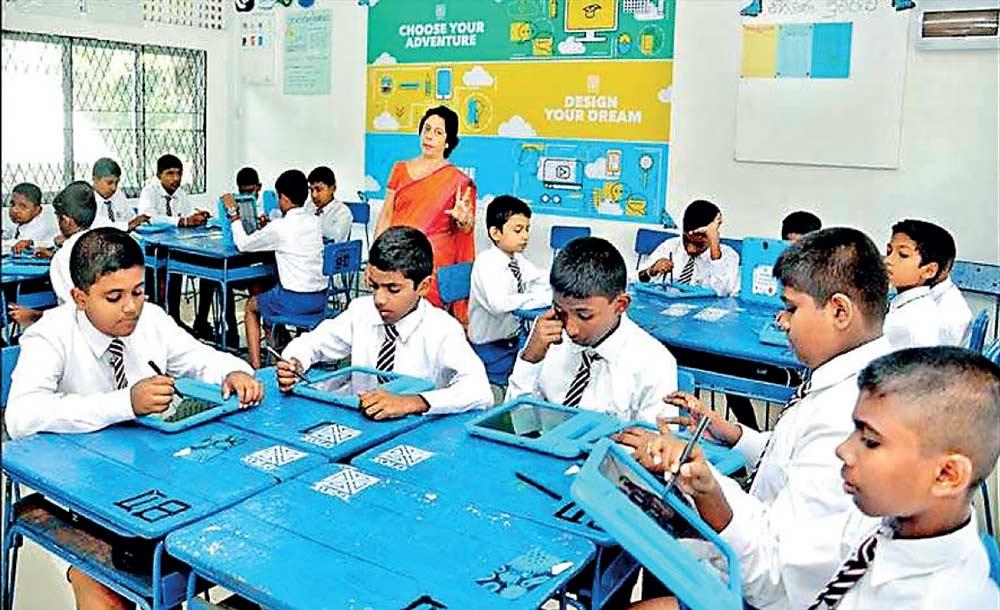
Above symbolic slogans of protecting free education lie the issue regarding robust resource allocation and, as a result, depriving children of a good quality education. FILE PHOTO
 Our free education system at the school level is neither broken nor struggling. It has performed tremendously well
 The government’s proposed education reforms, in their snippets that are still available for public knowledge, appear to be transformative. The optimist in me makes me think that, if implemented, they could well be the greatest contribution to free education in this country in decades, if not for over half a century. Ideas are impressive; however, a detailed blueprint is lacking—perhaps it is in the making, or the government has not chosen to make it public. Since the education of children in this country is not the type of stuff that is discussed in the National Security Council, the government has an obligation to come up with a detailed plan, with more stakeholder participation. Yet, none of that should be a reason to undercut the process or to play petty political gamesmanship, which some opposition parties seemed to be indulging in, which is also sadly the signature behaviour of the many members in this government and their elders, way back to the Education White Paper in the early 1980s.
However, one should give it to the government and the Prime Minister in her capacity as the Minister of Education for placing the education of our children among their topmost priorities. That is something its successors callously neglected. As a result, we are a decade behind even the most generous account. That also makes education reforms all the more urgent and a national endeavour. Probably the missing link of our less-than-inspiring economic growth is the failure in comprehensive education reforms, alongside the stifling red tapes that make the country even less appealing for investment. The government now has a historical opportunity to break this stranglehold.
The President, who delivered a lengthy speech in Parliament, probably underscoring the government’s importance on education reforms, said education reforms are not mere revision of curriculum, but ‘a fresh transformation of our entire society, our economic body and our country’.
The revision of the curriculum itself appears to be revolutionary if one goes by even the sparse details available. It compartmentalises education into five stages—early childhood, primary ( Grade 1-5), Junior secondary (Grade 6-9), Senior Secondary (Grade 10-11) and Senior Secondary College level (Grade 12-13), and introduces a modular and credit-based curriculum and assessment system. Subjects are also forward-looking, keeping track of the underlying social, economic, and technological changes. One would expect the syllabuses to be equally transformative.
Our free education system at the school level is neither broken nor struggling. It has performed tremendously well. The overhyped analogy of mushrooming tuition classes has much to do with the competition for limited places in universities—in the same way, aspiring and well-to-do applicants for top-notch schools in America spend tens of thousands of dollars on standardised tests. Yet, there are resource disparities. However, as the President noted in his speech, certain dogmas have perpetuated the inequality.
He observed: “In 2023, there were 98 schools with no new admissions. Furthermore, 115 schools had fewer than 10 students, 406 schools had fewer than 20 students, and 752 schools had fewer than 30 students. There were 1,141 schools with fewer than 40 students and 1,506 schools with fewer than 50 students. This means approximately 15% of the entire school system falls into these categories. Moreover, there are 3,144 schools with fewer than 100 students. This means approximately one-third of all government schools have fewer than 100 students.”
Beyond the slogans of protecting free education, this is the crux of the problem. This distorts resource allocation and deprives the children of a quality education. Since those kids generally come from the most disadvantaged socio-economic sections of society and areas, a low-quality education effectively feeds into another cycle of inter-generational poverty, at the very least, crippling under-employment.
The government’s reforms envisage massive investment in infrastructure and teacher training. It should also rationalise the spread of the school system in the country, setting a minimum student number within a feeding area and develop each school to be on par with its better-equipped counterparts in the cities. The distance should not be the primary criterion, which can easily be addressed with a publicly funded school bus service. Instead, schools throughout the country should be equipped and continuously invested with resources to provide a world-class education to the children of this country.
Sri Lanka’s free education system has been a great equaliser. However, these days, education is much like international politics—it’s not how good our system is, but more importantly, how good we are compared to our competitors. However, successive governments have opted not to conduct international comparative examinations such as PISA (Programme for International Student Assessment). The latest reforms propose skill assessment and a ‘psychometric test’ at Grade 9 to assess literary and numerical skills, which might give a general idea of the comparative performance of our 14-year-olds against their international peers.
However, the greatest concern is not the school education, but what comes after it. In 2024, approximately 273,000 students sat for the GCE Advanced level, of which 177,588 or 65% qualified to apply for university entrance. However, public universities admit only 45,000 students, leaving the vast majority of the cohort with limited higher education opportunities. As much as public universities have underperformed in international comparison, incessant student activism there has deprived the country of the chance to build a public-private partnership. The numbers reek of despair when you add nearly 100,000 students who fail to qualify for university admission. The proposed education reforms emphasise skill paths in the secondary and senior secondary education, which might address some concerns. However, the fundamental problem of limited university and vocational training opportunities, in part due to the callous self-interested activism of their own peers in publicly funded universities, would continue to stun the future of the vast swathe of Sri Lankan youth. The government should come out of its ideological straightjacket and explore innovative solutions, which are not hard to find, if it borrows from the success of lead nations. It can establish a separate agency to promote public-private partnerships in higher education and strive to lure some of the top 300 global universities to set up branches in Sri Lanka through financial and other incentives. Similarly, it should welcome internationally recognised vocational training providers, provide incentives to set up branches in the country and cultivate a long-term partnership. The President announced that the government would set up 40 vocational training colleges in the coming years. That is a step towards the right direction. However, considering the underperformance of state-owned similar institutions among others, under the Vocational Training Authority, which has barely filled half of its student intake, it would help to learn from the current deficiencies and also to strive for some form of private-public partnership with the country’s trade bodies and willing international partners. That would mitigate the prospect of long-term stagnation, but most state-run institutions are generally condemned. The President noted that only 3% of Sri Lankans work in the professional sector. In order to increase the percentage of professionals and skilled labour, the country might need to set up quality technological colleges that are similarly structured to India’s Institutes of Technology. Such institutions could be set up in association with internationally recognised institutions of friendly countries. Such an association not only cultivates human capital but also brings in investors, who are more likely to place faith in the graduates churned out by their own institutions.
Finally, it would be financially draining and unaffordable to publicly fund a large-scale, quality tertiary education. The quality of public universities in this country is a case in point. The government should introduce a tuition fee loan system to finance the university and vocational training education of hundreds of thousands of our children. That itself could be transformative.
The government’s education reforms offer a momentous opportunity to transform human capital and turbocharge the economy. It should not be politicised, nor should it be allowed to be undermined by petty party politics.