Reply To:
Name - Reply Comment
US-India relations haven’t worked out the way Modi envisaged
 Jawaharlal Nehru, India’s first prime minister, invested heavily in newly independent India’s relations with the People’s Republic of China, which New Delhi was among the first to recognise. Comradery with China was not just a pillar of his policy of non-alignment. It was part of Nehru’s civilisational outlook, which defined what India would become: A secular multiparty democracy, with a strong judiciary, and a military firmly under civilian political control. Also, India became a byword for the Licence Raj of quasi socialism.
Hindi-Chini bhai bhai(India and China are brothers) was the catchphrase of Nehru’s China relations. So much so that when relations were strained along their disputed border, Nehru never suspected China would attack. Then, when the Chinese fought a brief but bitter border war and routed the Indian army in 1962, Nehru suffered a reality check. Nehru, being Nehru, survived in his office, but he nursed a huge sense of betrayal until his death. Barely one and a half years later, he died heartbroken.
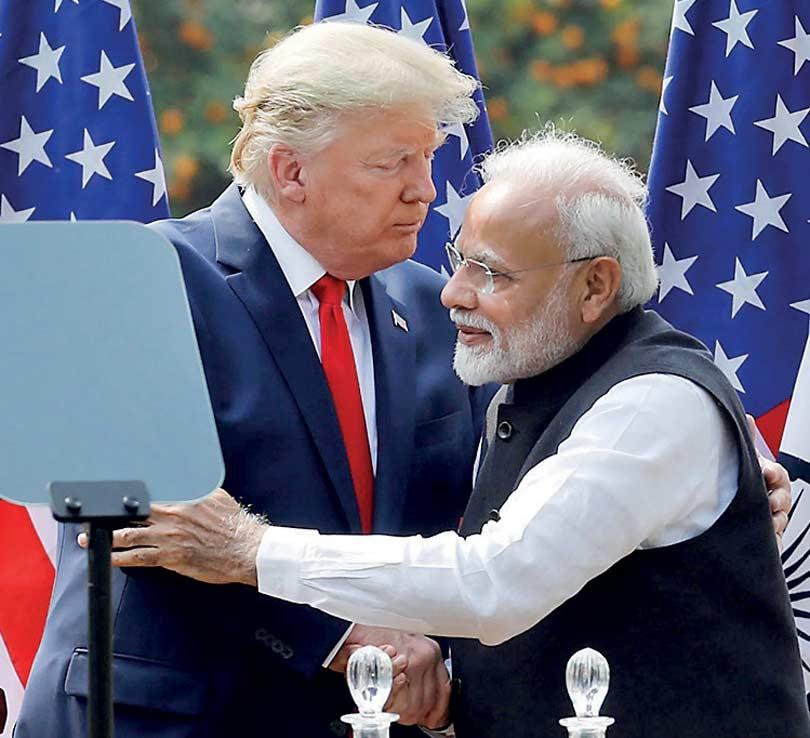
Leave aside that last part; much of the same could now be said about the incumbent. Narendra Modi took great pride in his relations with Donald Trump, who hosted him during his first term in a mega Texas rally, aptly titled ‘Howdy Modi.’ When Trump on his second term tossed the wrecking ball of trade tariff against America’s (mainly) friends and foes, Indians thought Modi’s bromance with Trump would not only spare India from the worst, but also create new opportunities for India to become the next global manufacturing hub, thanks to global firms exiting and diversifying from China due to Trump’s trade war. But in a single off-handish broad stroke – and an act generally reserved for hostile states -- Trump has shattered all that hope.He slapped a 25% punitive tax on Indian goods, punishing India for its purchase of Russian oil, on top of an earlier 25% Trump tariff, making Indian exports to America among the most heavily taxed and effectively pricing them out of competition. Along with that, any hope of India becoming a destination of global companies’ ‘China plus one’ strategy evaporated.
Modi was left with two choices: cut down on Indian oil purchases from Russia, double-cross its ‘all-weather friend’ and a major defence supplier, intriguingly -- all the while Mr. Trump is sycophantically cozying up to Putin -- or look for new allies and opportunities. The first option would come at a huge reputational cost for Modi, who has positioned himself in a muscular nationalism at home, as well as India’s broader policy of non-alignment, now repurposed as multi-alignment, and India’s perennial emphasis on strategic autonomy.
The lacuna of the second option is that there are not many friends nor opportunities that could match the heft of America, if such a choice comes at the expense of its two-and-a-half-decade-long partnership with the USA.
Treading softly
Modi had trodden softly: While India has stopped short of retaliatory tariffs on American imports, thereby keeping room for negotiation, Modi has moved to mend fences with the neighboring giant, China. He attended the just-concluded Shanghai Cooperation Organisation summit in Tianjin, marking his first visit to China in seven years. The earlier hopes of a growing thaw between New Delhi and China after Modi’s visit to Wuhan in 2018 were dashed in a savage fisticuff between Chinese and Indian forces in the glaciers of Galwan two years later. Since then, relations have remained frozen, although the two sides have moved on to de-escalatory measures and protocols of engagement between the armies of the two sides on their disputed border.
The recent thaw began after Modi met with Chinese President Xi Jinping on the sidelines of the BRICS summit in Kazan, Russia, in October last year, well before the Trump tariffs. However, Mr. Trump has surely added incentives for India to repair its relations with China, which may explain Modi’s attendance at the summit, first mooted by Russia and China in the early 2000s as a de facto bloc of security cooperation to limit Western influence in Central Asia. Modi skipped the previous summit in Kazakhstan last year. In the just-concluded summit, Xi Jinping invoked an old slogan: “for the dragon and elephant to dance together.”
“It is the right choice for both sides to be friends who have good neighbourly and amicable ties, partners who enable each other’s success,” Xi said.
Modi said India was “committed” to taking their countries’ relations forward “on the basis of mutual trust and respect,” and referenced their bettering of ties, including an easing of tensions along their disputed Himalayan border – where the two fought a deadly skirmish in 2020.
“The interests of 2.8 billion people in both our countries are tied to our cooperation,” he added.
Leave aside the de-escalation of the border, which Nehru referred to as a forsaken land,‘where not a blade of grass grows’, which still looms over as the main obstacle in the bilateral relationship. However, the very idea of two neighbouring great powers - each with contrasting political systems and historical claims to greatness -- in cooperating, rather than balancing -- against each other, leaves much of contemporary understanding of great power politics on its head. Therefore, the growing Indo-China thaw leaves much to be seen in the years to come.
However, Mr. Trump, who had himself taken credit for solving many global conflicts, could take credit for pushing India and China together, and effectively, hitting an own goal, and potentially setting off the undoing of America’s Indo-Pacific strategy. His cozying up to Pakistan’s army chief and de facto leader, Asim Munir, might alone make India ponder over America’s credibility as a reliable ally.
What we are witnessing may be a short-term major geoeconomic opportunity – or if it persists, though unlikely, a major geopolitical reconfiguration in South Asia and the Indian Ocean in the decades to come.
In the immediate term, Sri Lanka could tap into Indian firms (electronics, gems and jewelry, and pharmaceuticals), diversifying out of India to escape Trump’s tariffs. That offers Sri Lanka an opportunity to diversify its export basket, create employment, and cultivate trade and industrial nexus with the world’s fastest-growing large economy. However, Sri Lanka has a limited window; it’s unlikely that the US-India trade split will outlast, at best, the Trump administration. The government should act fast and present Sri Lanka as a favourable second hub for Indian businesses, not just ones selling to America, but for the broader Indian industries and its world-beating tech firms. Sri Lanka should do so with extreme care, without being seen as undercutting India at its time of duress. Nonetheless, this is a monumental geoeconomic opportunity that Sri Lanka should not miss. The government should set up a dedicated mechanism to make it easier for Indian businesses to move in and set up shop, and should actively lure them.
Secondly, if the punitive tariff on India persists, it would decouple the Indian economy from America. With economic decoupling, it is unlikely for a strategic alignment to last long. One might wonder how India, strategically detached from the United States, would behave. The most extreme example would be India in the 1970s and 1980s, which loathed the presence of external powers in the region, particularly in its de facto sphere of influence in South Asia and the Indian Ocean region. In the early 1980s, J.R. Jayewardene burned his fingers and burned the country by trying to be too cocky with Indira Gandhi’s India. India’s broader strategic policy is aptly named ‘Indira Doctrine.’
However, there is a second analogy of Nehru’s predicament in 1962. The Chinese attack vindicated the reservations of those, like Sardar Patel, who had warned him very early on about the danger of Chinese intentions. Those concerns resurfaced after the Indian route in the border war, and some in the Cabinet demanded a greater alignment with the USA. Instead, Nehru persisted in his policy of non-alignment.
Similarly, would Modi proceed in the well-trodden path of the US-India partnership, which his administration brought out of the cold? Or would he take a U-turn? Time will tell.
Follow @Ranga Jayasuriya on X