Reply To:
Name - Reply Comment
Only if you make sure that the ocean ecosystem is functioning, that it actually has the resources needed, only then can it support long-term sustainable fisheries
We don’t really understand the marine environment, because, even if some of us are divers, we don’t really see the complicated marine organisms
You have a changing precipitation system and different run-off from land. You can also have different contributions from agriculture and industries that would affect the marine environment
Being close to the ocean does something good for your health. That’s why all the tourist resources want to be with a sea view. It has actually been proven by medical doctors that it actually works
There are other minerals that we still have a lot of undiscovered on land. Actually, it’s much easier to mine on land than in the deep sea because many of these resources are several thousand metres deep
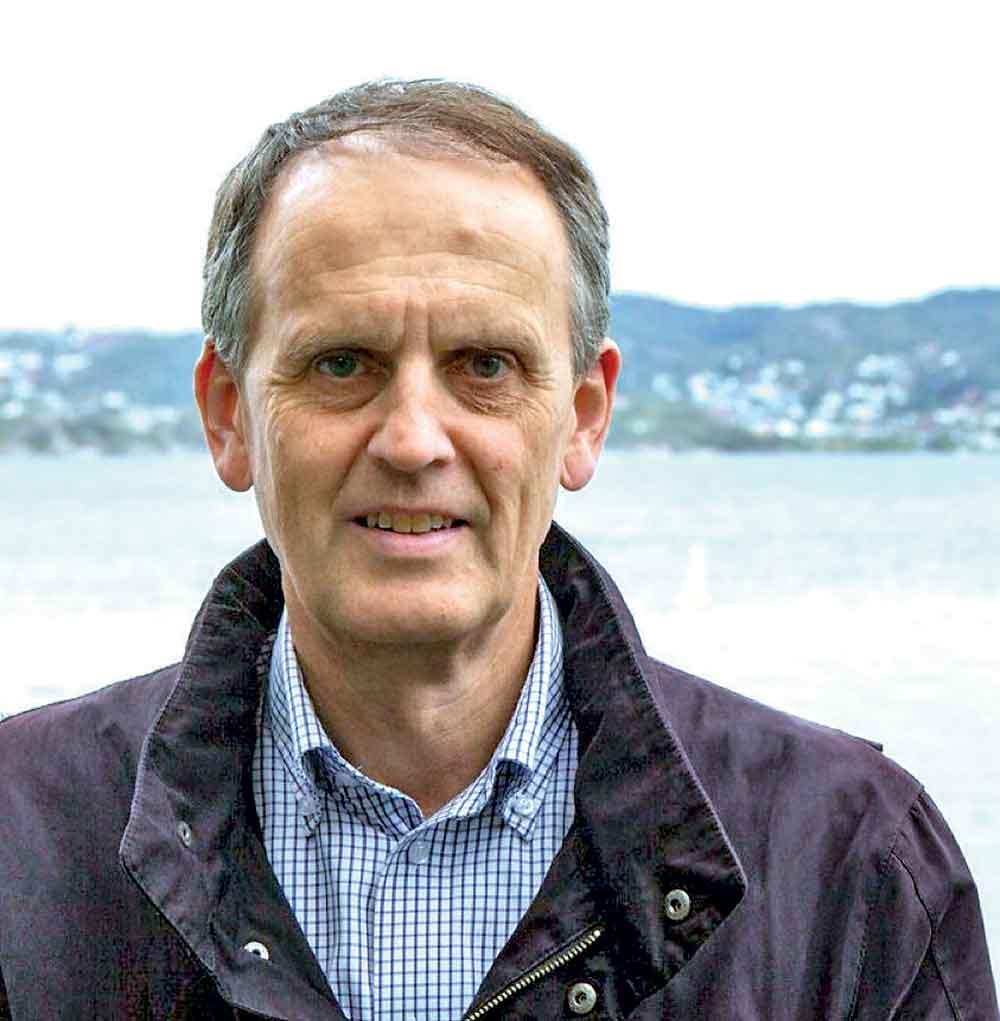
Peter M. Haugan, the policy director at the Institute of Marine Research, Norway and a professor at the Geophysical Institute, University of Bergen in Norway, shares his vision on the blue economy and what the ocean holds for the benefit of mankind. He has more than 30 years of experience in marine scientific research and international ocean science coordination covering ocean, climate and energy issues. His professional merits include five years as a Research engineer in the petroleum industry in the early 1980s. He was in
Sri Lanka at the invitation of the Pathfinder Foundation.
QHow important is it for the countries to get together to realise the potential of a blue economy for shared prosperity?
I think that’s crucial. The ocean is a shared resource. There’s only one ocean, and you have it together. I know that there are fisheries resources that move. Fisheries then have to go across borders, perhaps. If one country pollutes, it can affect the other country. So, you need to have collaboration on that. We have also seen from many other regions where countries go together at the highest political level. The heads of state agree to jointly manage and use a shared resource like the ocean. Only then can we really harness the possibilities that the ocean economy offers.
QAs far as the realisation of the full potential of the blue economy in this region is concerned, what is your assessment?
Well, I’m not an expert on the region. So, I shouldn’t be too specific on that. But I think, in general, what we see is that investing in the sustainable planning of the ocean resources is very good. It is an investment that gives a good return. Only if you make sure that the ocean ecosystem is functioning, that it actually has the resources needed, only then can it support long-term sustainable fisheries. Only then can you get the resources out of the system.
The other aspects of the ocean economy are typically maritime transportation and tourism. Tourism is also much easier to do in a well-functioning, healthy ocean. You will not have tourists coming to look at a polluted ocean.
QIn recent months and years, Sri Lanka has experienced a change in climate. As far as the Indian Ocean is concerned, how does it affect climate change?
Yes, we have seen it in other parts of the world. I come from a very cold country. What happens there is that if we have heat waves, even in the ocean, some fish stocks move. That could happen here as well. I think we don’t know enough about how quickly that would happen. But it could happen because different fish have different preferred temperatures and conditions.
You have, in this region, run-off from land, which is polluted water. You have a changing precipitation system and different run-off from land. You can also have different contributions from agriculture and industries that would affect the marine environment. When the climate changes, these will also change. I think that’s where we need to know a bit more about what the perspectives are and what the actual impacts are on different parts of the environment.
QHow important is it for countries like Sri Lanka to devote a percentage of their national budgets to doing research in the ocean, actually?
It pays off. It’s an investment. We are humans. We are land animals. We understand trees, plants, animals and land. We don’t really understand the marine environment, because, even if some of us are divers, we don’t really see the complicated marine organisms. We may fish for some species. We have some shellfish and something that we know. But the marine environment is so fascinating, with plants and animals and how it all works.
I’m sure there are unutilised resources in the ocean beyond what we normally eat and normally take out. Only by researching it, creating people’s attention to the ocean, providing ocean literacy to the people at large, writing in newspapers like you are doing to educate people, only then can we realise the potential of the ocean for a blue economy.
QCan you support your point with some examples?
You may be surprised at this- Ocean and Human Health. People talk about one’s health. It is amazing how people’s health relates to the ocean in different ways.
From food to medicine, there are a lot of untapped resources. There are genetic resources in the ocean for medicine. You can see some of the COVID medicines came from this.
Being close to the ocean does something good for your health. That’s why all the tourist resources want to be with a sea view. People like it. It has actually been proven by medical doctors that it actually works. A connection to the ocean is probably something installed in our bodies and brains even before the human race developed properly. We are connected to the ocean. We like to be there.
QWe also have some untapped petroleum resources in the ocean. What is your opinion about them, particularly in this region?
I don’t think it would be unfair if Sri Lanka develops its petroleum resources. My home country, Norway, is a big oil and gas country. We had a big discussion. We should reduce oil and gas production because of the climate impact of fossil fuels.
I’m hoping that the age of oil and gas is limited. So, there is a danger in investing in petroleum. It will not be something that you can rely on for a very long time.
QIs that the kind of idea or advice you can present to the Sri Lankan government?
Yes, that’s my personal opinion. It is a risky business because it won’t be long-lasting.
But I would not say that it’s wrong for Sri Lanka, also like lots of other countries, to exploit its own natural resources. That’s a natural thing. But it is a risky investment.
QOceanic activities lead to geopolitical issues among countries. Now, for example, Sri Lanka is facing a huge issue with India, which protests Chinese research vessels involved in maritime research activities here. What is your view?
I have a very strong opinion about ocean research and how it can be used and should be used.
I think it’s crucially important that ocean research is done in a way where data, observations, information, and knowledge gathered from that are shared among different nations, particularly when it happens in international waters.
If another country wants to do scientific research in the exclusive economic zone of, for example, Sri Lanka, it has to have a permit. Then, the country can add conditions that they put scientists on board and that they get the data and so on. I think there is great potential for international collaboration in ocean science.
The Dr. Fridtjof Nansen vessel that is operated by the Food and Agriculture Organisation (FAO), funded by Norway and with scientists from my institution will be coming here in the middle of August to do a survey where we will have Sri Lankan scientists on board for one leg in Sri Lankan waters and then it will go to Bangladesh with Bangladeshi scientists on board to do investigations in their waters.
I think there is great potential for more research vessels, small and large, to work together to cover different areas, to share data, to share expertise, provide capacity building for science, but also to provide information to the public - ocean literacy.
QTo avoid these geopolitical concerns, how can countries cooperate with each other?
I think they can do it under the present programme called the United Nations Decade of Ocean Science for Sustainable Development. It’s a very long name, but it runs from 2021 to 2030. We are mid-term in that decade.
I just call it the ocean decade because it’s really focused on that. Under that framework, you can go together, and create projects and programmes that address various missing information in science, and ways for mechanisms by which ocean science can inform policy development. I think that could also be explored for this region very much.
Transparency is a key word because, if you have political, geopolitical tensions and conflicts, the worst thing that can happen is that opposing parties have different information, different data. But if you have the same information, the same scientific observations, the same basis, it provides a much better basis for both negotiations and agreement rather than conflict.
I think ocean science can be a critical tool to avoid conflicts and actually lead the way towards more collaboration between nations.
QHow do you see the issue of rare minerals in the ocean?
I think the potential of deep-sea minerals to be crucial for the transformation to renewable energy is actually overstated. I think it’s not so easy to mine these minerals. I think there are some minerals which are in demand, like copper and maybe cobalt and so on. There are other minerals that we still have a lot of undiscovered on land. Actually, it’s much easier to mine on land than in the deep sea because many of these resources are several thousand metres deep. You have to have very sophisticated, very expensive equipment to get it out. It will be difficult to manage the environmental consequences if you do that.