Reply To:
Name - Reply Comment
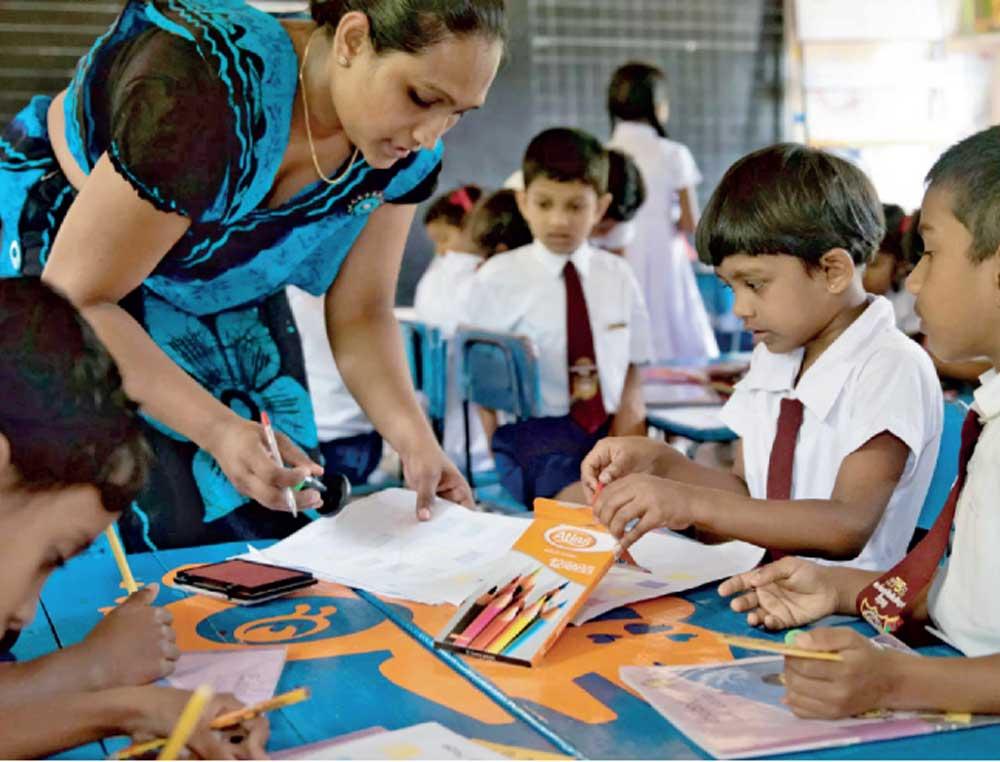
Young learners, big questions: critics warn that reforms may prepare children for the job market, but not for citizenship. Image Source: UNICEF Sri Lanka / Earl Jayasuriya
 Education Minister Dr. Harini Amarasuriya, Prime Minister of this NPP government, travelling around marketing “her education reforms” says, they would be implemented from January 2026 despite false accusations, criticisms and protests. She is yet to release the complete draft of the proposed “Education Reforms”. What has now been hastily released through social media is a PowerPoint (PPT) presentation that the Ministry of Education (MoE) perhaps uses to explain reforms to provincial and zonal education bureaucracy. The social discourse that a government should invariably engage in, especially with education reforms, has thus been completely shunned.
Total absence of “accountability and transparency” is not all that makes them akin to previous governments. The JVP/NPP government took over the whole economic programme signed with the IMF under President Wickremasinghe in March 2023, for they had none of their own to negotiate on. Now, Education Minister Harini Amarasuriya is preparing to implement education reforms begun in 2019 and completed by 2023 under President Wickremasinghe’s administration, approved by his Cabinet. Kin of the old regimes, no doubt.
If we begin this discussion based on the PPT presentation of the MoE, a middle-class majority may agree with these reforms, for there is a clear job orientation in it. The “National Curriculum Framework” (NCF) prepared by the NCF ‘Team’ established in 2019 at the National Institute of Education (NIE), was approved by the governing body of the NIE in 2022. No doubt, there are contentious issues within them when the focus shifts more towards employment. The main expectation written as “Overall Goal” (No. 2 - Aims & Objectives/Overall Goal) for this reform package is better articulated in the Kannangara Education Reforms, adopted by the State Council as Sessional Paper No. 24 of 1943. The fundamental objective of the Kannangara Reforms is to provide a rational thinking citizen to society, one with a strong personality who understands the cultural diversity of this country and would positively relate to it. The “overall goal” of the now proposed education reforms is stated as “To lay the foundation for creating a citizen ready for the challenges of and beyond the 21st century, and to contribute to the process of sustainable national development and peace of the country.”
Contradictions begin here with “objectives” mentioned as “Foster 21st century skills; Promote entrepreneurial mindset” backed by other objectives like “Enhance curriculum relevance and quality with Increase enrolment in Science and Technology Streams” while curriculum relevance is left undefined.
These objectives effectively change the “Overall Goal” stated under “No. 2 - Aims & Objectives”, leaving stress on employment. Demand for an “employment-focused” school education system gained a louder voice over the last few decades, among middle-class parents. Now it is more or less established as a responsibility of the formal school education.
If we don’t spare a little time to understand how training children for employment came to be entrenched as a responsibility of formal school education, we would end up accepting vocational education and training for employment as the main objective in school education that by now hinders producing children as worthy citizens, who could think humanely and rationally, have empathy for others, stand for a multi-cultural society and for peace and unity.
Let me say this clearly. ‘School is no vocational training centre’. It was during the second half of the decade of the 60s, when I.M.R.A. Iriyagolle was the education minister from 1965 in PM Dudley Senanayake’s government, that pre-vocational education came to be discussed as necessary in school education. This Senanayake government, with no attention paid to model the economy as one that generates employment, was caught in fast-increasing unemployment, an issue since the early 60’s. The Institute of Policy Studies (IPS) is on record as saying that unemployment was 300,000 in 1960, and had increased to over 800,000 by 1971. Thus, towards the end of the Senanayake tenure, unemployed graduate numbers increased, with the education minister Iriyagolle accused of ignoring them. Demand for ‘employment as a right’, campaigned for by university dons and students, thereafter established the social mindset, the government is wholly responsible for employment.
Dumping the responsibility for employment on the government negated the much-wanted discussion on economic alternatives for creating employment. Discussion for an economy that should be productive, generating not only foreign exchange and State revenue, but also regular employment, was never paid any attention to. An easy way out was to hold the government responsible for ‘jobs’. This brought pressure on the ruling government, which from the late 60s led to ministers and MPs taking over providing jobs in government departments and in State corporations. Subsequently, the same middle class that cried for ‘jobs as a right’ and as a responsibility of the government, began demanding ‘privatising’ of State agencies, saying they are loss-making and are a burden on society.
Such social irresponsibility kept pressure on the political system and compelled Madam B’s government to enact the ‘New Education Reforms of 1972’. This was the first reform package that integrated vocational skills development within the school curriculum. Two new subjects, ‘Pre-vocational Studies 1 and 2’, were introduced from Grade VI to X. Vocational skills development was based on local traditions and resources that were primitive. While Colombo schools decided on vocational training areas like motor mechanism, radio repair and house-wiring, rural schools were stuck with clay work, masonry, carpentry, gem cutting and the like. Thus, there was growing anger and opposition among middle-class parents who wanted their children to be introduced to professional careers.
With the change of government in 1977, Wickremasinghe, then minister of education, scrapped the ‘72 reforms in their entirety in 1981, and introduced his ‘White Paper on Education Policy’. This was opposed by university dons, students and opposition political parties, leaving school education with no proper reform programme. Yet the middle class demand for employment post-school education, left vocational and skills development within the school curriculum and is now being stressed and highlighted with the proposed reforms. PM Amarasuriya is determined to implement as education minister, yet again, with no social dialogue on reforms.
We as a society have never engaged in a serious dialogue on educational reforms, and led to miserable decisions in reforming education. That, in fact, is the reason for the present demand to have the whole draft of the proposed education reforms published. For such serious discourse to begin, there is also an uncompromising condition to be adhered to in defining formal school education. The social mindset created from the 60’s that holds the government responsible for jobs has to be declared wholly inappropriate. It has to be accepted that school education is about producing a responsible, respected and cultured citizen for society.
The government has a responsibility to provide jobs, no doubt. That is not about appointing to jobs, but about creating jobs. That responsibility comes with the “National Development Programme” based on a development policy, the government should have and implement. The national development programme will have to include an alternative economic model that would create employment.
Thus, skills development and vocational training have to be programmed within national development, aligned with economic needs. This also requires education reforms to be within the national development policy of the government. Sadly, we have no policies.
Education Reforms that PM Amarasuriya is bag piping around are ones that were crafted for this utterly corrupt free market economy, influenced by President Wickremasinghe’s neo-liberal outlook. Free market economies, corrupt as they are, do not demand rationally thinking, respectable citizens. They are mega-city-centric consumer societies of the growing middle class that expand with increasing profits. Another important fact is, it is not possible to pre-decide categories of employment generated in a free market economy and plan for their skills development.
Our experience is that free market economies provide ample space for informal economic activities. It is estimated that over 40 per cent of our labour force is in the informal sector as unskilled and semi-skilled labour. PM Amarasuriya’s unwavering pledge as the education minister to provide all school leavers with an NVQ-4 certificate is about turning out such semi-skilled labour from her proposed education reforms. It is certainly not about creating opportunities for fully trained, qualified technicians and professionals, the middle-class parents are aspiring for. But that is all that a free market would allow.
Meanwhile, the apparent scrapping of the Year 5 scholarship exam and restructuring of the two G.C.E. exams from 2029 are not being spoken about in these reforms. Scrapping the Year 5 scholarship exam is no issue if education reforms could guarantee equal facilities and equal opportunities to all pupils in over 10,000 public schools. Yet introducing a new ‘National Assessment’ at Grade 9 and restructuring G.C.E. exams with national assessments in Grade 11 and 13 would leave pupils in a sour pickle of a sort. They being “national assessments”, inequalities and disparities among different areas and from school to school, including varying attitudes and aptitudes of teaching staff, will certainly leave much to be desired, more because, top bureaucratic promise to train 100,000 teachers within 03 months is a classic case of ignorance and irresponsibility. Our teacher trainers are fossilised old-timers, and would require Minister Harini Amarasuriya to work on a new training programme for teacher trainers, before everything else.
This much is not all that needs to be discussed on reforms. But serious discussions demand that Education Minister Harini Amarasuriya be transparent and socially responsible by making the detailed draft copy of education
reforms public.