Reply To:
Name - Reply Comment
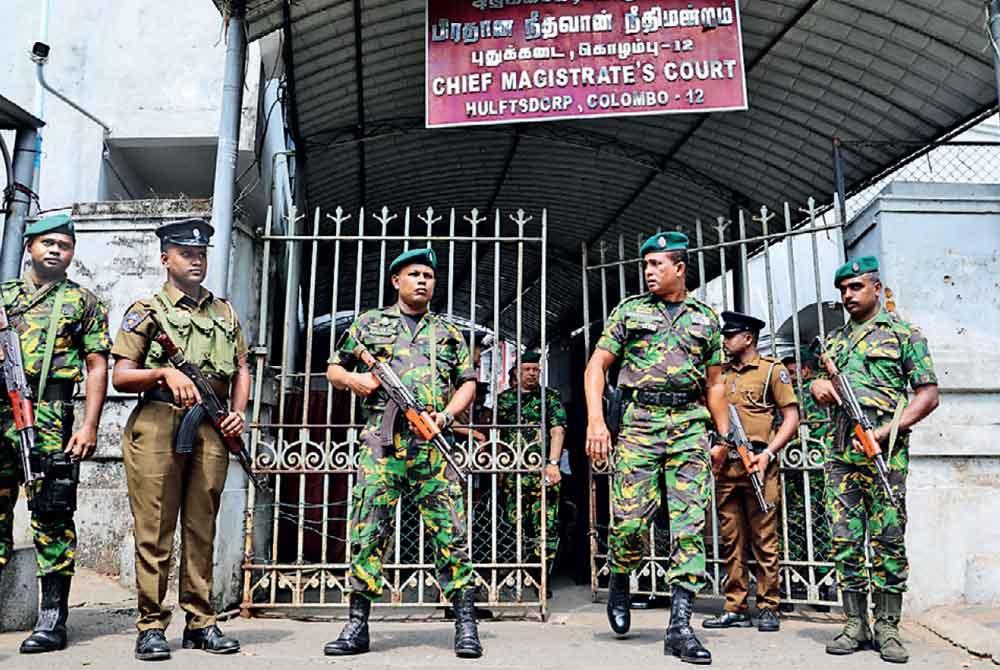
Special Task Force (STF) personnel stand guard outside the chief magistrate’s court in Colombo on February 19 after a high-profile suspect was shot dead inside the courthouse by a gunman disguised as a lawyer, triggering a countrywide debate on national security. AFP
 It may not be an exaggeration to say that national security has become the most politicised topic in Sri Lanka these days. In parliament and political platforms, much precious time is spent on the critique of and in defence of the government’s national security policy, but there is very little introspection.
Just as much as the war is too important to be left to the generals, national security is too precious a subject to be left to the politicians or the government alone. Although ensuring national security is not solely the responsibility of the state, the primary responsibility lies with it. National security is a comprehensive and all-inclusive concept. In a modern state, every citizen and every institution has a role to play in ensuring and enhancing national security. By being civic-conscious and law-abiding, a citizen plays his or her part in ensuring national security.
Usually, national security becomes a public topic when there is an external or domestic military threat to the state. But in Sri Lanka, what triggered the national security debate in recent weeks was a fatal shooting incident inside a courtroom in Colombo and the rise in gun violence. National security is not an alien or rarely discussed topic in Sri Lanka, which has, since its independence in 1948, seen multiple national security challenges in the form of a thirty-year civil war, two major insurrections by angry socialist youths, and the 2019 Easter Sunday attacks by Muslim terrorists.
However, national security threats manifest in multiple formats, arising even from areas that receive limited expert focus. Even a reduction in the health or education budget can pose a threat to national security. If the health budget is slashed to bolster the defence budget, it would undermine the state’s preparedness in fighting epidemics or even preventable diseases. The outcome will have an adverse impact on the economy. The country will be deprived of a healthy working force. The number of labour hours lost will also retard growth. The economy suffers, and the state becomes poorer, lacking resources to enhance its defences to encounter external or internal threats to national security. Moreover, the state will be deprived of a healthy population essential to defend the nation. Volumes can be written by academics and students of national security studies about adverse impacts on national security due to cuts in the health, education, or social security budgets. Such examples are cited to drive home the point that national security encompasses not only a military facet but also many other facets, including socio-economic, cultural, religious, environmental, and cyber security threats, among others, emanating within the country and outside the country. Additionally, one must not underestimate the security threats lurking in the artificial intelligence tsunami.
Such examples also emphasise that national security threats are multidimensional and multistructured. Academics say there are traditional and non-traditional approaches to security studies. They exist at national, regional, and international levels.
As pointed out, increased military spending requires reducing resources for other security sectors such as health and environment. In other words, there is a security dilemma, in which a rise in security in one area causes a drop in security in other areas. There is even a paradox in security enhancement. For instance, if a country increases its security by X amount, it causes X amount of insecurity to its adversary. This gives rise to an arms race and ever-growing military expenditure, which in turn leads to constraints in a state’s ability to ensure social security for its citizens. This in turn may even cause the collapse of a state—like what happened to the Soviet Union.
Non-traditional approaches to security address threats such as ecocide, natural disasters, population explosion, food security, drug trafficking, outbreaks of epidemics and pandemics, economic recessions, and both the absence and the abundance of democracy. Yes, some argue that too much democracy is a security threat.
From a non-traditional security perspective, everything is security.
Within Sri Lanka’s current national security debate, the spike in gun violence is a critical concern, as it undermines efforts to promote the country as a safe tourist destination and, in turn, poses a threat to the economic revival—economic security—that heavily depends on tourism.
In overcoming gun violence, the use of force alone will not succeed. It requires a multi-faceted approach that delves deeper into the socio-economic issues contributing to the rise in gun violence. In its efforts to find a solution to the rising gun violence and underworld crimes, the state must go beyond arresting criminals or tackling the symptoms of the canker. It must address the roots of the problem stemming from societal disintegration. The police alone cannot handle this gigantic problem. Criminologists, sociologists, psychologists, educators, and religious leaders must come together under a state umbrella to prevent the country from falling into civic bankruptcy.
At the core of the security issue is the people’s well-being. Also need to be addressed are issues such as the easy accessibility to guns in the underworld market, the rising drug culture, the existing law’s weaknesses to effectively deal with crimes, poor rehabilitation within the prison system, and the lack of state will to implement the death penalty for big-time drug dealers.
An answer should be found to the question: Why do some children grow up to be law-abiding citizens, while others become criminals? The educators have failed them. The temple, the church, the mosque and the Kovil have failed them. There is certainly a parenting deficiency. Perhaps, pre-natal care programmes in state and private health clinics should also include mandatory parenting courses emphasising the importance of teaching children core values—honesty, truthfulness, fairness, responsibility and respect for law and order. After all, every parent dreams of his or her child reaching a respectable position in society. No mother nurses her child to make him or her a criminal.
Sharing with our readers a story that was instilled in us as children is relevant: When asked by prison officials what his last wish was before being sent to the gallows, a notorious criminal said he wanted to rip open his mother’s chest and eat her spleen. When the shocked officials asked him why, he explained that if his mother had punished or reprimanded him to correct him when he stole his Grade 1 classmate’s pencil and brought it home, he would not have grown up to be a thief and a killer.
The moral of the story is to correct the children when they are young.