 MOHAMED AYUB
 Reply To:
Name - Reply Comment
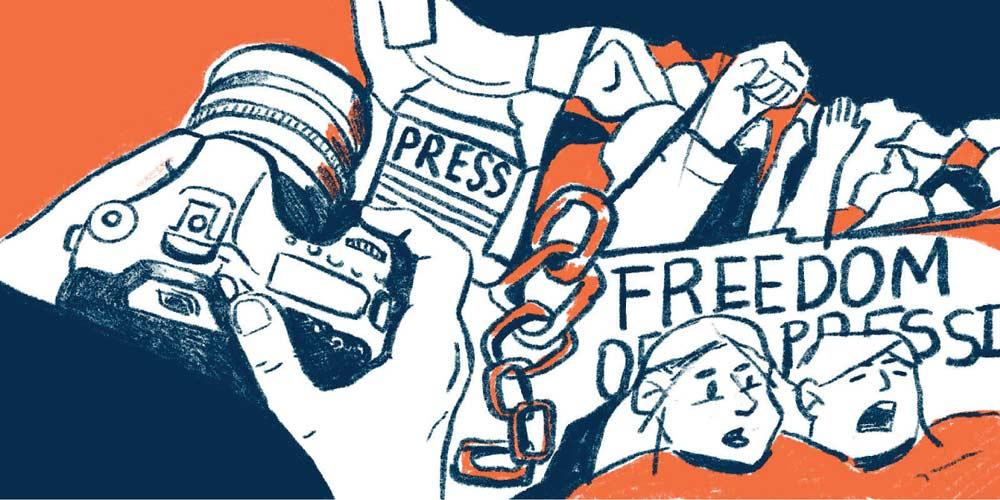
 As pointed out at the beginning, the NPP government was accused of suppressing media freedom when the Editor of Aruna newspaper was summoned by the CID in November. In fact, the same editor had given a statement to the CID a few months ago as well
The National People’s Power (NPP) government is being accused of suppression of media freedom again, a month after it was accused of the same, after the Chief Editor of the Sinhala language daily, “Aruna” was summoned by the Criminal Investigation Department (CID) over a news item published in that newspaper.
The government this time is being accused after the police requested the Telecommunication Regulatory Commission of Sri Lanka (TRCSL) to look into certain news items telecast by a controversial television channel. Even most groups that are not happy with the conduct of the said channel were up in arms against this police action, on the grounds that the police have nothing to do with the contents of media outlets and that such police meddling would be a bad precedent.
The right of the police and the TRCSL to take note of media contents has been a contentious issue. Criticism by the media of actions of any government, or a statement made by a leader of the government is an undeniable and inalienable right of the media, despite it being unacceptable to the government and its supporters. In line with this, and from an abstract point of view, police do not have any right to question the content of a given media.
However, given the fact that there are laws such as the International Covenant on Civil and Political Rights (ICCPR) Act of 2007 in the country that curtail the rights of the media, the police would have to act upon receiving complaints of breaching of such laws.
Whims of the government
Nevertheless, it is common knowledge that it’s not the law acting on its own that mobilises the police against media. They act according to the whims of the government and its members unless on the direct advice of the ruling party. Hence, the government cannot avoid blame when the police take action against the media, irrespective of the fact that it has nothing to do with such action.
In the current controversy, it is justifiable to conclude that police have requested the TRCSL to look into the media content of the TV station in question on the advice of the government, given the government, especially Health and Media Minister Dr. Nalinda Jayatissa, having expressed views endorsing the police action.
Dr. Jayatissa amidst rumours that the said TV channel would be banned or its license would be withdrawn, said during a recent public meeting that if a television channel telecast news and views detrimental to public health and public security, it would be deemed as a breach of the conditions of the broadcasting licence it was granted, and the minister thus has the legal right to withdraw that licence.
He listed some of the news items that were aired recently over certain TV channels allegedly damaging the public trust in public health and public security systems. He recalled a news item repeatedly telecast over these channels in June last year claiming that the controversial Human Immunoglobulin injections that were imported by former Health Minister Keheliya Rmbukwella had been imported by the current government as well.
Not always substandard
He argued that despite investigations having revealed that substandard Immunoglobulin had been supplied by the health ministry during Rambukwella’s time, Immunoglobulin is not always substandard. In a lighter vein, he stated that Immunoglobulin did not synonym with Rambukwella. He accused the media for attempting to instill fear among patients who would be administered with Immunoglobulin.
Secondly, Jayatissa pointed out another fear mongering attempt by Opposition parties and the media among patients following the death of two patients, and the resultant suspension of Ondansetron, a drug used to prevent nausea and vomiting that is caused by cancer medicine or radiation therapy. He stated that the suspension of the drug does not mean that the drug caused the deaths. It was suspended only on suspicion and only until the investigations are over.
The behaviour of certain media outlets after the catastrophe caused by Cyclone Ditwah last month was a clear example for the attempt by certain Opposition parties and media outlets to put the total blame on the government, the minister said. He recalled that they first attempted to say that the government failed to take preventive action despite the Meteorological Department warned about the disaster as far back as November 12.
He pointed out that the November 12 warning was only about an atmospheric turbulence that ended by November 18. Another warning was issued by the Met Department on November 20 about another turbulence which travelled towards Thailand, Malaysia and Indonesia, and later named Cyclone Senyar. It was only on November 25 that the department issued warnings about a depression which turned into a cyclone on November 27, Jayatissa explained with details.
He accused the media for spreading false news on public security and argued that licenses issued to such television channels could be cancelled under the powers vested with the media minister. However, nobody challenged his argument, except for the channel in question.
As pointed out at the beginning, the NPP government was accused of suppressing media freedom when the Editor of Aruna newspaper was summoned by the CID in November. In fact, the same editor had given a statement to the CID a few months ago as well. However, he did not comply this time; nor did the CID follow the matter further after the media community and the Opposition parties condemned the police action against the editor.
The parties that have been champions of media freedom becoming oppressors of the same freedom after assuming power is a common occurrence in many countries. Similarly, parties that brutally suppressed the media, killing journalists and physically attacking media houses while in office, become saints suddenly after falling from power, as we witness now in Sri Lanka.
Clashes between the state and the media can be cropped up due to corruption or mismanagement on the part of the government as well as unethical behaviour of the media. Many journalists these days suggest the government should appoint an independent media commission to handle these issues. However, the question remains if a commission appointed by the government would be independent. On the other hand, many media houses and journalists do not respect the Code of Practice compiled by the Editors Guild of Sri Lanka, or the observations of media behaviour made by the Press Complaints Commissions of Sri Lanka (PCCSL), a creation by the media industry.
Thus, self-regulation of media has proven to be a failure in Sri Lanka. It seems that legal powers have also to be given to such a self-regulatory mechanism, in order to maintain a healthy relationship between the government and the media.