Reply To:
Name - Reply Comment
 Post-mortem examinations of the prison officers killed during the recent violence at Negombo Prison have revealed the brutality of the attack they endured. According to the post-mortem findings, the officers died from severe head injuries caused by blunt force trauma, indicating that they were subjected to brutal physical assaults before their deaths.
The recent violence at Negombo Prison should not be viewed merely as another prison riot caused by rival gangs. It should be understood as a warning sign of a much deeper crisis: the collapse of a detention system struggling under decades of neglect, overcrowding, institutional weakness and a culture of impunity.
|
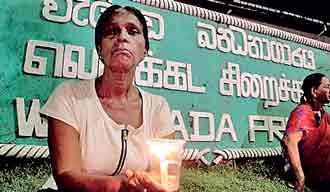
Family member of slain prisoner commemorates the 2012 Welikada prison riot |
The deaths of at least 28 people, including prison officers, and the injuries suffered by more than 100 others are a tragic reminder that Sri Lanka’s prisons have become environments where violence can flourish. While the immediate trigger was reportedly a clash between rival drug-trafficking networks operating inside the prison, the conditions that allowed such violence to occur were created long before the riot itself.
A prison system is meant to uphold justice, protect society and rehabilitate offenders. It is not meant to become a place where human dignity is abandoned. Yet Sri Lanka’s detention facilities have for years reflected the failures of the wider criminal justice system.
The country’s prisons are severely overcrowded. Facilities built to accommodate around 10,000 inmates are reportedly holding close to 40,000 people. Some institutions operate at several times their intended capacity. When thousands of people are forced into confined spaces without adequate medical care, sanitation, security or rehabilitation programmes, violence becomes almost unavoidable.
Overcrowding is a human rights issue.
Many prisoners are not convicted criminals but remand detainees waiting for trials that may take years. Delays in courts, slow forensic procedures and inefficient legal processes have transformed prisons into warehouses for people awaiting justice. The principle that a person is innocent until proven guilty becomes meaningless when individuals spend long periods behind bars before their cases are even heard. The expansion of anti-drug operations has placed further pressure on an already failing system. Large-scale arrests have dramatically increased the prison population, leaving thousands trapped in overcrowded facilities. A policy intended to fight crime cannot succeed if it creates conditions that violate basic human rights and weakens the justice system itself.
A Legacy of Unanswered Violence
Sri Lanka’s prison history reveals that the current crisis did not emerge overnight. Some of the country’s darkest episodes of ethnic and political violence have taken place behind prison walls.
The Welikada Prison Massacre of July 1983 remains one of the most painful examples. During the violence of Black July, 53 Tamil political prisoners were killed by Sinhala inmates inside Colombo’s high-security Welikada Prison.
The killings occurred in two waves, on 25 and 27 July 1983. Among those murdered were Tamil political detainees Sellarasa “Kuttimani” Yogachandiran and Ganeshanathan Jeganathan. Reports described acts of extreme brutality against the victims before their deaths.
The most disturbing aspect of the massacre was not only the violence itself but the allegations surrounding official involvement and failure to protect prisoners. Investigations and witness accounts raised serious questions about whether prison officials and security personnel enabled the attacks. Despite the scale of the killings, no one has ever been convicted. The absence of accountability sent a devastating message: That certain victims could be killed without justice.
The same concerns emerged years later at the Bindunuwewa detention centre in 2000, where 27 Tamil detainees were killed after a Sinhala mob entered the facility. The victims included young detainees, some of whom had been former child soldiers undergoing rehabilitation. Although police officers were prosecuted, the accused were ultimately acquitted.
Hidden Crisis of Violence, Abuse and Impunity
The Kalutara Prison killings of 1997, where three Tamil political prisoners were murdered by Sinhala inmates, further demonstrated the recurring failure to protect vulnerable detainees. The International Commission of Jurists questioned how killings inside a high-security prison could occur without serious failures or possible involvement by officials.
These incidents reveal a troubling pattern: violence inside prisons has often been accompanied by questions of discrimination, accountability and state responsibility.
Torture Allegations and the Duty to Protect Prisoners
Recent allegations following the Negombo riot have renewed concerns about what happens to prisoners after public attention fades. Human rights organisations have reported claims that some inmates transferred from Negombo to other facilities were subjected to severe mistreatment. Reports of deaths after transfers have led to calls for independent investigations into possible torture. The Human Rights Commission of Sri Lanka has acknowledged receiving credible complaints of prisoners being beaten and abused after being moved to separation units, including at Welikada Prison. The Commission has called on prison authorities to ensure access to lawyers and medical professionals for affected detainees.
These allegations must be investigated transparently. Prisoners lose their freedom as a punishment imposed by law, but they do not lose their basic human rights. The state has a legal and moral responsibility to protect every person in custody.
A society committed to justice must be judged not only by how it treats law-abiding citizens, but also by how it treats those who are accused, convicted or detained.
The Forgotten Victims Inside the System
The prison crisis affects different groups in different ways. Women prisoners often face inadequate privacy, limited healthcare and insufficient facilities for mothers and children. Transgender detainees face discrimination and insecurity because of the absence of clear policies protecting their identity and placement needs.
These groups often remain invisible in discussions about prison reform. Yet their experiences reveal whether a justice system truly respects human dignity.
Reform Cannot Wait
Prison crisis requires more than increased security after riots. A long-term solution must address the causes of violence.
Meaningful prison reform must begin with modernising the legal framework. The prison system remains governed by the Prisons Ordinance of 1877, a colonial-era law that is inconsistent with contemporary human rights obligations, including those under the International Covenant on Civil and Political Rights (ICCPR). At the same time, the continued use of the Prevention of Terrorism Act (PTA) has allowed prolonged detention without charge or trial, curtailed access to legal safeguards and increased the risk of torture and ill-treatment. Addressing these shortcomings requires comprehensive legal reform, faster judicial processes, reduced reliance on remand detention and stronger independent oversight to ensure accountability.
Sri Lanka has experienced decades of prison violence, from ethnic massacres to modern gang conflicts. The names and circumstances have changed, but the underlying problems remain familiar: overcrowding, weak oversight, delayed justice and a failure to hold perpetrators accountable.
Violence Behind Bars: Prison System on Trial
The Negombo riot should not become another entry in a long list of forgotten tragedies. It should be a turning point. A prison system that respects human rights is not a sign of weakness. It is a measure of a mature democracy and a functioning justice system. Reforming Sri Lanka’s prisons is not only about preventing future riots; it is about restoring dignity, accountability and the rule of law.