 MOHAMED AYUB
 Reply To:
Name - Reply Comment
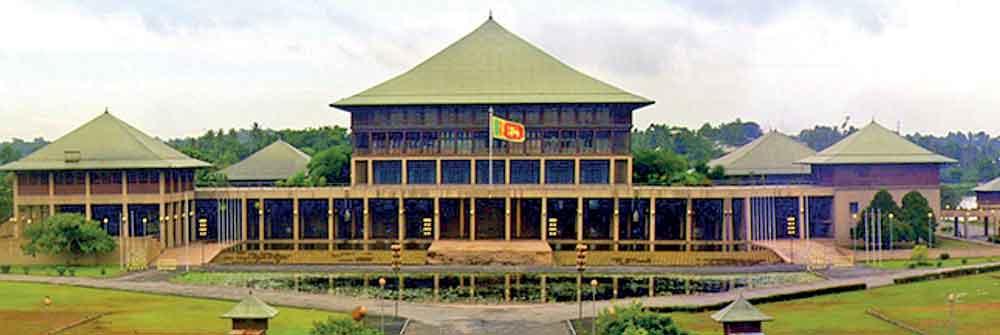
The Opposition seems to be not certain of their own stance about the Parliament Pensions (Repeal) Bill that was passed on Tuesday. They criticised the Bill, but did not vote against it. They had left the House when the Bill was put to vote, instead.
The Janatha Vimukthi Peramuna (JVP) from the beginning had been against paying pension for the Parliamentarians and were insisting on the abolition of the Parliamentary Pensions Act since it was adopted in 1977 by the J.R. Jayewardene Government.
The rationale behind their stance has been that politics should be a voluntary social service rather than being a money-making business. The National People’s Power (NPP), a coalition formed by the JVP followed the same position on pension for lawmakers on the same grounds. Thus, it promised to scrap the pension schemes for Presidents and the legislators during the last Presidential and Parliamentary elections and kept a part of that pledge on Tuesday.
the Opposition parties do not have such a clear-cut stance on the matter. They did not criticise or protest against the NPP’s pledge on it during the last elections. The main Opposition, the Samagi Jana Balawegaya (SJB) not only refrained from criticising the NPP stance, but SJB Parliamentarian Hesha Vithanage, on November 20, 2024, a week after the last Parliamentary election, stated that he would present a private member’s motion seeking the abolition of pensions for the MPs.
Clarifying further his position on privileges granted to the Parliamentarians, Vithanage stated that all privileges including low-cost breakfast and lunch, security, the low-interest loan facility, official residences, vehicle allowances, the insurance coverage, must be scrapped. SJB’s silence then indicated its agreement with him. However, he never presented such a private member’s motion for the past 15 months.
Yet, Ravi Karunanayake representing the New Democratic Front led by former President Ranil Wickremesinghe, did present a private member’s Bill to abolish pensions for MPs in February last year. None of the Opposition parties opposed it nor did they criticised him for doing so. The former MPs who deserted the JVP some time ago too did not oppose moves by Vithanage or Karunanayake despite them wanting to take legal action later against the NPP for its move to deprive them of their pensions.
Nevertheless, it was the SJB that took the NPP to task when the Bill to abolish pensions for Parliamentarians was debated in the House on Tuesday. However, none of the MPs of that party was in the chamber when the Bill was put to vote. What then was SJB’s stance on paying pensions to MPs or the abolition of the Parliamentary Pensions Act? However, Ravi Karunanayake voted for the Bill with the NPP and stated that he wanted to prevent the NPP getting the credit outright for the Bill, apparently not in line with the private member’s Bill he presented last year.
He seems to be of the view that public opinion was against paying pension for politicians. The SJB skipped the house when the Bill was put to vote on the same grounds - as they did not want their opposition to the Bill to be recorded. It was for the same reason they did not criticise the NPP’s promise to abolish the MP’s pension scheme during the elections.
Critics of the Bill argue that those who served a long time as MPs must have an income after their retirement. In spite of this being put as an innocent contention, the practical side of it in Sri Lanka is a far cry from it. It is very unlikely any former MP is left destitute, solely depending on the meagre pension granted to them.
Political parties, except for the JVP/NPP, Frontline Socialist Party and a few leftist parties, field financially comfortable candidates at elections, especially at Presidential and Parliamentary elections. Those candidates have such an income that they spend millions of rupees for their election campaigns. Campaign cost of many current candidates for general elections exceed Rs. 10 million. They never lose their previous income during their tenure as MPs.
Until the NPP assumed office, Parliament members were given a permit to import a duty-free luxury vehicle. Once, an individual who was appointed as an MP two weeks prior to its dissolution of Parliament was also granted a permit. Many members of Parliament sell their permits or the vehicles imported and purchase a relatively less valued one, saving millions. Recently an MP told during a YouTube interview that he as an MP drew monthly around Rs. 400,000 as his salary and allowances from the state coffers. Also, the nexus between the politicians and the high-profile businessmen is also common knowledge. Hence, the possibility of a former MP being left destitute is extremely minimal.
The current Parliamentary pension scheme has drawn public ire due to its discrimination against the ordinary people. It was paid while millions of people in the unorganised sector were ignored. The low-income earners such as agricultural workers, fishermen, pavement hawkers, masons and carpenters do not have any social security system that would help them during their eve of life. Even the people’s representatives in provincial councils and local government bodies do not have any such social security scheme. Lawmakers who were elected by the people have not thought about making laws for the benefit of these people.
Secondly, others who are in the pensionable category get the benefit after ten years of service while the parliamentarians are entitled to draw pensions after a five-year service. And others are paid after their retirement age – generally 55 years – while the parliamentarians were granted those benefits immediately after their first tenure ends. Thus, a young individual who was elected or appointed to the Parliament at the age of 25 would draw his pension since the age of 30.
However, abolition of Parliamentary pension scheme, despite its role in changing the political culture, would be another blow, apart from the high cost of election, on the people from poor families who aspire to enter Parliament, irrespective of their intellectual capacity and integrity. This would affect especially such members of the JVP and the NPP, in spite of those parties bearing the election cost of their members. Other main parties generally do not field candidates from poor families.