Reply To:
Name - Reply Comment
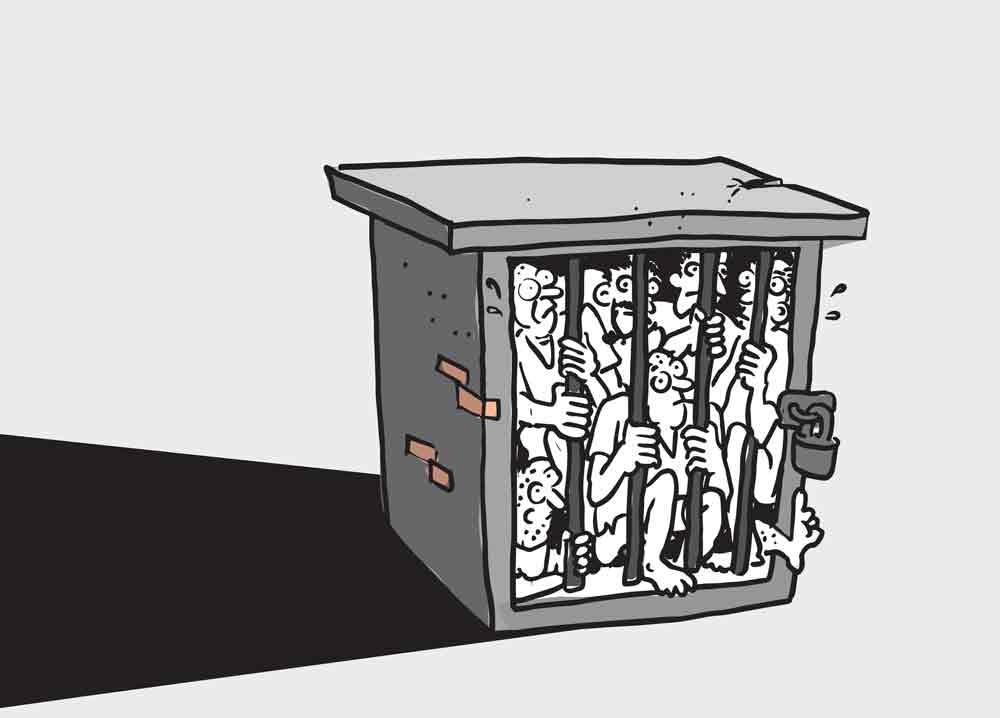
The deadly clashes at the Negombo Prison once again revealed the ugly realities that inmates have to endure while being remanded or serving a sentence. This is not the first instance that such clashes occurred inside a prison premises in the country. But what transpires from the recent incident is that the larger issue of overcrowding, congestion and poor facilities inside prisons have been ignored by successive regimes.
Prison overcrowding is only the tip of the iceberg. Conditions inside Sri Lankan prisons are dire. Most inmates are being packed into cells and there’s hardly any space for them to sleep. They don’t get proper meals, drinking water and water to bathe or use the toilet. The congestion inside prisons is so much so that around 100 inmates queue up to use the toilets. Due to intense heat, inmates are subject to various illnesses while in prison. They develop rashes, skin conditions and they are also diagnosed with sexually transmitted diseases.
But certain other inmates that are influential among the underworld or in drug networks receive luxurious treatment while in prison. Some even get separate cells, mobile phones, food they prefer to eat and lead a better life while in prison.
According to experts in criminology and criminal justice, there has been a marked increase in the number of remand prisoners over time. During the Yukthiya anti-drug operation launched in 2023, tens of thousands of individuals were arrested on narcotics-related offences. Media reports indicate that over 176,000 arrests have been made since the incumbent government launched the ‘Ratama Ekata’ anti-drug operation.
As an immediate remedy, prison officials took action to transfer inmates from the Negombo prison to Jaffna, Batticaloa, Angunukolapelessa, Boossa and other prisons. But that too, is not a solution to the crisis at hand. According to reports, two inmates who were transferred to the Angunukolapelessa and Boossa prisons had died reportedly due to a ‘brief illness’. But the actual cause of death is not yet known.
Various narratives are now being portrayed to justify the attacks. Nobody knows the actual reason as to why a second clash occurred on Monday even after the situation was curtailed on Sunday evening. According to the Prisons Commissioner, the second confrontation occurred when a group of prison officers from Welikada Prison were deployed to distribute food among inmates. Whatever the reason may be, many lives were lost.
The government has taken steps to address the issue of overcrowding by initiating several legal reforms, one being the introduction of the House Arrest Bill. Justice Minister Harshana Nanayakkara issued an extraordinary gazette notification to establish a new prison complex in Mahamodara, Galle. According to media reports, the new prison is expected to operate on a temporary basis in a section of the closed Mahamodara Hospital premises. In 2021, the Gotabaya Rajapaksa regime had plans to establish a modern prison at a 250-acre property in Horana. However, these plans didn’t see light of day.
But rather than building new prisons, human rights lawyers opine that the government should now look at alternatives for imprisonment. The Community Based Corrections Act, No. 46 of 1999 in Sri Lanka establishes an alternative to imprisonment for minor offenders, allowing courts to issue correction orders instead of incarceration. Through directing minor offenders into community Based Corrections, it helps to reduce overcrowding in the prisons and cost incurred in maintenance of prisoners, preventing minor offenders from becoming organised criminals by imprisoning them, and while also directing them to a more effective rehabilitation process.
Penal philosophy is shifting in this day and age of robots and advanced technology. Countries such as The Netherlands have closed down numerous prisons over the past decade due to falling crime rates. Dutch courts favor fines, electronic monitoring and community corrections over incarceration. Perhaps these maybe distant dreams for South Asian countries such as ours. But the time has come to look at alternatives such as rehabilitation, restorative justice and community based alternatives.