Reply To:
Name - Reply Comment
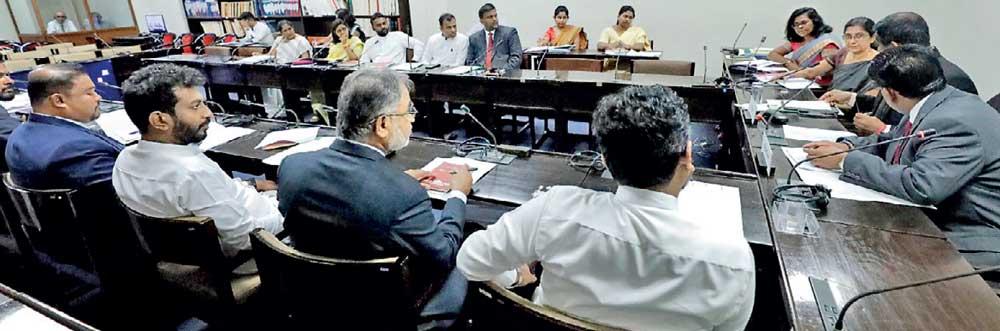
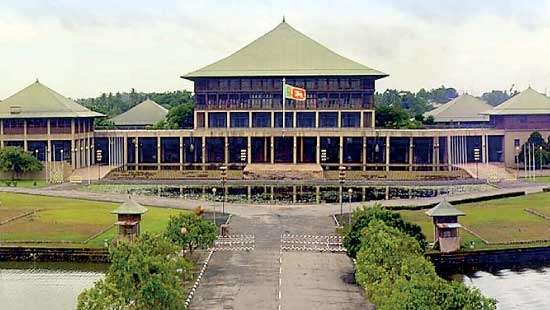
The COPE has been a strong tool for the governments to identify corruption, mismanagement and waste in public institutions. Image courtesy – Parliament
 Various financial irregularities taken place at several state institutions such as the National Youth Services Council (NYSC) during the last government are being exposed these days at the ongoing meetings of the Committee on Public Enterprises (COPE), one of the three watchdog committees of the Parliament.
Some of the transactions revealed at the recent COPE meetings point how audacious and outrageous the authorities of those institutions had been in wastefully spending millions of rupees of public funds. For instance, while sheds for stalls of a NYSC function in Galle had cost Rs. 100,000 whereas the same had cost Rs. 500,000 in Jaffna. Cheques valued at over Rs.180 million had been issued a day before the last Presidential election without the Board approval.
The COPE meetings had never been as dramatic as they are under the current Parliament. At one point, NYSC officials were questioned as to how they purchased T-shirts from a hardware store. The officials of the NYSC openly stated at these meetings that they were threatened with transfers by higher officials unless they obeyed their illegal orders. These officials who were unprecedentedly candid seem to be either scared of the new administration or confident of their safety under it.
Subsequent to the Parliamentary election held in last November, the Opposition parties, reminding the new government a tradition where the Chair of the COPE would normally be offered to the Opposition, requested to do so this time as well. When Opposition Leader Sajith Premadasa made the request directly addressing President Anura Kumara Dissanayake at the Parliament the latter declined it stating that there were issues involving the officials of the past governments which need to be investigated. The government’s position in this regard seems to be justifiable.
However, COPE is still being run as a media show, with the Chairman, the Auditor General and the members of it aggressively grilling the officials of various public institutions, as happened under previous Parliaments. Does the current government have any mechanism to take the corrupt officials or politicians to task and recover the funds that were plundered by them? We don’t see any.
The National People’s Power (NPP), before the last Presidential and Parliamentary elections, gave the people an impression that corruption is the root cause of all economic and social ills and eradication of it would be the panacea for those ills. Although this is not always the case, the fraud and corruption have tremendous impact in slowing down the economic progress and sometimes in ruining the economy. And the NPP’s entire election campaign had been based on an anti-corruption slogan.
When former President Gotabaya Rajapaksa approached the International Monetary Fund (IMF) for a bailout package in March 2022 when Sri Lanka encountered an unprecedented economic crisis, the Managing Director of the Fund Kristalina Georgieva told India’s NDTV that Sri Lanka’s crisis is a result of mismanagement.
In 2023, the United Nations High Commissioner for Human Rights had gone a further step to call Sri Lanka’s economic crisis a result of “economic crimes” committed by those responsible for running the country’s economy. And in every discussion with the Sri Lankan officials the IMF representatives have stressed the need for a mechanism to minimise corruption. A major precondition for the bailout package offered by the IMF to Sri Lanka was also a strong anti-corruption mechanism being in place. Accordingly, the government on July 19, 2023 passed the Anti-Corruption Bill in Parliament.
The COPE has been a strong tool for the governments to identify corruption, mismanagement and waste in public institutions, if they have the political will to address those issues. It has unearthed large-scale corruption in public institutions during the past two decades.
Wijeyadasa Rajapakshe as COPE Chairman presented a report in Parliament in 2007 highlighting corruption in 26 institutions that had run into a staggering Rs. 160 billion. During the same period the Public Account Committee (PAC) of the Parliament headed by SLMC leader Rauff Hakeem brought to light corruption of similar magnitude in public institutions.
Later, in 2017, the then COPE Chairman, JVP Parliamentarian Sunil Handunnetti too had presented a report to the Parliament which pinpointed Rs. 110 billion losses incurred to the State from 15 public institutions within four months in 2016. It was also revealed at the COPE in October 2023 that nepotism has cost the National Housing Development Authority a staggering Rs. 10 billion in 2011 and during Yahapalana Government.
These reports point to the fact that these parliamentary committees have exposed high profile corruption, irrespective of the political party that ran the government of the day.
However, it is surprising to note that these reports had been in the public domain only for a day or two before they were swept under the carpet. No media would carry any follow-up stories on these revelations creating a serious public discourse, nor does any politician or a party seriously pursue the matter thereafter. The main reason for the reports not rousing enthusiasm among the masses or the politicians can be attributed to the people in general getting accustomed to hear the stories of mass-scale corruption running into billions of rupees without any follow-up action. Finally, the country went bankrupt due to mismanagement of the economy.
Samagi Jana Balawegaya (SJB) MP Eran Wickramaratne on October 25, 2021, questioned in Parliament the purpose of the COPE if it cannot take punitive action against frauds and corruption in State-owned entities. Then, Prof. Charitha Herath as the Chairman of the COPE in 2022 suggested during proceedings of his committee to take up the follow-up issue in Parliament and create a mechanism for action against the culprits.
In October 2023, COPF Chairman Dr. Harsha De Silva told Parliament that having a representative from the Attorney General’s Department present during meetings of the PAC and COPE would facilitate the utilisation of evidence uncovered in future court proceedings.
Both Prof. Herath and Dr. De Silva as Chairmen of COPE had requested the Speaker to amend the standing orders of the Parliament to have a representative of the Attorney General at the sessions of their committees, so that culprits of frauds in public institutions could be taken to task. Yet, nothing happened, corruption continues and revelations too continue to be a media show.