Reply To:
Name - Reply Comment
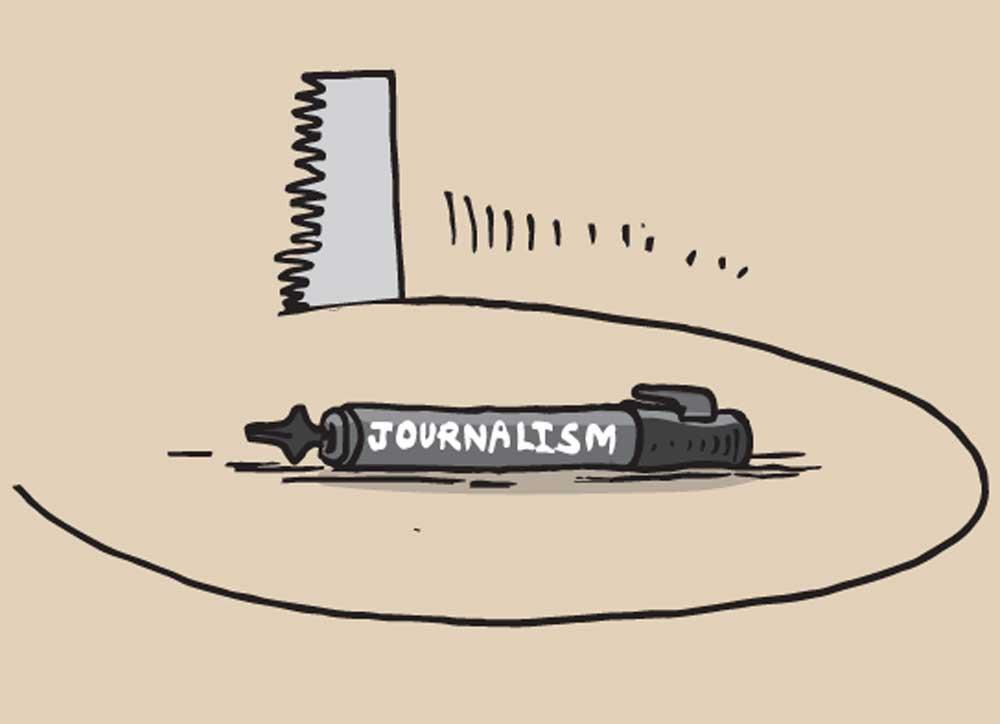
During a recent confrontation, a video journalist of a popular TV channel was not willing to adhere to the requests of a security officer in terms of maintaining a distance when covering the incident. The confrontation occurred when the notorious underworld criminal Nadun Chinthaka (Harak Kata) was being brought to courts. The security officer was heard saying that since Ganemulla Sanjeewa was killed by an individual who was dressed as a lawyer, there is no guarantee that the same could be done by someone holding a camera. Therefore, when the officer asked him to maintain a distance, the journalist was heard responding with his years of experience, further demanding the officer to ensure their safety.
Many who observed the incident blamed the journalist for his behaviour, but it could be that the media house expects him to bring the most exclusive footage. Therefore this journalist, in fact, all photo and video journalists often take the risk of capturing the best shot in order to ensure that their publications and channels receive more views and ratings. But in this day and age of uncertainty, especially with situations like what is unfolding in Gaza, no job is too precious than one’s own life.
Sri Lanka has a dark history of media suppression. Journalists are often referred to as ‘troublemakers’ as they are compelled to seek the truth and keep the public informed. There have been instances when political hierarchy questioned the very existence of journalists who were assassinated in broad daylight. Today, under the Prevention to Terrorism Act (PTA) many journalists are being taken in for ‘interrogations’ by the Counter Terrorism Investigation Department (CTID) of the Police. Taking to Facebook, one journalist said that the questioning took place for 6 hours and 45 minutes and covered his journalism and photography, social media activities, financial activities, phone records and overseas visits.
This kind of intimidation and harassment needs to stop, as it has been a practice which has continued over successive regimes. Each regime had been more interested in unearthing the activities of journalists as opposed to identifying perpetrators of atrocities committed during the war or various other crimes that are still unresolved to date.
Sri Lanka has a chequered past in terms of bringing about media reforms. From a time when the media was governed by draconian laws to the introduction of the Colombo Declaration on Media Freedom and Social Responsibility to now where the incumbent government is vying for the passage of a National Media Policy initially drafted by the Ranil Wickremesinghe government. Besides passing policies which are controlled by the government, the government should first end impunity against crimes on journalists such as Prageeth Eknaligoda, Lasantha Wickrematunge, Dharmeratnam Sivaram and Keith Noyahr, provide legal protection for journalists and activists and ensuring independence of state media. So at least now, Sri Lanka deserves a media policy that upholds press freedom, ensures journalistic independence and fosters public service media rather than one that consolidates state control.
Today, journalism is not a lucrative business even though the media industry is a money spinner. Sans insurance and other protections, most journalists would still travel the extra mile to find the most exclusive story for their publication or channel. But sometimes they themselves may wonder whether taking such a risk is actually worth it.
So when the video journalist in the previously mentioned incident risked his life to position himself at a place where he could get the most exclusive footage, he should also think for himself about the repercussions in the event of a mishap. After all, as mentioned earlier, no job is as precious as one’s own life!
‘Your Thought’ is a space, a right of the readers to support or contradict and discuss the issues highlighted in the editorial and other articles in the editorial and op-ed pages. Designed as the reader’s editorial; our readers can send in their writings, with a word count not exceeding 200, to ‘Your Thought’, Daily Mirror Political Features Desk, No 8, Hunupitiya Cross Road, Colombo 2 or email to [email protected]