Reply To:
Name - Reply Comment
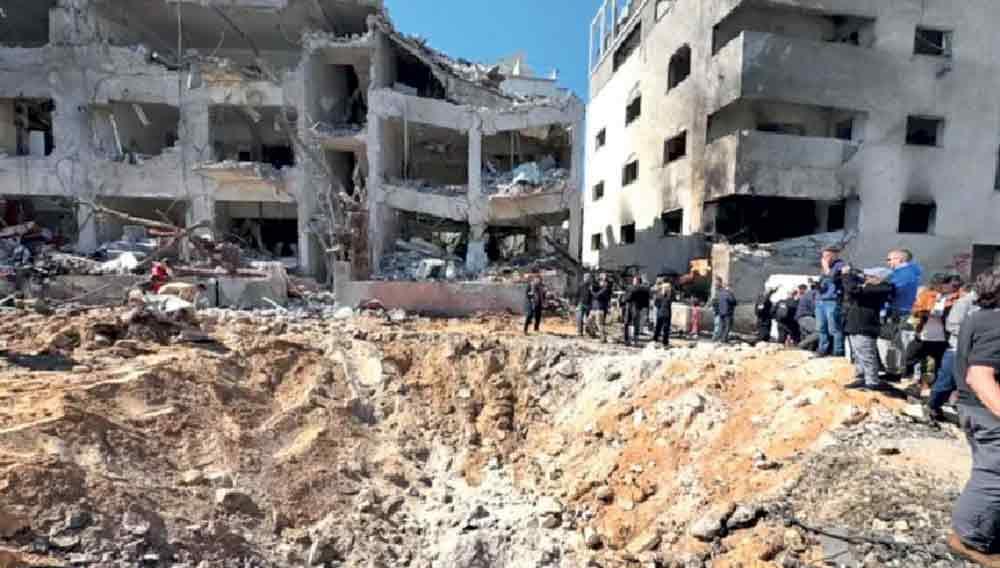
The Tel Aviv apartment building destroyed in an Iranian strike is next to one of the city’s historic Bauhaus structures
 Risk-averse, transactional mercantilism of Chinese foreign policy seeks no part in the Middle Eastern conflict. That is despite China itself is importing 1.4 million barrels of oil from Iran, which is 13 percent of China’s demand. Altogether. 5.4 million barrels a day of oil destined to China pass through the Straits of Hormuz. Despite China’s long-term oil reserves, a prolonged war would threaten its energy security
 Donald Trump’s deadline for ‘power plant day’ and ‘bridge day’ to blow up Iranian civilian infrastructure if Tehran refused to open the Strait of Hormuz was set to pass 8 p.m. on Tuesday, setting the stage for a dangerous escalation in the Middle Eastern conflict.
The American and Israeli war on Iran, now in its sixth week, has descended into an act of naked aggression and a litany of potential war crimes. The international law and the rule-based world order, which America itself once championed, lie in ruins. Among other casualties, the Middle Eastern conflict and unrivalled American unipolarity have shattered the much-hyped slogan of an emerging multipolarity in the international system. If anything, it has been proved to be a premature fancy a cart before the horse.
For nearly two decades, as Asia’s economic heft has grown, policymakers and scholars have been clamouring for an emerging multipolar world. The Indians were among the strongest advocates, as were the Chinese, the South Africans, and much of the global south. BRICS, a grouping of emerging powers, named after its founding States, was described as a harbinger of a multipolar system.
However, America’s war on Iran has shattered the myth of multipolarity. If anything, it smacks the State behaviour of apex unipolarity, unrestrained by the stopping power of any rival power in the system.
Interestingly, more than the freedom of action enjoyed by the United States, it is the meek indifference of the other major powers that challenges the whole thesis of an emerging multipolarity.
Understanding why the States or the international system as a whole behave that way is not just an academic exercise. That would provide important lessons for the countries, like ours, as they navigate the fluid international system that is witnessing a major power transition from the West to the global South, but the State behaviour has not yet reflected the shifting power.
Many pundits recommend various strategies, from hedging, balancing, or band-wagoning to provide security for smaller and medium-sized States in the face of a fast-changing power configuration in the international system. However, the danger is that such measures, adopted prematurely, rather than increasing security, may decrease it. At the end, when it comes to the crunch, the would-be allies would not turn up for help. Iran is learning it the hard way. So was Venezuela, and so would be Cuba. However, the risk does not need to materialise in a military threat. It is more likely to come in the form of a crippling economic shock.
For a starter, the massive power transition in the international system is a fact. Asia’s share of global GDP has increased from 18 percent in 1980 to 45 percent in 2025. Advanced economies which held three quarters of the global GDP in 1980 had seen their share reduced to 40 percent.
However, the power transition to Asia was fundamentally a power transfer to China, which had seen its share in global nominal GDP grew from 1.8 percent in 1980 to 16 percent in 2025. India’s GDP has grown from 1.7 to 3.5 percent during the corresponding period.
Therefore, if economic power is the primary gauge, bipolarity should come before any form of multipolarity. In fact, China’s current share of relative power vs. the United States (25%) is higher than that of the Soviet Union at its peak (when the USSR had only half of American GDP). And when converted to Purchasing Power Parity, China’s GDP is greater than that of the United States.
However, economic power along does not create a pole. Japan in the 1980s and the Western Europe through out the post World War II carried them with a substantial economic heft, but still served as outposts of the US-led western order. The only potential third pole in the international system is India. However, it would take at least 25 years, and a Congress government at the helm, for India to emerge as a distinctive pole in the international system.
Relative power alone does not make a pole-it requires an ideology, foreign policy interests, and a distinct threat perception.
Only China holds all these characteristics. Russia, though a military superpower, does not – though it has the capability to serve as a spoiler.
Therefore, the Chinese silence and acquiescence should prompt many observers to ponder, especially since many of them had spent years warning that a rising China would be a potential aggressor and hegemon.
Now, the general argument is that China was applauding as the United States mismanaged the war, and true to a dictum attributed to Napoleon – “Do not interfere when your enemy makes mistakes” – the Chinese are watching from a distance while America messes it up.
But all that overlooks the reputational cost China incurs from inaction. The power alone does not make a great power; the prestige of a great power comes from its willingness to wield it and face potential blowback.
An international system that emerges from the ruins of the US war on Iran would place a much lower premium on China than it had been before.
All that would call into question China’s behaviour, confined to routine statements of concern and condemnation.
To understand this, one should inquire into the Chinese foreign policy-making. During its early decades, under Chairman Mao, China was a revolutionary State, which fought, directly or indirectly in North Korea, Vietnam and much of Indo-China.
However, Mao was also China’s last revolutionary communist leader. What followed was a succession of risk-averse Chinese nationalists, who withdrew inward and concentrated on domestic economic development.
Later, when China emerged as an economic power post-2000, risk-averse Chinese nationalism was joined by economic diplomacy as guiding principles. Much later, as economic diplomacy gathered momentum, it acquired traits of mercantilism. For the last 15 years or so, China has practiced a degree of mercantilism no different from what Donald Trump threatens with its trade partners.
Risk-averse, transactional mercantilism of Chinese foreign policy seeks no part in the Middle Eastern conflict. That is despite China itself is importing 1.4 million barrels of oil from Iran, which is 13 percent of China’s demand. Altogether. 5.4 million barrels a day of oil destined to China pass through the Straits of Hormuz. Despite China’s long-term oil reserves, a prolonged war would threaten its energy security.
Over time, China’s strategic behaviour would change. However, still, its behaviour is guided by Deng Xiopeng’s dictum: Hide your strength, bide your time.