Reply To:
Name - Reply Comment
Nearly a week after the Horana elders’ home tragedy that killed 12 elderly persons following a fire, three more individuals succumbed to burn injuries following a fire that occurred at a restaurant in Thalawathugoda. One glaring similarity between the two incidents is the fact that there had been no emergency exits in both establishments. As a result, several individuals were trapped inside without any chances to escape.
In Sri Lanka, fire exits are legally mandatory under Construction Industry Development Authority Fire Regulations (CIDA/DEV/14), the Urban Development Authority (UDA) Guidelines, and the Factories Ordinance. Compliance requires unobstructed escape routes, a minimum of two exits per floor, outward-opening fire doors, and proper emergency exit signage. The guidelines provide details about the recommended design for stairways, minimum road access, firefighting shaft requirements and various requirements for different types of buildings. But despite these guidelines being in place, the approval process for building plans seem to be flawed, given the nature of recent incidents.
The elders’ home doesn’t fall into the category of a commercial building, but the restaurant in Thalawathugoda was at the ground floor of a two-storey building. The fact that three staffers couldn’t escape despite the restaurant being located at the ground floor of the building is indeed worrying. In both these instances, many individuals succumbed to injuries; but who would be made accountable for their lives remain a question.
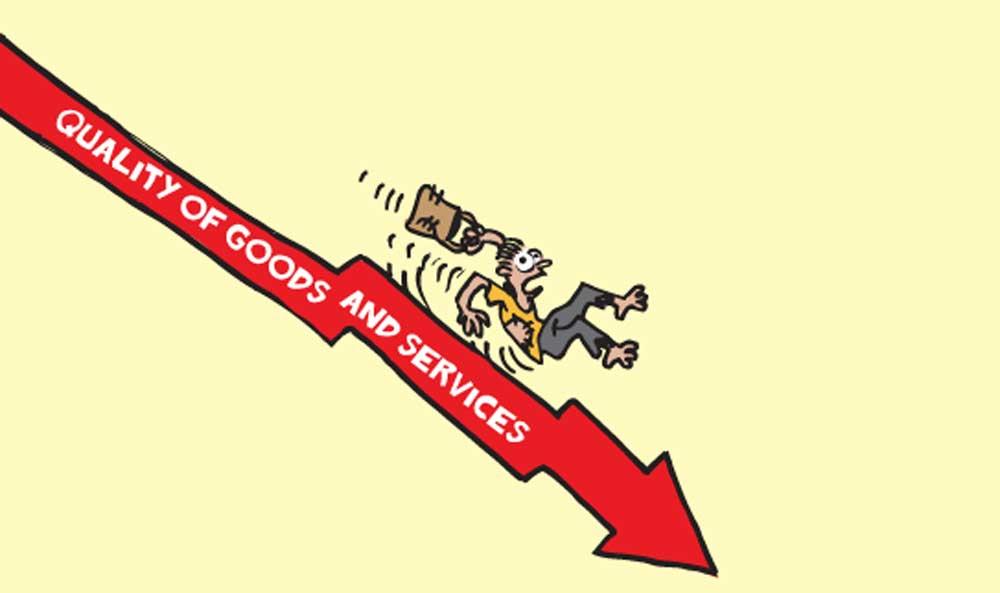
People visit a shop or any other institution seeking some kind of service. But it has become increasingly obvious that the standards of services (and even goods for that matter) have deteriorated. Many establishments including restaurants operate as businesses, without giving much thought about the quality of food being served. If one visits five restaurants, each one of them will have a different quality of service, varying quality of food and varying prices. Many food establishments are more concerned about having more customers, even if there’s hardly any space to accommodate a large number of people.
One has to forget about having a meal in peace if they ever step into these restaurants. They may have to literally crouch in order to make space for another person at the same table, and consume meals in a very confined area. Even when it comes to the quality of food, in most restaurants the taste of stock powder and additives have overrun the actual taste of food. But for these shop owners, quality is often an afterthought.
The Consumer Affairs Authority (CAA) has been vested with the arduous task of conducting surveillance and raids to ensure that eateries maintain their quality of food. Legal action has also been taken on various food outlets that have sold food unfit for consumption. The incumbent government should be credited for imposing a Maximum Retail Price (MRP) for bottled drinking water. But prices of many other items need to be regulated, keeri samba rice being one of them. The government still couldn’t manage to impose an MRP for keeri samba. Therefore, even though the label indicates an MPR of Rs. 1300, a kilo of keeri samba is nearly Rs. 450 and a 5kg bag costs around Rs. 2000.
One might blame the economic crisis and global tensions for the deteriorating quality of goods. It is common knowledge that the prices of certain items need to be increased to cover up costs. But, while the prices increase, the quality of items is often compromised. Despite having authorities such as the Sri Lanka Standards Institution, the question of whether the country has adequate standards for various products remain a question. India for instance has over 23,000 active quality standards managed by the Bureau of Indian Standards. But according to media reports, Sri Lanka has around 4000 standards.
The CAA Act No. 9 of 2003 empowers citizens to demand fair trade practices, uncompromised product quality and compensation for substandard items. In today’s transparent market, consumers easily spot inauthenticity. Therefore, authenticity should be at the core of any business in order to ensure long-term commercial success.
‘Your Thought’ is a space, a right of the readers to support or contradict and discuss the issues highlighted in the editorial and other articles in the editorial and op-ed pages. Designed as the reader’s editorial; our readers can send in their writings, with a word count not exceeding 200, to ‘Your Thought’, Daily Mirror Political Features Desk, No 8, Hunupitiya Cross Road, Colombo 2 or email to [email protected]