 MOHAMED AYUB
 Reply To:
Name - Reply Comment
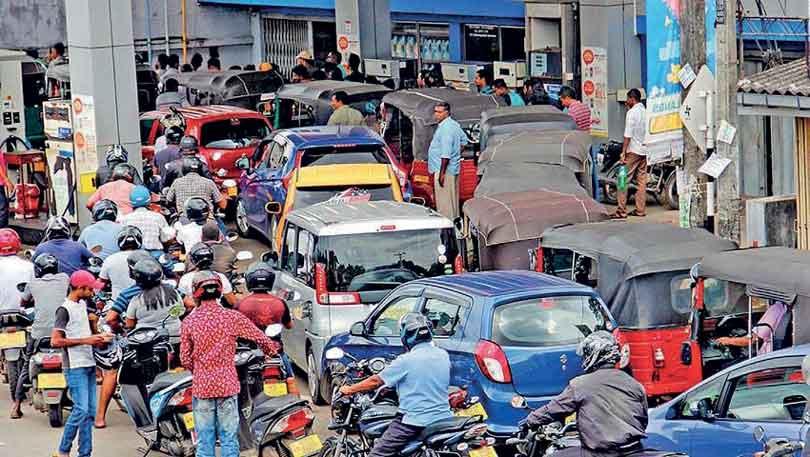
Motorists queuing at fuel stations following the implementation of the QR code system
File photo
 Many European and Western countries that have backed many immoral wars launched by the US so far for its economic and political gains, have sidestepped this time. Reports suggest that the US is struggling for an exit strategy with the number of high-ranking US officials calling for an end to the war
Unlike during the previous wars in the Middle East, at least for the moment, it is not the US and its allies but Iran that has gained the upper hand in the war theatre
Following the Government’s announcement last week that Wednesday would be a holiday in order to reduce fuel consumption in the country in the face of escalating conflicts in the Middle East, certain health sector trade unions had demanded a holiday allowance for their members as they are not entitled to that holiday.
The rationale behind this demand is not that they are going to lose anything due to the Government’s decision, but that employees of other sectors are enjoying this holiday while they are not.
This indicates how low some people can stoop even at a time when the country is facing an imminent crisis situation.
It was only four years since we experienced multiple hardships due to a huge fuel shortage as a result of an unprecedented foreign exchange crisis. It was against this backdrop that the holiday was announced for the employees of public sector except for essential services as one of so many temporary measures, to overcome a possible similar fuel crisis, in the event the current war the United States and Israel has launched against Iran being protracted.
At a time when the whole country has to encounter the approaching crisis as a unit with commitments, one group demanding compensation for their commitment is nothing but a serious attitudinal decadence. Nevertheless, their demand for a separate scheme for fuel is reasonable as they, as employees of an essential service cannot waste their time in fuel queues.
Meantime, there are also suggestions supported by some Opposition parties to announce Friday or Monday as a holiday instead of Wednesday. This is also an attempt to misuse the Government’s concession to have a long weekend apparently to go on excursions which runs counter to the purpose.
Despite the Government having said that the Ceylon Petroleum Corporation (CPC) has sufficient stocks of fuel for more than a month when the war started on February 28, its first reaction to the new developments in West Asia was to increase the prices of fuel. Later authorities explained that the measure was meant to discourage panic buying of fuel and to meet the imminent price hikes in the world market with these developments.
Government has also reintroduced the QR code as well as odd and even day fuel distribution system which were in place during the 2022 economic crisis. The purpose is to prevent hoarding and resultant artificial fuel shortages. Government has also stated that this fuel distribution mechanism will continue until normalcy returns. Officials have been instructed to look into the possibility to implement the work from home facility that was also in place during the recent economic crisis.
In fact, the Government was pressed for time to properly plan and execute these systems as the queues sprang across the country due to panic buying once conflicts broke out in West Asia. This has created some snags in the implementation of these crisis period measures. On the other hand, panic buying helped the Government to comfortably justify the reintroduction of them. Implementing these methods in a context without queues would have earned criticism for the Government.
In spite of the warring parties having attacked military targets initially, the situation now has worsened for the outside world, especially those countries that have weak economies, with the oil industry in Iran and Arab countries hosting American military bases increasingly coming under mutual attacks.
The Arab-Israeli war in 1967, though had a devastating effect in countries bordering Israel-Egypt, Syria and Jordan ended in six days. The First Gulf War between Iraq and 42 countries led by the US in 1991 during which hundreds of oil wells mainly in Kuwait were set on fire ended in 43 days. The Second Gulf War imposed on Iraq by several countries including the US, the UK, Australia and Poland on false allegation of stockpiling Weapons of Mass Destruction (WMD) by Iraqi President Saddam Hussein lasted only for 20 days.
But the current situation is totally different. Although the US and Israel might have planned to crush the Islamic republic within days with their huge fire power as they did in countries like Iraq and Libya, it does not seem to be the case, as Iran seems to have prepared to such an eventuality for decades. Tel Aviv has never suffered such a damage as it suffered this time, according to reports. Unlike during the previous wars in the Middle East, at least for the moment, it is not the US and its allies but Iran that has gained the upper hand in the war theatre with the US President Donald Trump pleading to the leaders of Europe and Canada to help him to free the Strait of Hormuz from the Iranian grip.
Many European and Western countries that have backed many immoral wars launched by the US so far for its economic and political gains, have sidestepped this time. Reports suggest that the US is struggling for an exit strategy with the number of high-ranking US officials calling for an end to the war.
Yet, Iran has lost very important political and military leaders during the last three weeks. And also, it is not to deny that the country has been withstanding such huge losses from the beginning of Islamic Revolution in 1979. Israel and rebel groups within the country have killed hundreds of such human assets of Iran including Presidents, Prime Ministers, Chief Justices, experienced military commanders and nuclear scientists. In a recent interview, Iranian Foreign Minister Abbas Araghchi said: “Iran has a strong political structure with established political, economic, and social institutions and the presence or absence of a single individual does not affect this structure.”
All these facts demand a strong preparedness for the coming months in countries like Sri Lanka. Ebrahim Zolfaqari, spokesperson for Iran’s military command said in comments addressed to the United States “Get ready for oil to be $200 a barrel, because the oil price depends on regional security which you have destabilised.”
However, National People’s Power (NPP) Government assures that a situation that prevailed in the country in 2022 would not return while Opposition parties eagerly await such a one. What matters to most for the people is that even if the situation that prevailed in 2022 returns, no Sri Lankan leader can stop the war in the Middle East and its impacts on Sri Lanka.