Reply To:
Name - Reply Comment
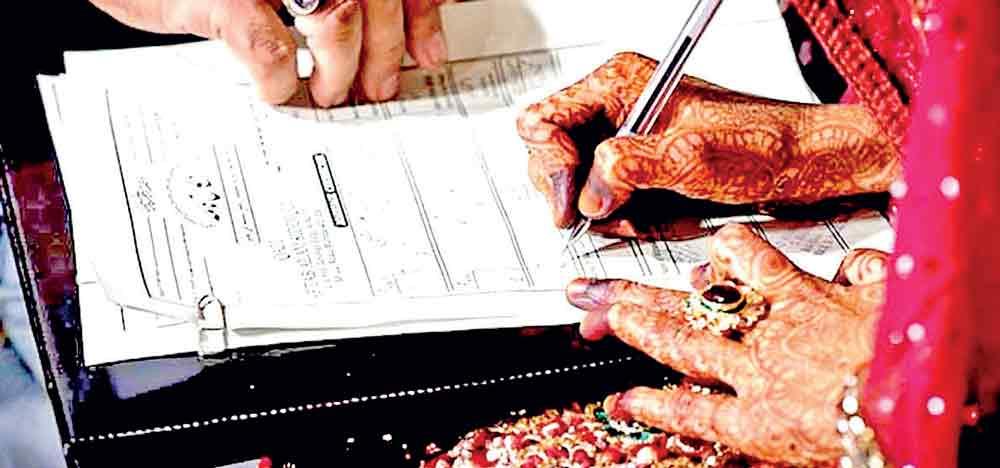
True and lasting reform of personal laws demands immediate, decisive action through our own democratic institutions
 Reform is not a distant or imposed idea; it is an active, internal process grounded in decades of consultation
No more selective campaigns. No more external interference. Only justice for all, under one sovereign law. May wisdom, courage, compassion, and unwavering commitment to our motherland prevail

In recent days, a petition was submitted to the United Nations office in Colombo urging the immediate repeal of Muslim personal laws, citing contradictions with international agreements and Sri Lanka’s Constitution.
Led by Venerable Akmeemana Dayaratne Thero of the Sinhala Rawaya National Organisation, the submission highlights concerns over differential treatment in cases involving minors, particularly regarding sexual relations with a 17-year-old. The petitioners argue that such provisions violate fundamental rights and demand their abolition.
As a senior citizen of this nation, a Muslim by faith, and a law enforcement officer who dedicated over 38 years to the Sri Lanka Police including critical roles in counter-terrorism, intelligence coordination, and maintaining national peace, I feel compelled to respond. Not out of defensiveness, but from a deep commitment to justice, equality, and the hard-won harmony of our motherland. Law and justice must be common to every citizen, irrespective of race or religion. The timing and selective focus of this petition, however, raise serious questions about its true intent.
Let us be clear: Sri Lanka is a pluralist society. Our legal system reflects this diversity through general law alongside personal laws for specific communities, Kandyan law for certain Sinhalese, Tesawalamai for Northern Tamils, and Muslim personal law governing marriage, divorce, and inheritance for Muslims. This framework is not a modern invention but a legacy of our history, preserved through colonial ordinances and post-independence recognition. The Muslim Marriage and Divorce Act (MMDA) of 1951 operates within this mosaic.
The core issue raised, protection of children and adolescents, is valid and non-negotiable. No community should enjoy exemptions that undermine the criminal law on age of consent, sexual offences, or exploitation. Sri Lanka’s Constitution, particularly Articles 12 and 14, guarantees equality before the law and non-discrimination.
We are also signatories to the UN Convention on the Rights of the Child (UNCRC), which prioritises the best interests of the child. Criminal provisions under the Penal Code apply uniformly to all citizens. Any perceived gaps in personal laws regarding minimum marriage age or consent deserve urgent, evidence-based review.
Risk of communal tensions
Yet, the petition’s approach risks inflaming communal tensions rather than resolving them. Consider the timing. It comes at a moment when Sri Lanka is grappling with shocking allegations of child sexual abuse involving nearly 300 Buddhist monks over the past three years, including high-profile cases. These demand accountability across all institutions. If the goal is genuine child protection, why single out one community’s personal law while broader enforcement failures across society require equal scrutiny? Selective outrage breeds suspicion, not solutions.
During my service, particularly as Deputy Director in charge of the Counter Terrorism Desk in the State Intelligence Service (2005–2009) and later as Intelligence Coordinator to the Inspector General of Police, I witnessed firsthand the devastating cost of division. The defeat of LTTE terrorism was achieved not merely through military might but through intelligence-led operations, inter-agency coordination, and crucially, the maintenance of social cohesion. We operated in a multi-ethnic, multi-religious environment where trust across communities was our greatest asset. Polarisation weakens the nation.
As a member of the Sri Lanka Wakfs Board, I have worked alongside leaders from various faiths to promote discipline in mosque management and interfaith harmony. Our efforts emphasise that true faith upholds justice, compassion, and respect for the vulnerable. Importantly, many within the Muslim community, including women’s groups, professionals, and moderate scholars, have long advocated for targeted reforms to the MMDA that address these very concerns while remaining faithful to Islamic principles of equity (adl) and justice.
Reform Proposals Already Under Discussion
Reform is not a distant or imposed idea; it is an active, internal process grounded in decades of consultation. Key proposals, drawn from government committees, Muslim advocacy groups like the Muslim Personal Law Reform Action Group (MPLRAG), and parliamentary initiatives, include:
 Raising the Minimum Age of Marriage: Set a uniform minimum of 18 years for both boys and girls, with no exceptions for Quazi discretion. This would align the MMDA with the general law and international child rights standards, effectively ending child marriage.
Mandatory Consent and Signature of the Bride: Require the explicit signature or thumbprint of the bride (and groom) on all marriage documents, affirming adult women’s autonomy and eliminating reliance solely on guardian (wali) consent.
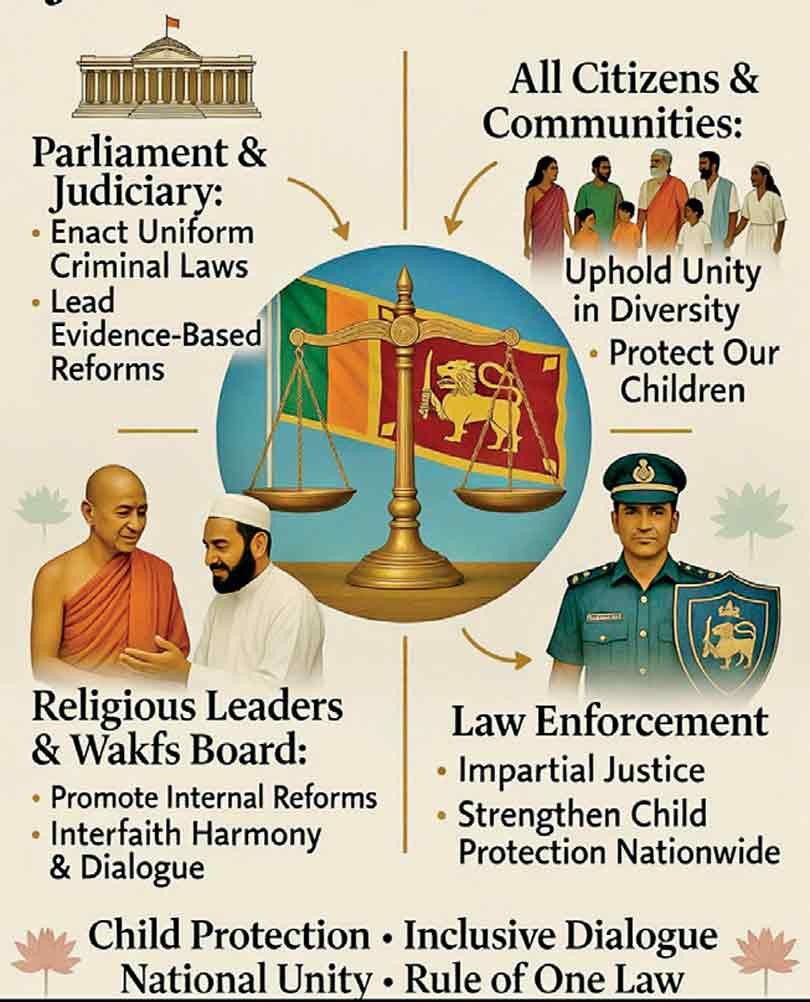
Sri Lanka is a pluralist society. Our legal system reflects this diversity through general law alongside personal laws for specific communities
Appointment of Women as Quazis: Amend eligibility rules to allow qualified women to serve as Quazis, registrars, and on the Board of Quazis, bringing greater balance, empathy, and professionalism to family dispute resolution.
Strengthening Quazi Court Procedures: Introduce legal representation, formal recording of proceedings, appeals to higher courts, standardised guidelines, and better oversight by the Judicial Service Commission. Maintenance claims could be transferred to Magistrate’s Courts for faster resolution.
Equitable Provisions on Divorce, Maintenance, and Polygamy: Require clear reasons for unilateral divorce, strengthen women’s rights to maintenance, mahr, and matrimonial property, and impose stricter conditions on polygamy, including justice to existing wives and economic capacity, with some voices calling for further restrictions.
These recommendations appear in landmark reports such as the Marsoof Committee (2017–2018), the Haleemdeen Report (2022), and a 2026 parliamentary bill advanced by MP Faiszer Musthapha. They reflect broad consensus-building within the community and enjoy support from the Human Rights Commission of Sri Lanka.
Modernising personal laws
Such reforms demonstrate that the Muslim community is capable of modernising its personal laws through internal reflection and national dialogue. They protect children, uphold equality, and reinforce trust without erasing cultural identity. Unilateral repeal via international petition, by contrast, bypasses this constructive path and risks alienating moderate voices who are best placed to drive change.
From my experience in strategic police leadership, police reforms, and securing major events like CHOGM 2013, I learned that sustainable peace requires fairness. Singling out Muslims today sets a precedent that could target other groups tomorrow. We must prioritise enforcement of existing child protection laws across the board, strengthening the National Child Protection Authority, ensuring swift investigations regardless of the perpetrator’s robe, uniform, or community.
To my fellow Sri Lankans: We must firmly reject the politics of selective indignation and communal finger-pointing. Allegations of child abuse or any crime must be investigated thoroughly and prosecuted without fear or favour, regardless of the perpetrator’s religious robe, title, or community. Child protection is a sacred national duty and not a weapon for division or political gain.
True and lasting reform of personal laws demands immediate, decisive action through our own democratic institutions. Guided by principles of justice, gender equity, and child welfare, these reforms must align fully with our Constitution while respecting religious ethics. Inclusive dialogue, led by the communities themselves and informed by decades of expert study, is the only responsible path. Let parliamentary committees, the Human Rights Commission, and civil society, working hand in hand with moderate religious leaders, drive evidence-based, time-bound reforms without delay.
Sri Lanka has paid too high a price for division in the past. As a father, grandfather, patriot, and senior intelligence officer who fought to preserve our nation’s unity, I assert unequivocally: unity in diversity is not optional, it is our greatest strength and non-negotiable foundation for a secure future. Let us channel our collective energies towards strengthening the rule of law for every citizen, safeguarding our children, and building a just, harmonious Sri Lanka that all communities can proudly call home.
No more selective campaigns. No more external interference. Only justice for all, under one sovereign law. May wisdom, courage, compassion, and unwavering commitment to our motherland prevail. I thank my almighty for the opportunity to serve this blessed land.
This column reflects personal views Mahil Dole, SSP (Retired). They are drawn from decades of public service. It is a firm call for mature, inclusive, and decisive nation-building. Dole is the former Head of the Counter-Terrorism Division of the State Intelligence Service of Sri Lanka, and has served as Head of the Sri Lankan Delegation at three BIMSTEC Security Conferences. With over 40 years of experience in policing and intelligence, he writes on regional security, interfaith relations, and geopolitical strategy.