Reply To:
Name - Reply Comment
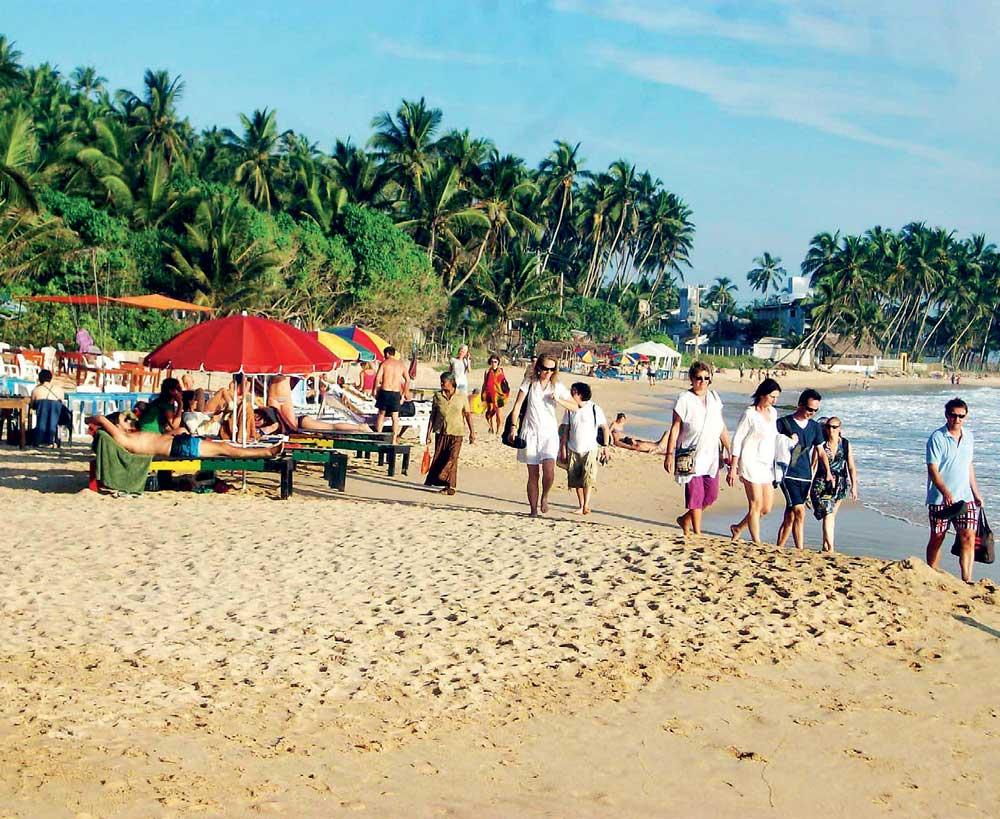
One excuse given for the prejudice associated with locals is that locals do not know how to behave, or that they leave a mess behind them, whereas foreigners are better behaved
 Discrimination against Sri Lankan visitors was reported recently from Ella area, a former backwater whose tourism potential was suddenly discovered 15-20 years ago. Believe me, doors are shut in our faces not just in Ella, but all over Sri Lanka where tourism exists. We are treated as third class citizens by our own people catering to foreign visitors.
I experienced this first hand during my brief stint in tourism in the early 1990s. When hotels were overcrowded and no room was available for the guide, the hotel arranged for a guest house room in the locality. But it’s not a prior contract arrangement. Doing the rounds at night looking for a room, I’ve had doors shut in my tired face with a resounding ‘no locals!’ They didn’t even have the decency to lie and tell me, ‘sorry, we’re full up!’
This happened mainly in the tourist-occupied southern coastal stretch from Colombo to Galle and beyond. Vacationing with my family in Galle two decades ago, we had a hard time finding a room. It was off season, but we were turned away from several houses before one kind guest house owner gave us a room. There is a universal contempt of locals, as if dark complexions might soil the bed sheets. This contempt is now not limited to the southern coast. It is everywhere.
Visiting Sigiriya with my family a decade back, I stopped in front of a small restaurant at the town’s junction to buy a bottle of water. The irate owner came running to warn me: “This parking space is for tourist vehicles!” We were talking of the main road, not his private front yard, and there were no tourist coaches, cars or vans parked there.
This was before the influx of Chinese and Indian tourists. Now, skin colour may no longer be the criteria for rejection, but there is a persistent downgrading of local visitors everywhere.
One excuse given for this prejudice is that locals do not know how to behave, or that they leave a mess behind them, whereas foreigners (mainly Europeans at the time) are better behaved.
Educated people from all countries will have better manners and behaviour than the uneducated. If we analyse the problem carefully, it is a fact that Sri Lankans on holiday (including guest house owners) leave behind litter – empty bottles, wrappers, paper etc. This isn’t a question of class and wealth. I have seen bottles thrown out of SUVs on the road. It’s a matter of education which brings about concern for the earth’s well being. Educated Sri Lankans don’t litter.
What is not mentioned in the same breath is the money. The general consensus is that tourists give better tips. But this isn’t a hard and fast rule. Hotel staff and guest house owners have told me stories about stingy tourists while many Lankan visitors are known to be generous. But these stereotypes endure.
But this is only part of the ‘no locals’ problem. There is a deep rooted prejudice against the local cultural imprint, a hangover which can be traced to neocolonialism. Mass tourism, parallel to air travel, the jet age and cheap charter flights, started in the 1960s and 70s, a decade or two after empires started breaking up and colonies (mainly those of European powers). But with a few exceptions, most of those countries are dependent on tourism for foreign exchange. Until the past decade, most of those tourists came from Europe and Japan (another former colonial power). Even now, Europeans account for more than 50% of all tourist arrivals in Sri Lanka.
Relics of that subservient mentality that became deeply rooted during colonial times is still evident in our culture, and tourism is a major conservator of that archaic mentality. There is an unconscious mechanism in many who work in the tourist industry automatically downgrading us.
As Shakespeare put it in Julius Caesar, the trouble is not the stars, but in ourselves. Mass tourism generates problems everywhere. If it isn’t prejudice against locals, it’s tons of garbage. Venice is a good example.
Legally, there is no cure for this deep-rooted prejudice. Officials say they can take action against such discrimination when tourist service providers are not registered with Sri Lanka Tourism Development Authority (SLTDA).
But what action can they take? To whom can those discriminated against complain? To the SLTDA, or would they have to lodge a police complaint? If any service provider is found guilty after an investigation, are they going to be fined? People are hard pressed for time; they rush back to their homes and jobs after vacations and won’t have the time for inquiries and bureaucracy. This is really a cultural problem, not a judicial one. The mindset needs to be changed, and that can’t happen with lectures and seminars (though that can help) but only via a profound re-evaluation of what we are worth, not just in US dollars of Yuan or whatever, but culturally and humanistically. Unless we learn to respect ourselves more, this problem will be there with us perennially.