Reply To:
Name - Reply Comment
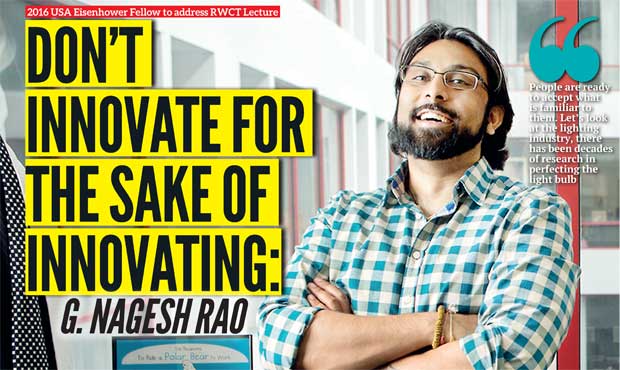
 the topic ‘Road Mapping the Future: State of Innovation Ecosystems’. Nagesh has been instrumental in advising and executing policies and programmes related to innovation, technology development, commercialisation, start up scale-up, and early stage investing. In an exclusive interview with the Daily Mirror, Nagesh spoke about the market for innovations, the projects that he was involved in and his thoughts about technological innovations today. Excerpts:
It is truly an honour to be asked to provide remarks for this amazing event. The pioneering and inventive work of Ray Wijewardene is truly phenomenal, and it is a bit humbling to provide remarks in honour of an Olympian, inventor, entrepreneur, and most importantly an honoured son of Sri Lanka. Mr. Wijewardene’s career has been most impressive and his work in the agro-tech space pioneered and empowered entrepreneurial farm owners to create their own destiny. In a time of unprecedented exponential growth and knowledge sharing amongst the human race, this lecture will provide us a moment to breathe, reflect on where we have come, and how we wish to build the future forward through science and technology development.
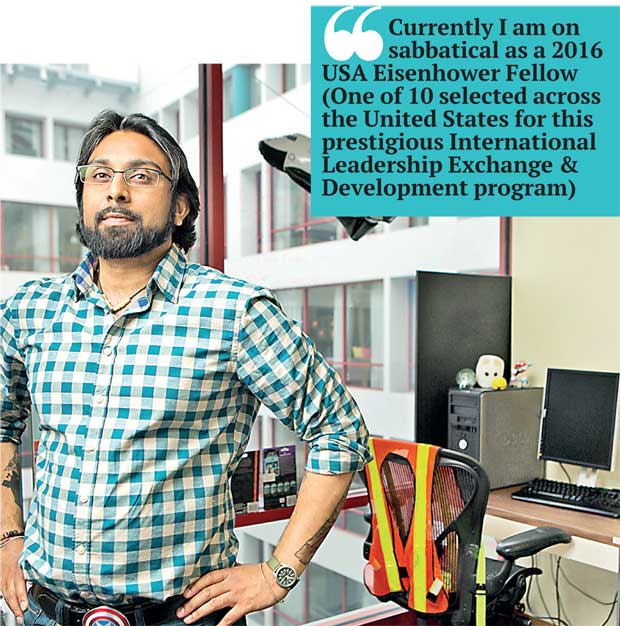
Currently I am on sabbatical as a 2016 USA Eisenhower Fellow (One of 10 selected across the United States for this prestigious International Leadership Exchange & Development program), but in my day job I serve as Chief Technologist and Entrepreneur in Residence at the US Small Business Administration-Office of Investment & Innovation, where I am involved with the execution and oversight of the, annual $2.5 Billion, Small Business Innovation Research (SBIR) programme (America’s Seed Fund), and serve on President Barack Obama’s Lab to Market Commercialisation inter agency policy committee. Our program literally “seeds the future” with catalytic non-dilutive investments into high  tech small business owners and entrepreneurs tackling problems like environmental security, life sciences, space exploration, AI, clean energy, etc… Iconic companies that have emerged from our program have included Qualcomm, Biogen-Idec, iRobot, Symantec, and many more. Recently we launched a re-tooled and slicker UI/UX business intelligence gateway platform and database system via www.sbir.gov . In my spare time I serve as an Advisor to LAUNCH, Village Capital, MAS Holdings, and AAAS-Lemelson Invention Ambassadors program As well I compose thought-pieces around the nexus of science, entrepreneurship, law, and innovation for various media publications like TechCrunch, et al.
Depends on who you ask. Big multi-national companies say they embrace innovation and innovative ideas, but it does not cut into their bottom line, or incite cannibalization of their money-making product lines. The general public embraces the notion of innovation and its integration into mainstream so long as the learning curve is not excessive. Small high tech firms thrive on the notion of innovation and are constantly embracing disruption because they long to be on the bleeding edge to hopefully gain a nibble at new untapped market areas of interest. As a former Materials Engineer & Scientist, I am interested in seeing where we can push the boundaries in creating stronger, durable, and yet lighter materials. I also think the word innovation gets thrown out there too much and has lost some of its cache value due to overuse and misuse of the terminology.
People are ready to accept what is familiar to them. Let’s look at the lighting industry, there has been decades of research in perfecting the light bulb. That is from making it more energy efficient to replacing incandescent filaments to that of CFL or LED. If you look at the new light bulbs out there on the market, they have been designed to be retro-fitted for use in current lighting fixtures, but the price point for some models tend to be a bit more cost-prohibitive up-front, even though economically long-term it makes sense. People are comfortable with what they have and what they know.
Another example, in America, we spawned the development of mobile wireless technologies, yet we lagged in adoption of that disruptive technology. There were a variety of reasons for why we did not jump on the technology’s use immediately (one of which in the early days it was quite cost-prohibitive) but if you look closer it all came down to “comfort”, “familiarity”, and “reliability”. Our land-line infrastructure for telecom is massive, and the heavy investments we made chained us down in embracing disruptive innovation ever so quickly. Whereas in countries like Sri Lanka, India, China, etc., where mobile wireless devices have spawned rapidly, part of that was due to the fact that there were no serious legacy assets and infrastructure that were about to be disrupted. It was a blank canvass, that was ripe for enabling technological leap-frogging rapid economies of scale.
At the end of the day, I think people are willing to embrace and adopt so long as it has some means of familiarity and ease of use.
According to MASS Tech, an innovation ecosystem is the term used to describe the large and diverse array of participants and resources that contribute to and are necessary for ongoing innovation in a modern economy. Therefore like in a biological ecosystem, you have a particular cast of characters that interact, engage, and build off of each other’s strengths in a supportive and collaborative manner. These unique clusters tend to rally around particular areas of technological growth and interests that are supported through smart alignment of social, intellectual, and financial capital. A good example of a modern day thriving innovation ecosystem is the always heralded Silicon Valley, and some are facilitated organically through a variety of factors and others occur as government initiated regions of interest. The end-goal is the same, a sustainable and viable economic growth and developable system that can evolve and adapt to various trends over time.
As the son of immigrant entrepreneurs from South India (Andhra Pradesh), I have noticed that Asia has come a long way from just being a source for general manufacturing of technological innovations, but to actually creating and designing novel products of their own right. The continent has begun to shed the image of being a destination for cheap blue collar labour and situate itself as a central node for innovative technologies and talent. I look at companies like MAS Holdings, TATA, Arcelor-Mittal, Lenovo, InfoSys, Samsung, LG, and many more creating platforms for technologies that are carving out the path to the future. Be it Samsung taking on Apple head to head in the mobile wireless space to MAS Holdings pioneering a next generation wearable such as tech-embedded clothes (I saw the TechShirt they launched in partnership with OmSignal and Ralph Lauren...it’s amazing!). The overtures to Asia from the US, Europeans, and Latin-American companies and political leadership should be a sign of things to come as to where technology pipelines are starting to emerge and grow rapidly in consort with joint cooperative economic means of engagement through various trade agreements.
They have clearly tried to dominate engineering and the IT related platforms. I think when you have a billion people in the population there are many other aspects of the economy that comes in to play. It is a tough game to achieve because the population is huge. However, India is gradually getting there. Except for companies headed by Lakshmi Mittal and the Ambani brothers that have dominated the business fraternity there hasn’t been much innovations been done. There is a difference between acquiring a business and innovations.
In my past lives as a former US Patent Examiner and Materials Engineering student at Rensselaer Polytechnic Institute, I was exposed to the notion of “useful arts and sciences” that enable “knowledge creation and purpose”. I am a huge believer in creating with purpose for a better world for all. I used to be a “mad scientist” type in the lab (still I am one but in a different work setting), but over the years I developed within my quirkiness this notion of being pragmatic with my work and driven towards the long-game, not the fashionable here and now crap I see with a lot of social media apps start-ups. Advances in technological or even non-technological development that ensure access and opportunity to all enables democratization. I am a technocrat who firmly believes that technology is a tool that can help make our very planet and very existence better, when utilized correctly. Don’t innovate for the sake of innovating. Innovate with purpose and a good heart at play.
Sri Lanka is on its way to achieving higher than what it already have in terms of innovations. People need to be encouraged to take risks while also having the willingness to do something new and extraordinary. I was thoroughly impressed by the team at MAS Holdings. However the time factor is also there because it takes a certain period of time to achieve a certain level.
Be yourself. Be fearless. And be honest. Be ready to jump to the next hill to climb. I was intellectually restless and rather than sticking to what I know, I would grow curiosity to learn something new. There is no secret sauce. It’s more about ensuring that drive and innovation and crossing the threads across different spectrums of interest. Don’t chase sexy. I think a lot of people are trying to make the headlines. Part of it is in understanding the value in crafting the narrative, finding the joy in it and then building out on that effort.