 MOHAMED AYUB
 Reply To:
Name - Reply Comment
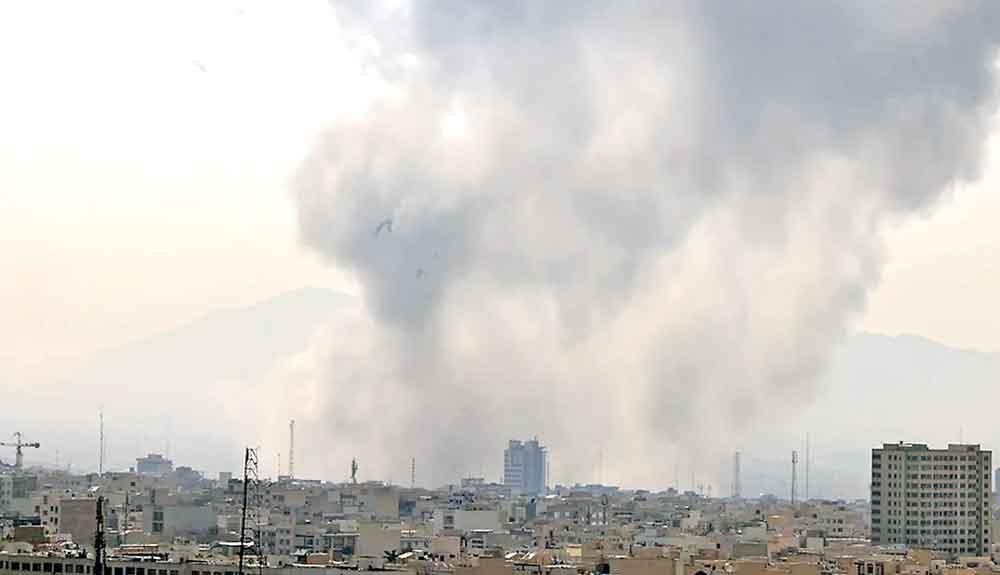
Smoke rises from a explosion in Iran due to an Israeli attack
Source: Cyprus Mail
 Sri Lanka has been pushed to make a difficult choice between international law and morality
It would be a dangerous experiment to antagonise the US, which is Sri Lanka’s largest single export destination, accounting for approximately 23% of its total merchandise exports
The Sri Lankan Government facing multiple issues that have stemmed from the missile attack by US and Israeli forces on Iran on February 28 and the latter’s retaliation targeting Israel and the US bases in nine countries in the Middle East that has now grown into a regional war.
It was the US and Israel that started the attacks while the negotiations between the US and Iranian representatives in Oman on the Iranian nuclear programme were ongoing. The two countries did the same in June last year as well while the same negotiations were on.
The Sri Lankan Foreign Affairs Ministry in a two-paragraph statement on March 1 said, “ The Government of Sri Lanka expresses deep concern over the rapid escalation of hostilities in the Middle East, which poses a serious threat to regional stability and to international peace and security,” while calling on all concerned parties to exercise maximum restraint and to take immediate and decisive action to de-escalate tensions.
The response to the situation by many countries was the same, despite from an abstract perspective every country should have condemned the unprovoked attack by the US and Israel on Iran. Yet, only few countries did so while most of the Western countries that justify any violation of international law by the US condemned the retaliation and not the initial attack. China and Russia stated that the attack on Iran was unacceptable. In our region, only Pakistan “condemned” the US and the Israel.
Thus, every country has laid emphasis on geo-political factors and self interest over the fact that who started the war or how justifiable the initial attacks, when expressing their stance on the situation. However, some political parties in Sri Lankan Opposition want the Government to condemn the US and Israel. They knew that it would antagonise the US and also its President, Donald Trump whose mind one cannot read.
Sri Lanka is recovering from an unprecedented economic crisis and a bankruptcy, but on a delicate path, depending mainly on remittances from the gulf region and sizable amount of exports to the same region where the missiles are crisscrossing. These income sources are already threatened. Against this backdrop it would be a dangerous experiment to antagonise the US which is Sri Lanka’s largest single export destination, accounting for approximately 23% of its total merchandise exports, with total export value approaching US Dollar (US$) 3 billion in 2025. Sri Lanka has been pushed to make a difficult choice between international law and morality on one hand and survival on the other.
As the case of almost all other countries, its choice was survival. If not, and if things go wrong, the same Opposition, on top of the repercussions, would interpret it as NPP Government’s amateurishness. However, the Government immediately responded to the distress call by the Iranian warship IRIS Dena which was sunk by the US Navy within Sri Lanka’s Exclusive Economic Zone near Galle and Foreign Affairs Minister Vijith Herath visited the Iranian Embassy to pay sympathy over the killing of Iranian supreme leader Ayatollah Ali Khamenei by the Israelis.
The torpedoing of the Iranian warship has also put the Government on a spot. Knowing well that majority of Sri Lankans have sided with Iran in its conflict with the US, members of the Opposition in various arguments attempted to blame the Government for not preventing the US attack. Government argued that the incident took place in Sri Lanka’s exclusive economic zone. However, both the Government and the Opposition know that Sri Lanka is not in a position to prevent a US attack even within one of our ports, if the US authorities choose to do so. The US and its allies, in practical sense, are immune to international law, in most cases. Palestine is the best case in point.
The US and Israel say that they preempted an Iranian attack on Israel. And they also argue that their mission is aimed at preventing Iran from possessing a nuclear bomb. However, it was US leaders who stated after their attacks on Iran last year that they destroyed the latter’s nuclear facilities.
They also argue that the attacks meant the liberation of Iranian people from the oppressive rule of what Trump called the current blood-thirsty Iranian leaders. However, the oppressive actions by the Iranian leaders pale in comparison to the ongoing cruelty unleashed by Israeli authorities against the Palestinians which millions of people across the world witness from their living rooms for the past few years.
They, following the Hamas attack on Israelis on October 7, 2023, flattened Gaza, leaving millions of people homeless, killed over 70,000 people, incarcerated thousands and tortured them, bombed hospitals, deprived them of water, food, electricity, medicine, chased thousands of Palestinians away from the West Bank and grabbed their lands. Nobody called Netenyahu the ‘butcher of Tel Aviv’, though no Iranian leader has ever been at least accused of such atrocities.
True, many freedoms are curtailed in Iran, but it is inevitable in a country that has been beleaguered and under attack by local and foreign enemies for over 40 years. On August 30, 1981, during the initial years of the Islamic republic, a bomb attack on Iranian Prime Minister Mohammad Javad Bahonar’s office killed Bahonar, the country’s President Mohammad Ali Rajai and six other senior officials. The briefcase bombing came two months after another massive and savage attack; Hafte Tir bombing which killed over 70 senior Iranian officials including country’s Chief Justice Mohammad Beheshti, the then Iran’s second highest official.
In the recent years, many senior military officials and nuclear scientists were killed by the infiltrators. Hundreds of policemen were killed during the recent demonstrations and riots, posing the question who armed the perpetrators. Hence, surveillance of ordinary people has become imperative and inevitable. No doubt, it is oppressive. Yet, the millions of people who throng the streets of Tehran to protest against the murder of Ali Khamenei shows that the current Iranian leaders still enjoy a massive public support.
Freedom was the promise that was offered by the West to the people of oil-rich countries like Iraq and Libya prior to the ouster and murder of the leaders of those countries, like Saddam Hussein and Muammar Gaddafi. Pakistani journalist Adnan Rehmat had reposted in a WhatsApp group a comment that had been posted in his YouTube channel by an Iranian dissident, comparing the fate of those countries and possible fate of current Iran. It vividly exposes the West’s promise of freedom.
It said among others, “Decades of economic mismanagement, suppression of dissent, and brutal ideological control have alienated multiple generations. No one believes in reform anymore - because every attempt has either been co-opted or crushed. But here’s the paradox: We are also terrified of regime collapse, because we’ve watched the aftermath of Western intervention in countries like Iraq, Libya, Syria, and Afghanistan. Each was promised freedom; each descended into chaos, civil war, or foreign occupation…”