Reply To:
Name - Reply Comment
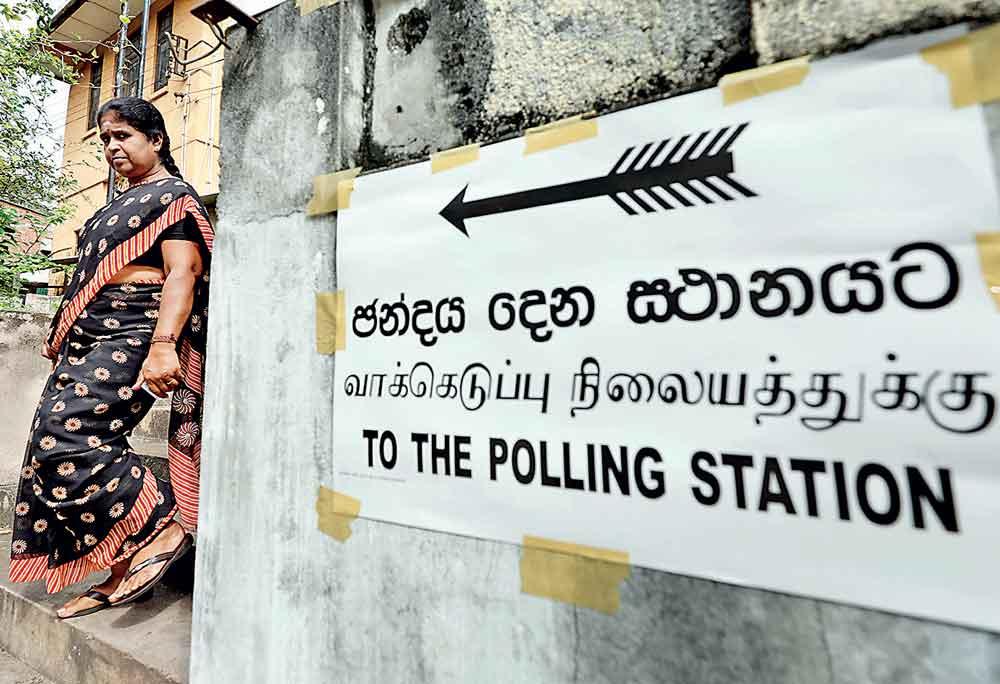
The current electoral system requires physical presence, making it impractical for overseas workers to participate in the democratic process.
| Those who send money back to Sri Lanka are overwhelmingly those registered with the Bureau of Foreign Employment.
Estonia has succeeded in enfranchising citizens irrespective of where they lived. Internet-based voting would not displace the traditional mode. It would be a supplemental mode, as it is in Estonia. |
 Given Sri Lanka’s dependence on remittances from expatriate workers, there is strong justification for enabling them to vote. But they cannot be enfranchised unless the government’s plans to give every citizen a biometric-based ID and provided authentication services are implemented.
What that means is that remote voting over the internet cannot be permitted unless the relevant state agency can verify or authenticate that the person voting remotely is a citizen who is registered to vote. Additional layers of verification and security are needed, but this is the foundation.
Those who send money back to Sri Lanka are overwhelmingly those registered with the Bureau of Foreign Employment. They are also those who have “skin in the game” in terms of Sri Lankan politics. The terms of their employment, the worth of the funds they remit to their families, and the conditions in the country they return to are subject to what elected politicians do, as was made evident during the pandemic and the economic crisis in 2021-22 until the currency was allowed to float. This differentiates them from professionals and others living in developed market economies who will not return and do not contribute significantly to the remittance stream but still want to participate in Sri Lankan politics.
Remote internet-based voting is the only fair and comprehensive solution for expatriate workers living in foreign countries. Putting polling booths in Sri Lankan embassies is not a fair solution, because the distances voters would have to travel to cast their vote would be enormous in many cases.
The Commission of Inquiry on electoral system changes headed by former Chief Justice Dep, was interested in enfranchising Sri Lankans living abroad. After stating that voters should have skin in the game, I explained that remote voting would not be possible without reliable authentication of identity over the internet. I presented the Commission with information on how Estonia has succeeded in enfranchising citizens irrespective of where they lived during the voting period which does not need to be a specific narrow time slot as it is now.
Why internet voting?
Remote internet-based voting is the only fair and comprehensive solution for expatriate workers living in foreign countries. Putting polling booths in Sri Lankan embassies is not a fair solution, because the distances voters would have to travel to cast their vote would be enormous in many cases.
Take for example, the embassy in Saudi Arabia, it is in Riyadh. It would take over eight hours of driving to get there from Jeddah, for instance. Saudi law does not mandate the granting of leave to vote in foreign elections. Only those living close to the embassies would be able to vote.
Once remote voting over the internet has been tried out successfully, the solution can be extended to those in government who now use postal voting, and then to private-sector employees who now must take time off to vote and so on. Internet-based voting would not displace the traditional mode. It would be a supplemental mode, as it is in Estonia.
If the internecine squabbling among government entities and procurement failures that have so far stymied efforts to introduce identification and authentication services for citizens can be resolved, we can get a biometric-based ID and authentication service in place quickly. India did it for more than a billion people and debugged the system. We can ride on their experience for our 22 million people.
The voter will be in a distant location not under observation by any official. The verification of eligibility and identity will no longer be done by a cursory examination of identity cards, the reading aloud of names, the checking of lists by observers, and so on. There would have to be fool-proof technological methods to verify eligibility and identity. The complexity of the changes makes it advisable its pilot with a small group and then scale up.
Why start with expatriate workers?
The expatriate workers who register with the Bureau of Foreign Employment are ideal for a pilot. Their mandatory visit to a Bureau office before departure provides a critical touch point.As part of the registration, they can also be registered to vote and provided with a card linked to the new ID number that will enable participation in a small-scale Public Key Infrastructure (PKI) system that is needed for a two-envelope system. They can even be familiarised with the process.
Internet-based remote voting depends on two criteria: the existence of advanced digital identity authentication systems and the ability to connect to the voting system using the Internet. Estonia, one of the most advanced nations in terms of ICTs, satisfies both criteria.
Many of our expatriate workers and state employees who now vote early can satisfy these criteria. Early voting booths can be provided for private-sector employees such as security guards if necessary. But in each of these cases, the election commission must be able to reliably verify that the person wishing to cast a vote is who she claims to be and is entitled to vote. Additional layers such as a two-envelope mechanism to safeguard the secrecy of the vote exist in countries such as Estonia. But all these features sit atop the foundation of a biometric-based ID and authentication system.
The opponents of biometric-based ID and authentication have a choice: Support the broadening of democracy by giving those currently shut out from voting or perpetuate the current cumbersome and exclusionary system because of technophobia and Indophobia. Some of us will not be able to vote. The rest of us will have to stand in queues and walk around with painted fingernails for months thanks to the Luddites.