Reply To:
Name - Reply Comment
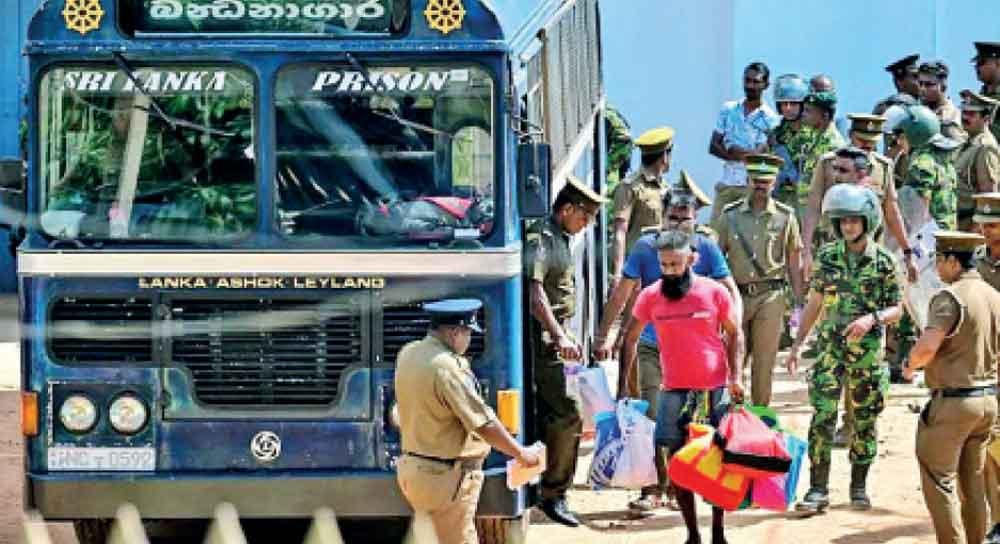
Prisoners being transferred after the riots
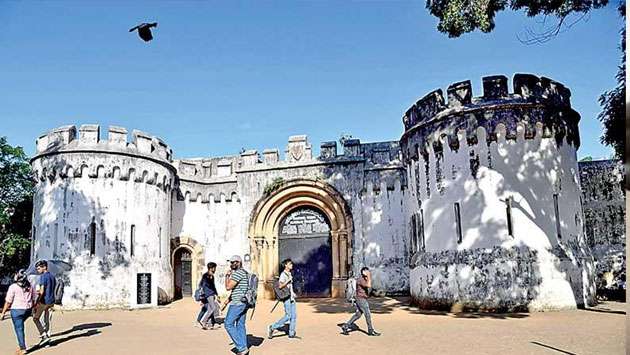
 Two days of deadly violence in the Negombo prison have laid bare the persistent decay in the Sri Lankan prison system, and by and large, the entire criminal justice apparatus.
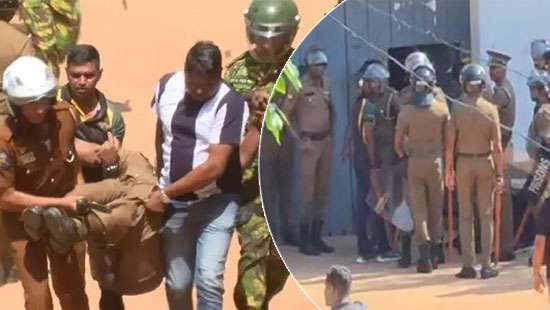
The violent riots cost at least 27 lives, including 8 prison officers’ and 19 inmates’, and injured over a hundred. The inmates clubbed to death several prison officers before waging running battles with the prison guards and Police Special Task Force commandos.
Violence first erupted on Sunday between two prison gangs, reportedly over a tip-off provided by one group over a narcotic operation carried out inside the prisons by another. The riot was reportedly led by a known underworld criminal, Katuwellegama Suresh Pushpa Kumara, a close associate of another underworld criminal, Booru Muna. Two inmates were killed in the clash, over twenty were injured and were admitted to Negombo hospital by Sunday evening. The relatives of inmates thronged before the prison looking for information on their kith and kin.
Violence, which seemed to have subsided, flared up again the following morning during breakfast. The prison officers who intervened to break up the fight were in turn targeted by the inmates, who also wrestled personnel weapons from prison officers. Seven officers succumbed to injuries on Monday, and another yesterday. During the clash, inmates broke into the prison’s armoury, which had however been relocated by the officials on the previous day anticipating trouble.
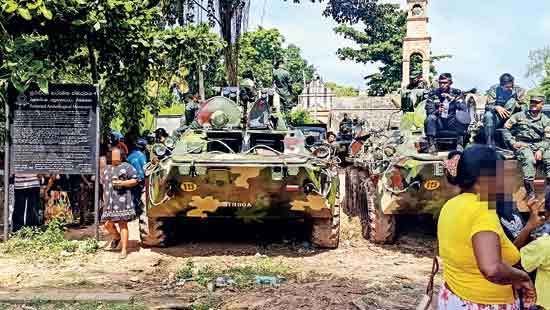
Police and Police Special Task Forces were later called in to control the situation. Airforce deployed a Bell 412 helicopter for air surveillance while a surveillance drone was also fired upon by the inmates. Later, the STF stormed the break through the prison door and stormed the premises.
Several deaths, and injuries to inmates, were caused by police firing, while many others suffered blunt force injuries during the clash.
The carnage at the prison should cause a moral and possibly a political dilemma for the government, of which members were outspoken during similar tragedies in the past.
However, it is hard to pin the blame on it alone. Prison riots have become an increasingly frequent phenomenon in Sri Lanka. Riots in Welikada prisons in 2012 cost 27 lives and a clash in Mahara prisons in 2020 killed 10 inmates.
Narco-mafias
However, the extreme violence in the recent incident has a parallel to the Latin American prisons where narco-mafias rule the prison system and settle scores within the prison compounds.
The failure in the successive governments and prison administration to address the persistent problems of Sri Lanka’s overcrowded prison system now threatens to breed a more virulent form of criminality.
The tragic loss of lives should now compel the government and officials to address the dangerous shortfalls within the prison system, and by and large the criminal justice system, which, unlike in most civilised nations, suffers from a strange fetish of locking up pre-trial suspects in prolonged detention, effectively overcrowding the prisons.
Sadly though, the debate has already been hijacked by petty politicking, with calls for the resignation of the Justice Minister, who one might say is one of the few principled professionals in a largely inept government. Disingenuous calls for Scandinavian level of accountability would not fix the problem, but concerted measures would do.
The Sri Lankan prison system has been stretched beyond its capacity. The entire prison network, including its high security prisons, remand prisons, open prisons and labour camps, has a capacity for only 12,000 inmates. It now houses 40,000 inmates. Of the total prison population, an overwhelming 30,000 (75%) are remand inmates, held in prisons awaiting trial. Only 10,000 are convicted prisoners. Similarly, an overwhelming 70 per cent of inmates are held on narcotic- related offences, and the vast majority are over the possession of narcotics in person.
Sri Lanka’s prison population has swelled over the past two years, largely owing to political initiatives implemented without common sense. The mid- year prison population in the Sri Lankan prison system in 2024 was 21, 916, which was still 200% over capacity. Yet the numbers have grown by another 18,000 since then, largely driven by an anti-drug campaign, which has filled the prisons with drug addicts who, in the first place, should be in rehabilitation centres.
First, It does not need to be a criminal justice expert— not least the so-called experts in this part of the world who have a habit of reinventing the wheel—to devise practical solutions to the problems besetting the Sri Lankan prison system. The starting point should be understanding the root of the problem, which in the first place is a fundamental failure in the judicial system by pumping prisons with remand inmates over often non-violent offences.
Alternative to remand custody
Instead of remand custody, Sri Lanka should introduce house arrest with appropriate measures adopted by other more sophisticated criminal justice systems. Successful nations don’t reinvent the system. They emulate the success of others.
A simple amendment in the penal code and instructions to lower court judges should help reduce the remand population by 75 per cent. To start with, the Sri Lankan judicial system should get over the temptation to use pre-trial detention as a punishment.
Secondly, the vast majority of remand inmates ( 70%) are drug addicts, which effectively rules out house arrest as a solution. Sri Lanka should introduce judicially mandated mandatory drug rehabilitation for Class A drug users. ( Like everything else in this country, this policy would become a joke when it is aimed at soft drugs such as marijuana, which is legal in much of the world, including Thailand).
Unfortunately though, President Anura Kumara Dissanayake’s much hyped, and now forgotten anti-drug campaign missed out on the rehabilitation element, instead filling up prisons with drug addicts, who in prisons get to socialise with the higher grade criminals. Prisons in the West are a primary conduit of Islamic radicalisation. In Sri Lanka, they are places of socialisation of the underworld. Most drug addicts are repeat offenders, and it is a sad indictment of Sri Lanka’s anti-drug campaign.
Rehabilitation and maintaining close scrutiny post-rehabilitation for heroin addicts, who have a 90 per cent relapse rate, is a far more complex affair where the expertise of the Sri Lankan defence forces during the COVID-19 pandemic could be utilised.
Rather than mobilising the defence personnel to clean canals like Gotabaya Rajapaksa or building bus stands, which should be contracted to the private sector under competitive tenders, the President can assign the tri forces to build and manage drug rehabilitation centres that can house remand inmates related to petty drug crimes, mainly the possession in person for personal use. A Military role in drug rehabilitation can be a stop-gap measure for around three years until the separate state agency acquires expertise and assumes duty. Countries like China run regular randomised drug tests post-release. An industrious government should be able to devise a similar method of scrutiny with the help of police.
Third is a malady of which true intentions go beyond the simple administrative explanations.
Sri Lankan prisons house known hardcore underworld criminals with the ordinary inmates. For instance, Negombo prison, which had 2400 prison population, housed 16 underworld heavyweights alongside the ordinary prison population. Those are not simple administrative oversights or measures taken for administrative convenience. Such luxuries are extended to underworld figures in exchange for millions of rupees. The arrest of Rakitha Rajapakse and co-conspirators over allegedly obtaining 120 million rupees in bribes from underworld drug baron Harak Kata is a case in point.
That underworld drug lords run operations from the prisons is an indictment of the level of corruption in the Sri Lankan prison system. However, Sri Lanka has also handled, rightly or wrongly, thousands of terrorist suspects under the PTA without a single one operating a sleeper cell from their prisons.
Sri Lanka should borrow from its successes, though they might not be morally appetising enough. The government should designate two high security prisons and transfer all underworld criminals into them. However, prisons don’t become high security simply by changing the name tag. As a stopgap measure, the high security prisons should be brought under the control of the military police until a separate division under the prison department, or a semi-autonomous unit similar to El Salvador. Such a division can directly recruit from retiring service personnel, effectively benefiting from their expertise.
Similarly, the president should consider designating underworld crimes at a higher level of national security concern, effectively authorising preventive detention similar to the PTA, and ideally, special courts similar to anti-terrorist courts in Pakistan. Granted some of those measures may not sound moralising enough. However, they are commonsense measures adopted more or less by commonsense states.
At last, as a die-hard utilitarian first and liberal second, I believe if liberalism is to survive, chain snatchers should be locked up, and drug Barrons should be hanged—or, if it makes for wrong headline news, at least locked up indefinitely.
Follow Ranga Jayasuriya
@RangaJayasuriya on X