 MOHAMED AYUB
 Reply To:
Name - Reply Comment
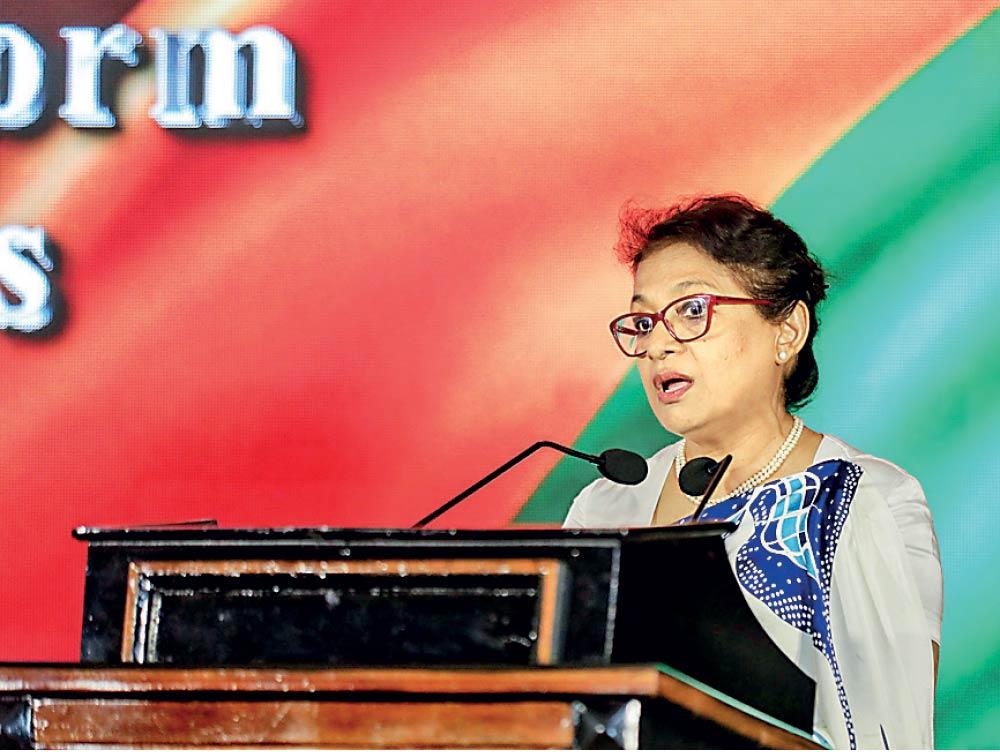
Prof. Deepika Udagama delivering the keynote address
 The event was organised by One Text Initiative, a multi-party platform as its inaugural open discussion aimed at formulating a model Constitution
Sri Lankans appear to be obsessed with Constitutional reforms, said Professor Deepika Udagama, the former Head of the Department of Law at Peradeniya University at a special event on Constitutional reforms held at the Bandaranaike Memorial International Conference Hall (BMICH) on Tuesday.
“It is a national obsession because we believe all our ills can be solved through Constitutional reform which is hardly the case,” she noted in her speech.
The event was organised by One Text Initiative, a multi-party platform as its inaugural open discussion aimed at formulating a model Constitution. Despite the National People’s Power (NPP) government having said that it was considering all past and present proposals and views pertaining to Constitution making before it formulates a new draft Constitution, nobody represented the government at the event which looked like an Opposition forum.
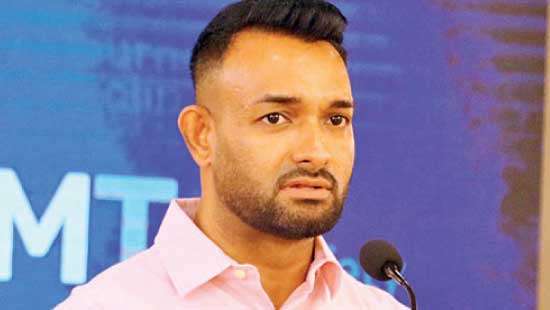
However, it was indeed an intellectual discussion, except for some political views expressed by Pivithuru Hela Urumaya (PHU) leader Udaya Gammanpila who was the only active politician participating in the panel discussion of the event.
Delivering the key-note Address of the event, Professor Udagama said: “When I was a very young law student several decades ago, we were discussing constitutional reform; now, as a retired academic, we are still discussing it.” True, we can recall the promise made by the United Front government led by former Prime Minister Sirima Bandaranaike during the 1970 Parliamentary election to bring in a new Constitution, which culminated in the enaction of the first Republican Constitution in 1972.
However, as we recalled last week, that Constitution was in force only for six years until the second Republican Constitution was introduced by President J.R. Jayewardene in 1978. Again, Chandrika Kumaratunga wanted during the Parliamentary and Presidential elections in 1994 to replace the 1978 Constitution which she described as J. R’s “Bahubootha Vyawasthwa” with another. Her government appointed a Parliamentary Select Committee (PSC) in September 1994 for this purpose.
Unable to arrive at an agreement with other parties over several issues, especially the ethnic problem, PSC members of her government presented a report in October 1997 with only their proposals for Constitutional reforms along with the responses of other parties to it. Then, after six years of consultation, Kumaratunga presented a draft Constitution in 2000 which Professor Udagama commended at the Tuesday’s discussion as being well drafted.
Mahinda Rajapaksa also promised Constitutional reforms especially with the abolition of the executive Presidency during the 2005 Presidential election, but, strengthened Presidential powers instead through the 18th Amendment to the Constitution. The so-called Yahapalana Government also presented a report after two years of consultation, only to be rejected by both the Sinhalese and Tamil nationalists.
President Gotabaya Rajapaksa also appointed a nine-member experts’ committee to draft a new Constitution. Therefore, Professor Udagama was correct when she said that we are obsessed with Constitutional reforms but the process has been dragging on for decades, indicating the deep divide among Sri Lankans in formulating the basic laws that would govern their lives. It has not been a division based on reason but on short-sighted party politics and ethnic prejudices.
Another important point Professor Udagama emphasised is the political commitment of the government of the day to the Constitution making purpose. “We must honestly ask if past efforts were in the public interest. If you look at the 21 amendments to the 1978 Constitution, the bulk of them were not in the public interest” she observed.
One cannot deny this fact when he/she recall the circumstances under which some of the Constitutional amendments were brought in. Third Amendment was meant to hold the Presidential election prematurely in 1982 while President Jayewardene’s main rival Ms. Bandaranaike was out of the political scene with her having been deprived of her civic rights. And the fourth amendment in the same year empowered Jayewardene to extend the term of Parliament by six years from 1982 without holding the Parliamentary election that was due in 1983.
Similarly, public interest was not involved when the 18th Amendment and the 20th Amendment to the Constitution were adopted by the Mahinda Rajapaksa Government and Gotabaya Rajapaksa Government. They were meant to strengthen the Presidential powers.
Several more thought-provoking views on power sharing, intra-party democracy and the way public consultations are conducted were also expressed. Professor Udagama said that power sharing is more than sharing powers to communities; it should be realised at national, provincial, and local levels as well. Although intra-party democracy seems to be something not within the scope of the Constitution, she insisted that provisions to cover it should be included as the parties are supposed to govern the country.
It was noted that several speakers of the discussion were not happy with the way public consultation for Constitution making has been conducted so far. Professor Udagama said that public consultation is key to this process, and added that a truly meaningful process occurs when people are given the power to decide what they want, rather than a process initiated solely by the political establishment. She argued that public consultation should not be conducted to legitimise the process. For a constitution to last, people must develop an emotional attachment to it.
Agreeing to her view, Dr. Kumaravadivel Guruparan who once served at the Department of Law at the University of Jaffna, questioned as to which method is suitable to come to a conclusion when conflicting views have been expressed by the public with regard to a particular issue during public consultations. If we apply his argument to the Lal Wijenayake committee report presented during the 2016 Constitution drafting process, one would raise the question as to how the committee decided that the majority of people supported power sharing.
The NPP takes a different approach in respect of public consultation. They would first draft the Constitution and then go for public consultation. Prime Minister Dr. Harini Amarasuriya told Parliament in December the “draft will be presented to the public, followed by dialogue and discussion, after which necessary amendments will be made.
Gammanpila informed the gathering about an interesting and encouraging development within his party. He said that while devolution itself is a bone of contention among Sinhalese nationalists, there are various views on the unit of devolution with some preferring province as the unit of devolution while some others choose the district. He surprised many in the audience by saying that his party was ready to accommodate province as the unit.
If the PHU does not backtrack, and if the Tamil parties are also courageous enough to compromise in their rigid positions, it would pave the way to resolving the decade-long ethnic problem.