Reply To:
Name - Reply Comment
 Now that all the hubbub over Aloka - the Indian street dog adopted by the Rev. Pannakara for the World Peace Walk - is finished, there is a profound silence. That is all too familiar after such celebrations.
Aloka was incredibly lucky. In India, this dog simply chose to follow the monks from the Huong Dao Vipassana Bhavana Centre in Texas, led by Rev. Pannakara, as they walked through his territory in Kolkatta. Dogs are like us that way. Some are more intelligent than others. Some get luckier than most. But luck isn’t always a matter of kicking a stone and discovering that it’s the tip of a massive gemstone. Luck is often the result of hard work and perseverance, and that’s where Aloka got lucky. It’s also a matter of being able to know a good thing when you see it. Aloka was smart enough to grasp the potential of what he saw, something a world apart from his daily experiences as a street dog in Kolkatta.
So Aloka, with that famous heart-shaped mark on his forehead, joined the Vietnamese monks’ ‘Walk for Peace’ in India. When they left the sprawling city, it followed too, joining them in their 112-day, 3,700 kilometre pilgrimage across the vast country.
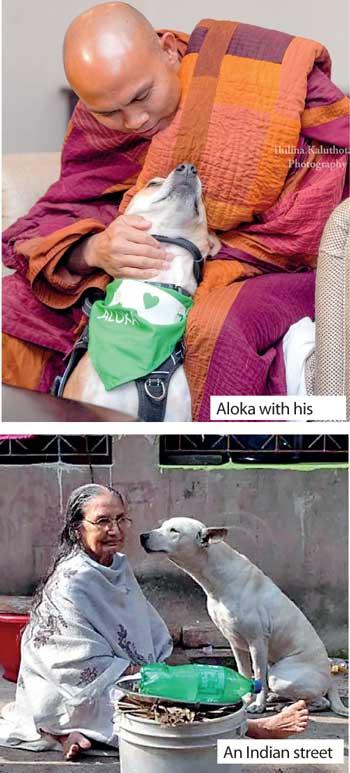 But his true calibre showed when it was hit by a car, in addition to falling ill. Despite the injury, this cheerful dog preserved, which endeared him to Rev. Pannakara and his fellow monks. This brings us to that other essential facet of luck – the ability to keep going against the odds. The peace walkers decided to make Aloka a permanent part of their entourage, bringing it not just international fame but a sense of security that would be the envy of any street dog – free forever from the ever present risk of accidents and abuse, plus guaranteed daily meals and clean water to drink. That’s incredible luck.
With decades of experience caring for and feeding street dogs (and cats), I know what an ordeal it is to be four-legged in the streets.
In his former self, Rev. Pannakara was Sư Tuệ Nhân, a successful IT engineer based in Texas. Millions of migrants struggling to be a success in the US would find it hard to understand his action and motivation in giving up the ‘good life.’ His biographical details are not available. But he must have seen, in his mind’s eye, something these millions cannot see – a freedom of spirit above the shackled liberation of money.
What impressed me above all else was this monk’s compassion for a street dog. It isn’t hard to love a Cocker Spaniel or a Doberman. There are millions around the world who dream of owning one, but can’t afford to do so. There are many more millions who own one even if they can hardly afford it, putting both dog and owner in great peril.
But to feel for a dog which has no pedigree, no class, no past and no future, and a present so precarious it isn’t worth mentioning, is truly the measure of someone’s humanity. It may be that the monk was unconsciously looking for a protégé all along, while Aloka too, must have dreamed of a saviour while scampering along Kolkatta streets. Finding the right partner, be it in love, or friendship, or business, happens at an unpredictable moment, often in the most unlikely of places. So it is in dog-saviour relationships, too. The irony is that, while people are now getting thrown out of the US, often brutally, an Indian street dog had the luck to find shelter there.
But this has as much to do with Aloka’s character and stamina as well as luck. Many of Aloka’s street friends would have liked what they saw, but they may have stayed away due to fear. They are used to being chased away, not welcomed. India has an estimated 60 million street dogs. There are many organisations and individuals doing their best to feed and help them, but the task in Herculean. At the same time, dogs are killed – beaten, shot or poisoned. The southern Indian State of Telangana has launched an investigation after hundreds of stray dogs were killed across at least six villages two months ago.
Police say they have confirmed at least 354 killings so far and arrested nine people in connection with some of the cases. According to villagers, the killings were linked to promises made by candidates during recent local election campaigns to get rid of stray dogs and monkeys.
The situation is no different here. Sri Lanka has a sordid history of killing stray dogs officially via the ‘gas chambers’ method, usually by locking them in an airtight space and exposing them to vehicle exhaust fumes (the way Nazis killed people in the early stages of the Holocaust). While this ‘catch and kill’ law that had been in place under the Rabies Ordinance of 1893 was finally replaced with a ‘catch-vaccinate-sterilise-release’ method in 2008, many individuals continue to kill stray dogs, and the fine for killing one is still the same that was a hundred years ago. No government has any interest in updating the Ordnance and introducing stiffer fines.
Those who care for street dogs are often thought of as cranks. I have been attacked both verbally and physically while feeding them. As Sri Lanka lurches from one disaster to another, both individuals and organisations caring for them find it harder and harder to do so.
Hopefully, all the excitement over Aloka in Sri Lanka during the past weeks brings a degree of enlightenment to the general public about the right street dogs have to exist. Despite our best efforts, many of them go hungry and diseased. We have to live with misconceptions and paradoxes.
There are Buddhist monks who care for stray dogs in their temples. But they face opposition from their ‘dayakas’ who complain about dog turd. The idea that stray dogs should be exterminated is always lurking under the surface. One municipal veterinarian actually proposed that as the best solution. One newspaper editor was openly saying a few years ago that all stray dogs should be killed.
The best solution is greater contribution to street dog maintenance and sterilisation, and awareness campaigns. Many dogs have a habit of chasing passing vehicles. They often get hit. But dog bites occur when motorcyclists and cyclists try to kick them on the move. Motorists can be educated regarding this via social and print media.
Street dogs are as a rule very passive, and timid. There is the rare aggressor who chases and bites. There are such ‘rogues’ among all species. Such dogs should be removed from the streets to shelter. That is a relatively small number. Building shelters for all strays is unnecessary and impractical. But all this requires greater planning, motivation and compassion than what is visible now.