Reply To:
Name - Reply Comment
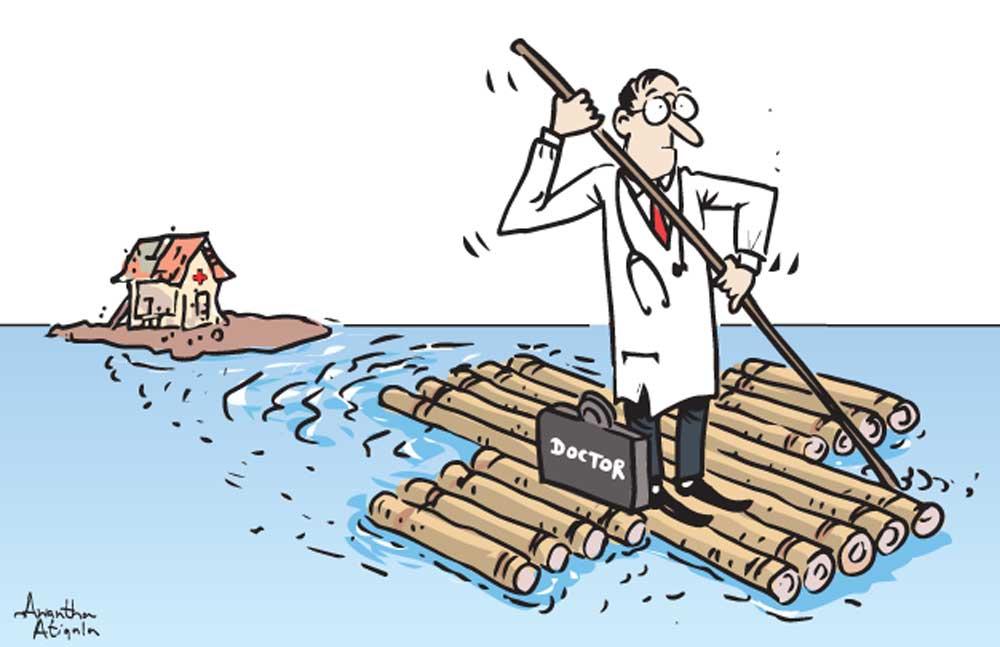
It is normal for patients to spend almost an entire day at a government or private hospital in Sri Lanka. It takes hours to complete their registration, doctor’s consultation and then obtain medicines from the pharmacy. Even for a common sickness like a fever, it is quite difficult to grab the attention of nurses or the supporting staff to get the temperature checked as they stick to ‘strict’ procedures at times.
The situation is no different at private hospitals, especially for doctors in high demand. They attend many private consultations and even if a patient is the first in the waiting list, he or she may have to wait long hours to meet the doctor. However, it is also difficult to blame doctors who have remained in the country during the brain drain that occurred between 2022 and 2024. Many doctors and health professionals went in search of greener pastures at the height of the economic crisis. According to the Government Medical Officers’ Association (GMOA) nearly 500 doctors have migrated between January to August 2022.
Recently, Minister of Rural Development, Social Security and Community Empowerment, Dr. Upali Pannilage said that the government spends Rs. 6 million to train a single doctor. According to the Minister, the cost of producing a medical graduate is significantly higher compared to other professions. He noted that while approximately Rs. 3 million is spent to train an engineer, the amount doubles when it comes to medical education. According to him, Sri Lanka currently has between 35,000 and 38,000 doctors, with around 25,000 to 28,000 serving in government hospitals.
But still there’s space to carry out better services and facilities. One might wonder about the status of hostel facilities available for doctors who are transferred to remote areas. Sometimes, female doctors and even trainee doctors have to live with bare minimum facilities. It is a known fact that doctors have to start from scratch and rise up the ladder to become a specialist doctor in Sri Lanka. The journey is tough and painstaking and perhaps this is why many opt to go in search of greener pastures, even today.
However, there are many dedicated doctors who do not want to abandon their country and the system that made them a medical professional. They are determined to serve patients, sometimes at no cost because for them, a patient is firstly another life that needs to be saved. They struggle to survive in a system mired by corruption and bureaucracy.
A Sinhala tele-drama titled ‘Amuthu Dosthara’ carefully captured this in-built corruption and bureaucracy within the country’s health system. From lethargic nurses on duty to underhand deals carried out by hospital staffers and locals in the area, lack of essential facilities such as an ambulance and operating theatre to dilapidated and abandoned hostel facilities were captured with much precision. This may not be the actual story everywhere but it remains true to an extent, especially when it comes to rural hospitals in the outskirts.
Further highlighting the present situation, Deputy Health Minister Dr. Hansaka Wijemuni recently revealed details about the surgical backlog at the Lady Ridgeway Hospital in Parliament. He said that there are over 2,500 children in its waiting list. He disclosed this information in response to a question raised by Samagi Jana Balawegaya MP Rohini Wijeratne. The Minister said that the breakdown of the surgical waiting list shows 1,025 children waiting for cardiothoracic surgeries, 593 for general surgeries, 388 for eye surgeries, 266 for ENT procedures and 240 for plastic surgeries. In addition, 133 children are awaiting spinal surgeries, 48 children awaiting orthopaedic procedures and 19 with pending neurosurgeries.
This is in just one hospital. There may be shortcomings and discrepancies taking place in many other hospitals, further inconveniencing patients. Hospital admissions are likely to surge during the upcoming festive season. Therefore with existing backlogs and administrative shortcomings, space and facilities required for deserving patients may be lost. As such, a country’s healthcare system should always be a national priority, ensuring that patients are being well looked after, even midst a crisis.
‘Your Thought’ is a space, a right of the readers to support or contradict and discuss the issues highlighted in the editorial and other articles in the editorial and op-ed pages. Designed as the reader’s editorial; our readers can send in their writings, with a word count not exceeding 200, to ‘Your Thought’, Daily Mirror Political Features Desk, No 8, Hunupitiya Cross Road, Colombo 2 or email to [email protected]