Reply To:
Name - Reply Comment
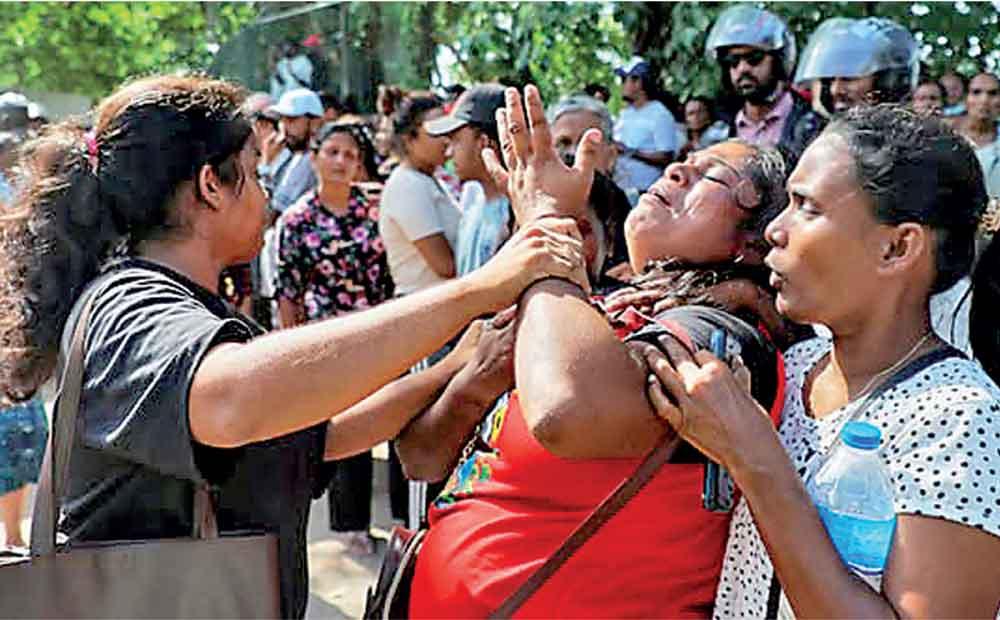
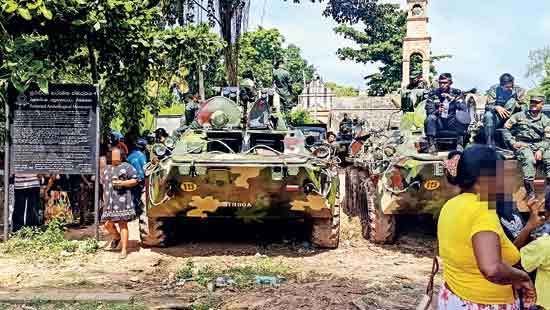
Grieving family members outside the Negombo prison
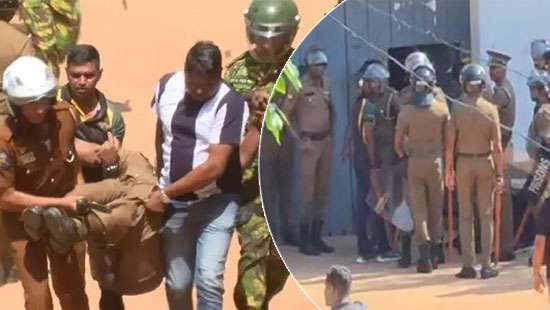
 The prisoner riot at the Negombo prison on Sunday and Monday (July 5 and 6) seems to be a godsend for the Sri Lankan Opposition parties, which are short of sensational issues to use against the government.
Until this unfortunate incident ended, leaving at least 26 people including seven prison officials dead and over a hundred people injured, they were agitating against a purported proposal by the government to increase the retirement age of the judges.
It was not clear whether they had convinced the public that the government was up to something suspicious through the proposed amendment, as it was too alien an issue for the majority of the population. Besides, some of those who oppose this purported amendment do not oppose the end but the means. They too, support the increase the judges’ retirement age, while questioning the ‘way’ the government is going to enact it. Yet, again regarding the ‘way,’ they themselves do not see eye to eye.
Against such a backdrop, a sensational issue like a prison riot that has claimed dozens of lives would no doubt be a stroke of luck. Therefore, the haste in the Opposition parties to use the parliament to attack the government over this prison riot is comprehensible. Even before a peace of sorts returned to the prison and its environs, and even before the real casualty count was taken, representatives of the Opposition parties met Speaker Dr. Jagath Wickramaratne to demand a debate in the House on the matter.
To be fair by the current Opposition, it must be said that there would be no difference had the National People’s Power (NPP) been in their place instead.
Nevertheless, the government has to take responsibility for the two day’s mayhem involving over two thousand prison inmates and dozens of officers, at least morally, until any lapses on the part of the government or officials are laid bare. Justice and National Integration Minister Harshana Nanayakkara, while on his way to the prison on Monday told journalists that he took responsibility for the carnage, though he was not fully enlightened at the point of time about the gravity of the situation, the degree of destruction and immediate as well as long standing causes of the incident.
Although it is commendable, his statement was vague, in a way. What did he mean by taking responsibility? Definitely not what the Opposition has been demanding - his head. As in every other issue, the past hounds both the Opposition and the ruling party in this issue as well. When the Opposition demands the resignation of the minister under whose purview the prisons fall, the question arises as to who in the past governments resigned when such disasters came to pass.
Samagi Jana Balawegaya (SJB) Parliamentarian Ajith P. Perera lost his cool on Tuesday and shouted down a journalist who asked him as to who resigned when nearly 300 people were killed in the Easter Sunday terrorist attacks, during the so-called Yahapalana Government, in which Perera was a deputy minister. Despite the likely understanding that the journalist was questioning the morality of demanding Minister Nanayakkara’s resignation, Perera distracted the audience at the press briefing by shouting and posing questions back at the journalist.
Prison riots have occurred under governments of almost all major parties in the country in the past. Worst among them was the one during the anti-Tamil pogrom in 1983, commonly known as the ‘Black July.’ 53 when Tamil inmates were brutally killed by fellow Sinhalese inmates and outsiders aided by prison officials and armed forces personnel.
Interestingly, attacks were carried out not in one day but two days, indicating the complicity of the officials and security personnel. To date, no one has been convicted for the killings. It was the UNP which is the parent party of the SJB as well which was at the helm then.
Forgotten prison massacres
Later, 27 Tamil detainees, predominantly teenagers and young men suspected of having links to the Liberation Tigers of Tamil Eelam (LTTE) were killed and another 14 seriously injured on October 24–25, 2000, when an outside mob armed with knives, rods, and torches stormed a government-run rehabilitation detention centre in Bindinuwewa, Bandarawela. Nobody in the People’s Alliance (PA) government led by the Sri Lanka Freedom Party (SLFP) headed by President Chandrika Kumaratunga took responsibility at least morally.
The Colombo High Court convicted and sentenced five individuals—including two police officers—to death in this regard in 2003, but only to be acquitted and released by the Supreme Court in May 2005.
The Janatha Vimukthi Peramuna (JVP) launched an attack on the Magazine prison in Colombo and rescued around 170 of their members incarcerated in the prison in 1988. The then Justice Minister Dr, Nissanka Wijeyeratne resigned his ministerial post, taking the responsibly for the incident. Ajith P. Perera recalled this incident when he shouted at the journalist on Tuesday, but forgot or conveniently ignored the fact that Dr. Wijeyeratne who was in charge of prisons during the Welikada prison massacre in 1983 did not choose to step down.
In 2012, 27 prison inmates were killed in Welikada prison following a protest by prisoners. It was said that some of them were called out by name and deliberately killed in execution-style. Prisons Commissioner Emil Lamahewage who was sentenced to death in January 2022 in this regard was acquitted of all charges and released by the Supreme Court in August, 2024.
A protest by inmates of Mahara prison in November 2020 demanding more PCR tests against COVID 19 turned riotous, resulting in the death of 11 inmates and leaving another 117 inmates severely injured. Several prison buildings were torched. It was then that NPP leader Anura Kumara Dissanayake argued that because inmates (both convicts and remand detainees) are held in state custody, the government acts as their custodian and is bound to safeguard them – a statement that is being repeatedly quoted by the Opposition for the past few days. They accuse Dissanayake, who is now the country’s President, of not walking the talk.
Overcrowding is mainly blamed for the tension in prisons. It is a severe, chronic crisis, with the national prison system operating at around 250% to 300% of its official capacity according to reports. As far back as 1971, tensions erupted in prisons, and two universities and several state farms were converted into rehabilitation camps for JVP rebels. None of the governments that ruled the country since took concrete steps to solve the problem.
Several other issues also contribute to the current state of affairs. Although prison walls are adorned with the motto, ‘Prisoners are human beings,’ the reality inside those walls contradicts that very sentiment. Prisons function more as punitive camps than as correctional facilities. It is not only a funding problem, but also an attitudinal problem. There is a long way to go before this is resolved. Until then, policing is the only safeguard.